“Too Close” Coming
Coming soon to a theater (rather than a neighborhood) near you: “Too Close.” View the trailer for this tell-it-like-it-is series of personal accounts about living near wind turbines.
. Then follow Fairhaven Windwise on Facebook.Ethics Ignored? Business as Usual on Wind Turbines
Curt Devlin finds plenty of bias in statements by Falmouth Board of Health chair Jared Goldstone as quoted by Ariel Wittenberg in South Coast Today on July 10. Devlin takes on Goldstone’s facts and attitudes (Falmouth official gives curious lesson in ethics July 22, 2013).
Goldstone says town decision are “‘based on some finding in fact that is scientifically and legally defensible.'” Devlin refutes both the science and the logic of official actions related to siting, running, and failing to silence wind turbines–which residents charge are disrupting sleep and more. He points to the 1987 work of N. D. Kelley, funded by the U. S. Dept. of Commerce, which identified low frequency pulses as one emission of wind turbines. (To date, all official approaches to measuring or mitigating turbine noise have addressed only audible levels).
Devlin goes on to discredit one of Goldstone’s comments.
Goldstone went on to say that a potentially conclusive study of the Falmouth turbines would involve turning them on “during the dark of the moon without warning and seeing if we have a sudden increase in complaints.”
Goldstone’s statement is utterly false and misleading. Anyone who is actually familiar with the scientific method will tell you that a test conducted on a single night would prove nothing, because it is purely anecdotal.
Goldstone’s next comment would be laughable, if it weren’t so pathetic. He claimed that his proposed experiment “would be entirely unethical and we would never do that.” How strange that Goldstone’s conscience bothers him about turning the turbines on without warning people.
Yet he apparently has no ethical qualms whatever about bombarding neighborhoods in Falmouth with intense infrasound night and day for more than three years. Just as in Fairhaven, no one in Falmouth was told that turbines cause sleep deprivation; seasickness-like symptoms such as nausea, dizziness and vertigo; or cognitive impairment severe enough to prevent someone from doing everyday things like gardening, shopping or work.
Related articles:
Curt Devlin, Your View: Falmouth official gives curious lesson in ethics July 22, 2013
Ariel Wittenberg Fairhaven, Falmouth deal with similar wind debate July 10, 2013
Noise Advisory
When the Technical Advisory Group met in Boston on July 18th, acoustician Stephen Ambrose delivered the paramount message: learn from the people who experience the noise and vibrations from the wind turbines in their vicinity.
In the meeting, he stated:
[W]e have to end up putting at the top of our list human complaints–that’s why we’re all here. If we end up putting our instruments there, we’re not going to end up solving the human complaint problem until we understand the mechanisms and the “whys” for those complaints.
The Massachusetts Department of Environmental Protection brought together a diverse panel for its “Wind and Noise Technical Advisory Group” (WNTAG). The initial meeting was held at the MassDEP offices on July 18, 2013. The Consensus Building Institute acted as moderator–the same consulting firm used in the Falmouth Wind Turbine Options Process.
In the clip captured by David Dardi, Ambrose told the committee:
I have gone out and listened as a neighbor. Slept in the neighbor’s bed–much to my surprise when they abandoned the home to me. Wind turbines are … not a good acoustic neighbor out in the country and I could go on and on explaining the “whys.”
Ambrose told the committee that looking back to 1976, when the noise standards were established, a greater than 10 dB increase has “been proven to be the point at which widespread complaints occur.”
But that’s more for steady state sound levels. This variation that we have with wind turbines, this amplitude modulation, we have to account for that amplitude modulation in that 10 dB difference. And when we do, we’ll end up finding that we’re not having complaints. [That’s] my professional opinion on this and after 4 years of research I think that it’s valid. I can present other information at a later date.
Calling for a TRULY Independent Health Commission

Capturing the Western Massachusetts focus in her video report of the hearing on July 9, 2013, WWLP 22 News reporter Christine Lee showed the public benches with the residents from Brimfield waiting to testify. Lee said in her commentary, “Wind Turbine critics claim living near turbines cause increased stress, blood pressure and headaches.”
[Editor’s note: be sure to listen to the report. The text on the WWLP page does not always match the sound clips.].
In her interview with Ray Hartman from Shelburne outside the chamber, he discusses the panel MassDEP and MDPH convened in 2011 to review the literature on wind turbine health impacts.
“Many people on the panel have connections to the wind industry, they’re funded by Big Wind, they’re predisposed to Big Wind, they’re philosophically in favor of Big Wind, and so you’re not going to get an objective study when that is the case,” Raymond Hartman said.”
Of the bills before the Joint Committee on Public Health, Lee has a clip with the governor reiterating that if a bill for a health study comes to his desk, he would sign it.
 In the Patriot Ledger Jessica Trufant reported “Scituate residents testify on health effects of wind turbines” (7/10/13) about Tom Thompson and others who were supporting H2048, sponsored by Sarah Peake, to create an independent commission charged with investigating adverse health impacts from wind turbines.
Residents were relishing what life was like before the wind turbine went up in March 2012. The turbine was struck by lightening on June 24th and was out of commission until it restarted on July 12th.
“It has been absolutely delightful,” he said. “…People are sleeping, and kids that were experiencing health issues say their headaches have essentially disappeared. You hear it in people’s voices that they’re feeling better, but the fact that people are comfortable and their health is improving brings forward the importance of having the turbine permanently dismantled.”
Thompson’s observations about the hearing were also quoted:
“Folks who live near and have been negatively impacted by wind turbines in Falmouth, Kingston, Fairhaven and, of course, Scituate testified, and were very powerful,” Thompson said Wednesday. “By their questions, I could tell the committee was appreciative of the information, and some were shocked by what has transpired.”
Tom Thompson’s written testimony is available here. David Dardi also testified. Describing himself as a Justice of the Peace and a retired Civil Engineer, he said his home is located 3200 feet from the 1.5 MW turbine.
Because of the close proximity to the wind turbine I suffer from sleep deprivation, headaches and ringing of the ears. The noise of the wind turbine is so invasive that it even wakes me when the windows to my bedroom are closed. Many nights I have to take doctor prescribed sleeping pills, …to go to sleep or to return to sleep when I am awoken by the turbine. When the windows are closed and my head is against the bedpost I can feel a vibration, which is in rhythm to turning of the blades. Whoosh, Whoosh, Whoosh, all night long. The sleep deprivation from which I suffer affects my relationship with my fiancée and many other people around me. I find myself constantly apologizing for my shortness of temper and terrible disposition. Because I am handicapped, with a partial leg amputation, I find that the fatigue causes me to be accident prone; I am constantly tripping. At my last visit to my dentist I was told that I have begun to grind my teeth and tops of them have been damaged. My quality of life has gone downhill since the turbine went into operation a year and a half ago. I thought that retirement would be better than this. A few weeks ago the turbine was struck with lightning and has been inoperative. I remarked to my fiancée, as we sat on the back deck that I could actually hear all the birds chirping with a clarity that was not there when the turbine was turning. Other people in my neighborhood have sold their homes rather than staying and dealing with this problem.
Independent Commission Supporters Testify–Louise Barteau
 Louise Barteau described the impacts of the two commercial Fairhaven Wind turbines, illustrated by yellow dots on the map. The blue dot is the new elementary school located less than half a mile from the turbines. Pink dots represent the clusters of households from which complaints have been lodged.
In Fairhaven there are 701 homes within 3000 feet of 2 1.5 mw Industrial Wind turbines.
Since the turbines were turned on in May 2012, there have been over 450 citizen complaints from 59 households.
After the first 100 complaints, the Fairhaven Board of Health asked for help from the MA DEP who performed sound testing to measure noise. I went out at night with the DEP while they performed the testing.
The MA DEP has found the turbines to be louder than the allowed 10 decibels over ambient on four nights out of the nine nights that they tested over the period of a year.
…
I became an advocate for the people in my town after I experienced pressure in my ears and head, dizziness, and nausea in May of 2012 in my art studio located 963 feet from one of the turbines. I was able to move out of my studio immediately, as my landlord let me out of the lease early.
Since I moved away I have tried to become an advocate for my neighbors who cannot move away so easily.
Louise describes her work to bring experiences of other residents to light and reports one family’s story in her full statement.
Independent Commission Supporters Testify–Mark Cool
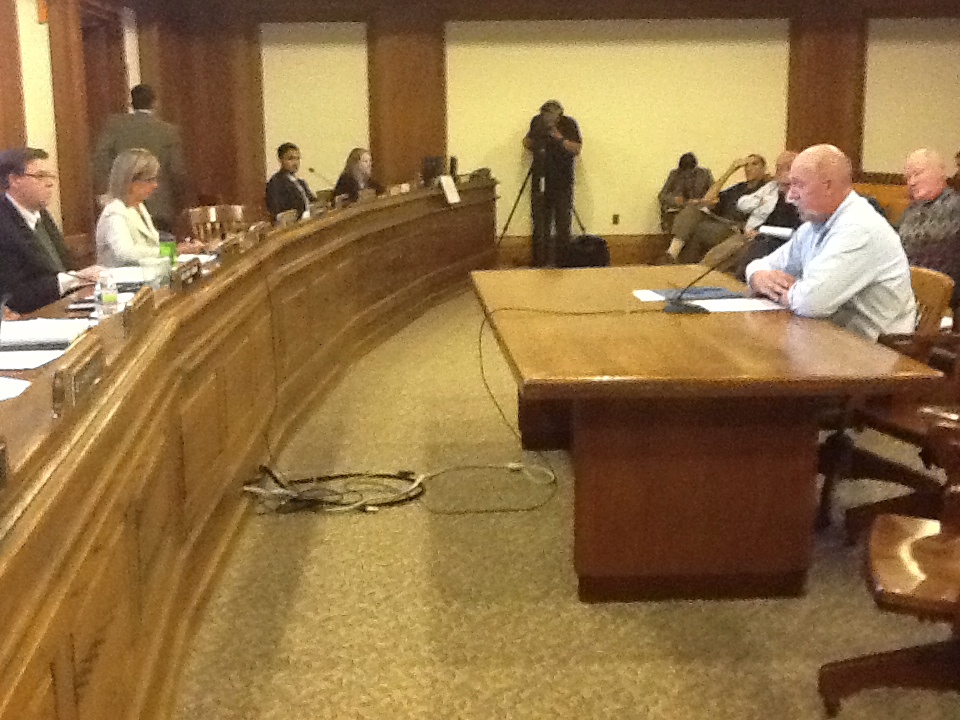 Mark Cool’s full testimony can be found on his Firetower Wind site–it follows a report on the July 9, 2013 hearing from the Falmouth Patch“Falmouth Townspeople Testify on Turbine Health.” He notes that “the Wind Turbine Option Process (WTOP) committee… [was] unable to determine legitimate methods for gaining answers to questions regarding the health, safety and well-being of Falmouth’s impacted neighbors.” He continues:
H2048 could be a start to actually doing health studies that will medically explain why I should abandon my home, or why poorly sited wind turbines effect my cognitive skills as an air traffic controller.
Since Falmouth turned on it’s turbines, I have become sick like no other time in my life. My private physician doesn’t understand my illness. Town Hall doesn’t understand my illness. Many community friends and neighbors don’t understand my illness. Yet, the state Department of Environmental Protection understands current regulatory noise guidelines are suspect, in their application to wind turbines. And further, the state Department of Public Health understands that my illness costs too much money to investigate.
The Falmouth Patch noted the hearing on Tuesday July 9, 2013 before the Joint Committee on Public Health, “Falmouth Townspeople Testify on Turbine Health” posted by Editor Emily Atteberry. Among the Cape Cod residents quoted was Lilli-Ann Green of Wellfleet, “who has researched turbine operations all over the world, [and] said the downfalls of living near wind turbines are also being felt in Europe.”
“There are clusters of people all over the world who are living too close to wind turbines and getting sick,” she said.
 In her testimony, Green described her research and advocacy and said,
A commission to study the very real health impacts of wind turbines could make great advances. Since the spring of 2010 when the people in Falmouth started to experience health problems, I and others started to call for an honest study of the people living near wind turbines and experiencing health problems they did not have prior to the construction of the turbines.
….
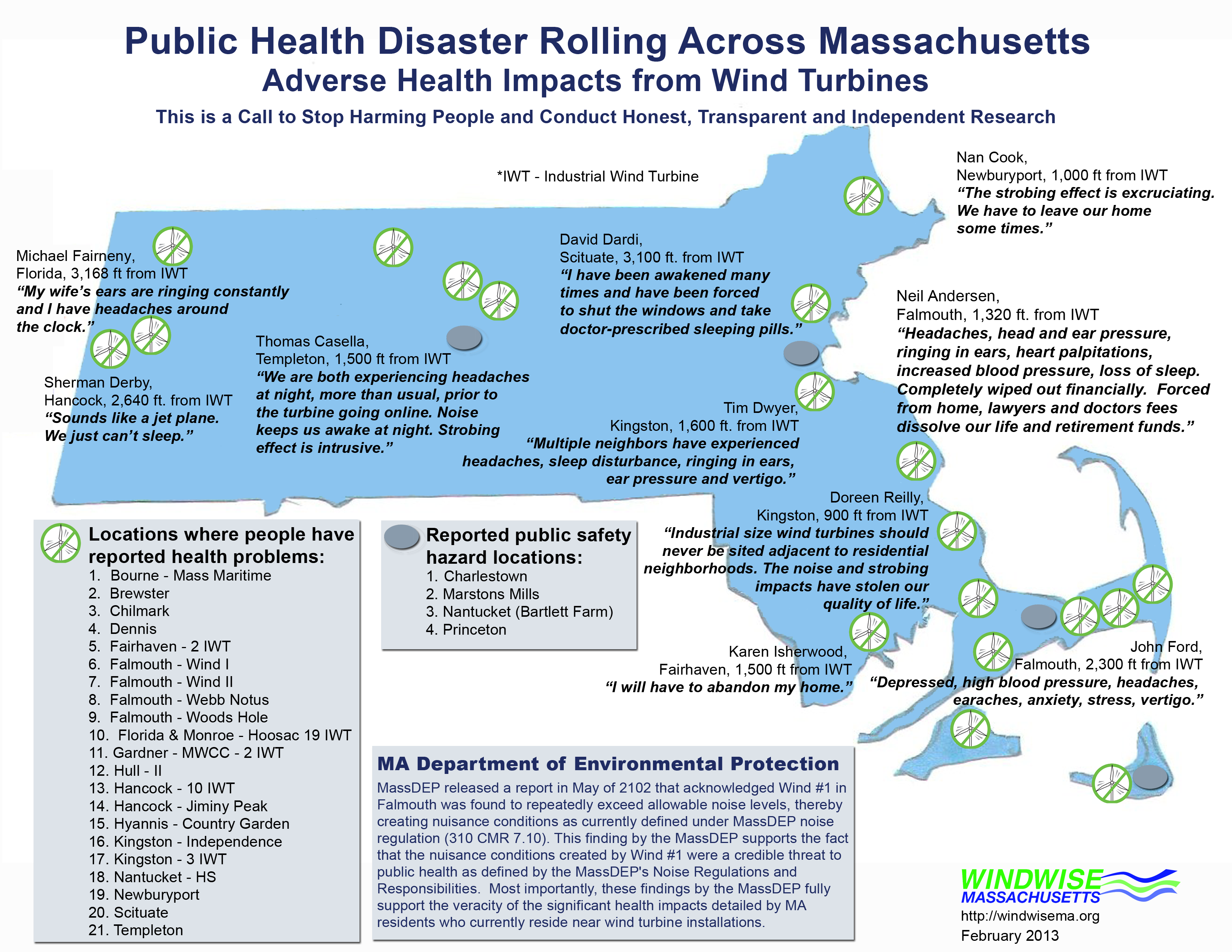
What is happening is just so wrong. I created a map recently to show that in at least 21 communities throughout our Commonwealth people are suffering physically from wind turbines located too close to their homes. [The map is shown here].
….
To date there has been no study. People who have filed numerous health complaints with their local boards, some over many years, are still suffering. It is extremely important that the health, safety and well being of the citizens in MA are first and foremost and not trumped by any political agenda.
Independent Commission Supporters Testify–Sue Hobart
Seven Falmouth wind turbine “neighbors” went to Boston on July 9, 2013 to testify before the Joint Committee on Public Health. The first to testify were Sue Hobart and her husband. Sue Hobart was forced to abandon her home and her florist business; Ed Hobart cashed out his retirement savings to be able to relocate.
At the hearing, she described her experience and challenged the legislators:
So my question to you as legislators is this. Who do you really work for? Do you work for the Green industry and the Governor or do you work for the people of Massachusetts?
Is your job to protect the people or the green team? That shouldn’t be too hard to answer… in fact that should be easy or we can all go home right now.
The only way this health issue is ever going to be dealt with is by bringing real doctors, sleep studies, EKGs and volunteer subjects into turbine effected locations and actually studying the issues ON SITE! Not one of these so called experts has ever even visited a turbine house. Without that there is zero actual science being dealt with. Itʼs all speculation without on site actual testing on human subjects.
This is science in the making. I encourage Massachusetts to be a REAL leader. Find out what the mechanisms for the illness really are. Ask the hard questions… Pull in some actual turbine victims and some top notch Otologists, neuroscientists, cardiologists and sleep experts and begin a real medical study on what is happening here.
I offer my home is a perfect place to start. There could be no better future for that place than to actually contribute to the progression and understanding of how wind turbines are effecting the people forced to live near them.
Hobart’s full statement can be accessed here.
Gov. Patrick Discusses Independent Commission
 Governor Patrick said he would sign a bill for an independent commission to perform a scientific health study of wind turbines if it arrives on his desk. The governor ‘s comment came during his monthly appearance on Boston Public Radio, a show hosted by Margery Eagan and Jim Braude on 89.7 FM WGBH Radio at noon each weekday. Caller Linda Ohkagawa from Falmouth had testified in Boston on Monday in support of H2048, sponsored by Representative Sarah Peake. On the radio show, Ms. Ohkagawa said of the bill,
I think it’s much needed. For once it doesn’t put the burden of proof on the suffering people to prove harm. It assumes that there is probably some harm and it seeks to see what is the extent of that harm. I think that what we really want to know is are these (wind turbines) harm-free? …We feel the harm.
Her own experience led her to ask the question from a grandmother-to-new-grandfather vantage point–Patrick’s grandson was born in May and his photograph tweeted on July 1, 2013 (“Deval Patrick Tweets Photo Of First Grandson” reported by CBS ‘s Boston affiliate WBZ).
Ohkagawa was one of seven Falmouth wind turbine “neighbors” to testify before the Joint Committee on Public Health in support of several bills that would establish an independent commission to study health effects. As she said on WGBH radio:
I fear the effects on my visiting grandchildren… when I see them holding their ears at my house, which I don’t see them doing at their own house.
Like many people in Massachusetts, Patrick’s remarks demonstrated little knowledge of wind turbine emissions. Like many officials, his comments minimize any dangers in the same dismissive way as the wind industry.
For the full 3-minute exchange, click here.

 Wind Wise ~ Massachusetts