Eleanor Tillinghast, President of environmental group Green Berkshires, shared her concerns in this Letter to the Editor printed in The Berkshire Eagle (7/17/24):
Supporting clean energy shouldn’t cost our home-rule rights. The only way to stop this outrageous power grab is for the delegations of the western counties to tell the House leadership they strongly object to any loss of local control. The vote is imminent. Please call your state representative right away and say “vote no to less local control.”
Her letter references S.2838 — An Act upgrading the grid and protecting ratepayers — recently passed by the Massachusetts Senate. Calling it “a radical overhaul of our state’s permitting structure for energy facilities of all kinds, at the state and local levels,” she warned that the House of Representatives is about to vote for virtually the same legislation. The House does in fact vote on H.4876, pdf available from this link, today, 7/17/24.
More LTEs appeared in the Greenfield Recorder
My Turn: We’re directly in path of green energy ‘steamroller’ (7/17/24) by Gloria Kegeles
Given that almost all solar and onshore wind projects are “small,” if some version of this bill passes, pretty much any solar or land-based wind project would have to be given the state-determined rubber stamp by the towns. Larger projects would get permitted directly by the state.
Why is this even happening? Because our local town boards, following the guidance of citizen-supported bylaws, try to protect our towns from inappropriate proposed energy projects. We have witnessed these conflicts for a while. Deep-pocketed developers descend upon smaller, poorer rural communities who they think are sitting ducks and will just permit their projects.
While some see our towns as weak and defenseless, what we have seen are dedicated citizens and boards working diligently trying to hold the line — often too successfully for the likes of the project owners. And that puts us in the way of the green energy steamroller. We are now “the problem.”
To fix this mess, the state wants to take control, and that means changing laws that have afforded us our cherished local control.
Eleanor Tillinghast: No to Loss of Local Control (715/24)
To meet our state’s clean energy goals, we will need 60,000 acres of solar arrays, and potentially double that, by 2050. This State House legislation is directed at our western counties, where land is cheapest. Government officials know that once citizens start seeing vast solar buildouts, ridgeline wind turbines, and huge battery-storage facilities, there will be furious protests throughout our region.
Radical Overhaul of Siting in Mass. S.2838
The Massachusetts Senate just approved energy legislation that is shocking in its scope and strips
communities of local control over the siting and permitting of industrial solar, onshore wind
turbines, large-scale battery storage, and utility transmission and distribution infrastructure.1
S.28382 is a radical overhaul of our state’s permitting structure for energy facilities of all kinds, at
the state and local levels.
The State House of Representatives is about to vote for virtually the same legislation.
One government report projects that “even with maximal rooftop [solar panel] deployment far in
excess of historic levels” we’ll still need 60,000 acres of ground-mounted solar arrays – and
potentially double that amount – to meet the state’s clean energy goals by 2050.3 Another official
report estimates that if all thermal power plants are shut down our state will need about 158,000
acres for solar panels by then.4
Land is cheapest in the western part of the state. This State House legislation is directed at us.
Government officials know that once citizens start seeing vast solar buildouts scarring our
landscapes, wind turbines littering our ridgelines, and huge battery-storage facilities shoehorned
into our neighborhoods, there will be furious protests in town halls throughout our region.
So the legislative leaders have decided that for energy projects 25 megawatts or larger, all decisions
will be made by a single state agency.5 The host town government will be able to submit
comments,6 or rack up legal bills trying to protest within a system stacked against it.7 That’s it.
For projects smaller than 25 megawatts, all local permits will be consolidated into one application,
to be reviewed and approved by the town8 using standards set by the state.9 The only possible
appeal will be to that single state agency,10 and that remedy will be available solely to applicants or
to parties that are “substantially and specifically affected,”11 meaning virtually nobody.
Supporting clean energy shouldn’t cost our home-rule rights. The only way to stop this outrageous
power grab is for the delegations of the western counties to tell the House leadership they strongly
object to any loss of local control. The vote is imminent. Please call your state representative right
away and say “vote NO to less local control.” If you want to find your representative, click here, and
scroll to the box below the map: https://malegislature.gov/Search/FindMyLegislator. And remember
on election day.
- S.2838, lines 179, 629, 663, 664, 1286, 1336
- https://malegislature.gov/bills/193/s2838
- https://www.mass.gov/doc/interim-clean-energy-and-climate-plan-for-2030-december-30-2020/download, p. 41
- https://www.mass.gov/doc/ma-2050-decarbonization-roadmap/download, p. 63 of 92.
- S.2838, line 1584
- S.2838, line 1663
- S.2838, lines 1646, 1658
- S.2838, line 701
- S.2838, lines 665, 695
- S.2838, lines 729, 734
- S.2838, line 736, 1752
End Run past Local Control bad for Climate
Shades of WESRA, the Wind Energy Siting Reform Act, in push to expedite siting?
The Governor’s Commission on Energy Infrastructure Siting and Permitting asked for comments by March 1 but will accept them through March 15, 2024. Survey questions include:
- How should Massachusetts balance the need to accelerate deployment of clean energy, ensure communities have input into the siting and permitting process, and ensure the benefits of the clean energy transition are shared equitably?
- How should we accomplish the above while also protecting health, safety, and community livability, particularly for vulnerable or under-resourced populations?
- How should we accomplish the above while also protecting the natural environment?
- Who should have a seat at the table when decisions are made about where to put clean energy infrastructure and what restrictions apply?
BEATING DOWN THE LITTLE FOLKS TO GET YOUR WAY IS NOT GOOD POLITICS
To members of the Governor’s Commission on Energy Infrastructure Siting and Permitting:
Your plan to strip local control over the siting and permitting of renewable energy facilities was tried once before and failed. For years, Governor Deval Patrick pushed the Wind Energy Siting Reform Act, which was fiercely opposed by voters across the state and eventually scuttled.
States like New York and Vermont, and others around the country, have found that similar efforts lead to angry opposition, and hostility toward clean energy development generally.
By contrast, when communities are offered incentives that residents think are fair, they welcome development projects. Fairness can translate into surprisingly reasonable dollar amounts. This is especially true in small rural communities desperate for revenues.
If you want to encourage the widespread buildout of clean energy facilities and infrastructure, then proffer rewards instead of wielding punishments. Do not strip municipalities of local control over the siting and permitting of renewable energy proposals.
Our state has a proud history of home rule. Municipal officials take seriously their responsibilities to apply local and state laws and regulations to the review of development projects. They generally apply those fairly, they abide by timelines built into those statutes, and they recognize that their regulatory role is to permit development while safeguarding public health and safety. As citizens, based upon what I have seen, they wholeheartedly support the expansion of clean energy. There is no reason to eliminate local control in order to accelerate the buildout of renewable energy facilities. There is no need for a trade-off. Both can co-exist.
So, to answer the first question of your survey directly: To ensure that communities have input into the siting and permitting process of renewable energy facilities, maintain local control. Offer tax and other incentives. Provide financial and technical resources so that local boards can work efficiently to permit projects.
To ensure that the benefits of the clean energy transition are shared equitably, divide your pool of available incentives more fairly between developers and municipalities. You will find that providing reasonable financial incentives will be a more effective way to accelerate clean energy construction than generating hostility by stripping towns of their historical rights of local control.
In addition, don’t expect rural communities in the central and western parts of the state to host the majority of large-scale projects simply because they have more open space and cheaper properties. If you are serious about equitability, then communities in the eastern part of the state, which have the largest populations and the greatest energy consumption, should host their fair share of renewable energy projects. Again, appropriately-scaled incentives will be key.
—————
We face not one but two catastrophes: climate change and crashing biodiversity. Climate change will be addressed by national commitments to energy research and technological improvements. The tools we have today will inevitably be replaced by more efficient, more effective tools down the road. That is the history and trajectory of technology. Biodiversity, once compromised, can never be restored to its original state. We cannot jeopardize our state’s irreplaceable natural resources in pursuit of clean energy goals. That should be our baseline position. Solar facilities should not supplant forests and fields, which sequester vast amounts of carbon in their trees, plants, and soils. Industrial wind turbines should not obliterate our state’s few remaining untouched ridgeline plant communities. Clean energy facilities must be sited within the built environment and on brownfields and other degraded sites.
—————
Finally, regarding the last of your four questions: Money talks. It is a lot cheaper to offer rewards than to fight in court, in town halls, and in the arena of public opinion. If you reward municipalities for hosting renewable energy projects, and provide the financial and technical support they need, you will find that those are built faster and with greater community support than if you strip towns of their primary role in the siting and permitting of those projects. So, abide by the current regulatory structure but add clear incentives to the mix, and you will succeed in your clean energy goals.
Sincerely yours, Eleanor Tillinghast, President, Green Berkshires, Inc.
Financial Relief for Impacted Communities
Testimony on H3373, the Wind Energy Relief Act, July 23, 2021
David Dardi and Karen Canfield asked the MA legislature’s Telecommunications, Utilities and Energy Joint Committee to report favorable on H3373. The bill, sponsored by Rep. David T. Vieira, would establish a trust fund to compensate citizens, businesses, and municipalities for losses incurred as a result of detrimental health effects, property loss or any other adverse impacts of wind turbines sited with assistance from the Massachusetts Clean Energy Center. The bill also establishes a Wind Turbine Decommissioning or Relocation Fund.
“Mistakes can be made,” Dardi said. “Some turbines have been constructed too close to residential areas such as Scituate, Fairhaven, Kingston, Falmouth, Plymouth, Bourne, Rowe, Florida–they go on and on.”
“Why should the mistake of an improperly located wind turbine result in such high penalties and costs to communities and individuals?” Dardi asked. He went on to say that this Wind Energy Relief Act would use existing funds in the Renewable Energy Trust Fund, so the Commonwealth would need no extra resources to help out affected communities
Karen Canfield, Vice Chair, Scituate Select Board said “This legislation is vital to addressing the unanticipated consequences of wind turbines located near residential homes.”
Scituate leads Massachusetts in receiving FEMA funds to rebuild after coastal storms, Canfield said, so the town has a particular interest in reducing the harm from climate change. For this reason, it embarked on a process in 2005 that resulted in wind turbine operations beginning in 2012. “However, immediately after the operations began, so did the complaints,” Canfield told the committee. The town has commissioned many studies only to learn that the turbines are operating within regulations, even though the operation continues to impact residents’ health. The town decided to protect its citizens by turning off the turbines at night from May to October during the hours when most complaints were lodged. This costs the town almost $100,000 per year.
Noise? What Noise? Tests Designed to Miss the Mark

The state constitution says noise is air pollution. The Mass. DEP’s job is to regulate air pollution. Residents who live near wind turbines say they can’t sleep, can’t think, can’t live a normal life because of wind turbine noise. But somehow the tests the DEP allows consultants to use never show excessive noise.
This failure of testing relies on 2 factors, according to Chris Kapsambelis:
- They don’t compare the turbines’ noise levels with pre-construction minimums.
- They don’t combine noise from all sources as the regulation states.
Once the turbines are standing, the L90 or minimum noise level, has already changed. Any readings, even quiet night time levels, are already skewed by the sound wind makes against the mast or at the blade tips–whether or not they are rotating.
Add to this baseline error the DEP’s willingness to allow wind turbine noise to be subtracted from other sources (air and ground traffic, machinery) and the turbines never fail the test.

No Dice: storage can’t solve wind energy gamble
Here’s the theory: take a wind turbine, smooth the intermittent surges to a steady pulse, send it out to the grid.
Here’s the schematic:
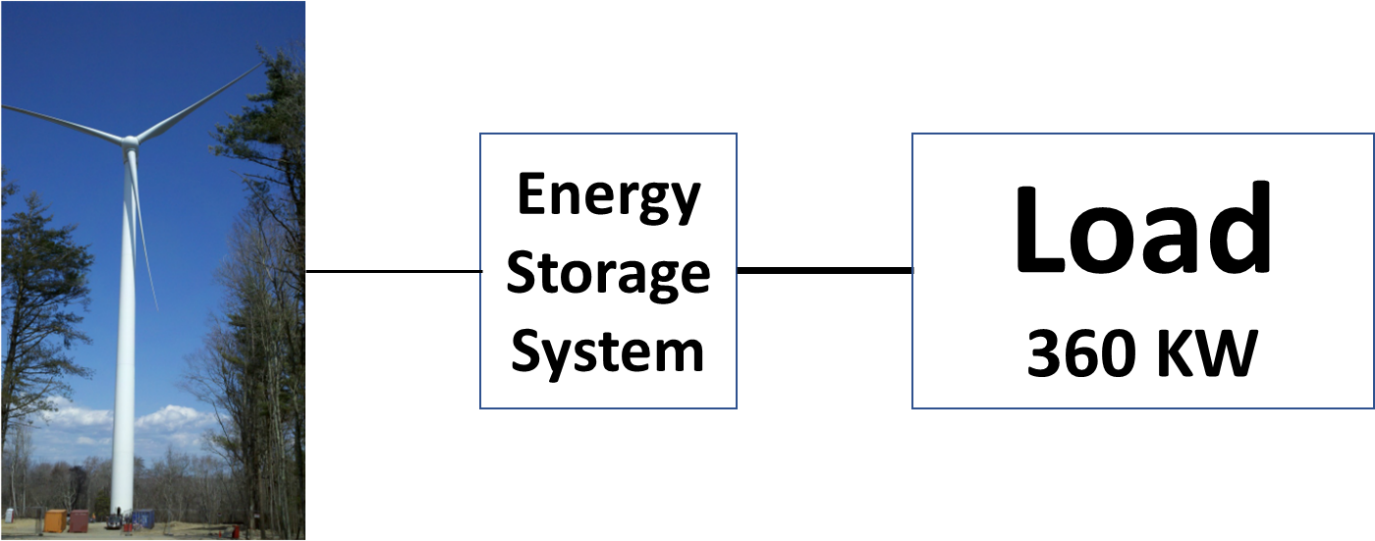
If this works from minute to minute and hour to hour, it is because turbines currently send their small output to a large grid with plenty of capacity from natural gas to stabilize the unpredictable output.
But what if this kind of renewable energy was all the grid relied on? What would a storage system look like that has the capacity to keep a reserve for the weeks when little to no electricity is available?
To answer that question, Chris Kapsambelis used two years of data from a 1.5 megawatt (MW) turbine in Fairhaven MA. Its output in a day could range from a high of 36,000 kilowatt hours (KWh) down to zero. Read his report.
He graphed peak storage In May. Ideally that means the slow discharge through late summer leaves enough to carry subscribers through the autumn, when the wind on the South shore picks up again.
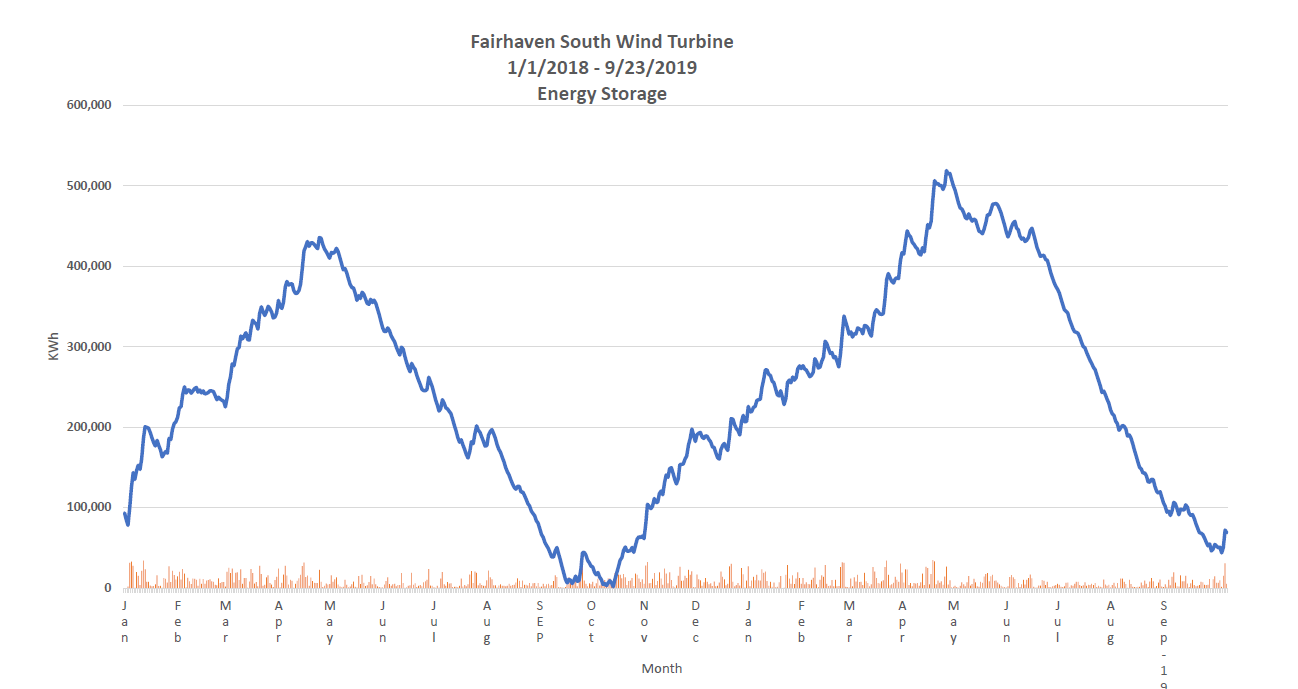
He established a break-even level of 8640 kilowatt hours. More than that and energy is added to the battery, less than that and energy is drawn down.
So far so good.
Then Kapsambelis recalculated his assumptions about demand on the system. If the grid operator drew 5 KW more power from the battery, a 1.4% change, the grid could experience blackouts at any point between mid-September and mid-October.
If that weren’t enough of a worry, he found that the battery would need to be large enough to store 500 MWh. But wait! The largest storage field in the world, the Hornsdale Power Reserve in Australia, “can only store 129 megawatt-hours, which is about a quarter of the storage needed for just one small wind turbine.”
Chris Kapsambelis has news for us: energy storage for wind power is not possible.
Another one bites the dust
One pipe dream, like that of so many communities in Massachusetts, vanished in a puff on September 22, 2020. Another land based wind turbine came down after years of failure to produce the promised electricity. South Coast Today contributing writer Tim Dunn recounted the story (UMass Dartmouth wind turbine comes down after stormy history) while Peter Perreira captured the time lapse photos for New Bedford’s The Standard-Times.

UMass Dartmouth acquired the turbine in 2012 after Cape Cod residents prevailed against siting it at the Community College in West Barnstable.
“It never really worked well from the beginning. They were supposed to build it and after it ran correctly for 30 days, we were supposed to take over possession of it. It took three years for them to get it to run for 30 consecutive days,” [Jamie] Jacquart said, stating that the ultimate decision to tear the turbine down came last year, when the bids for a service contract went up “significantly,” something he said caused school officials to reevaluate its cost-effectiveness.
Believing the Elecon model was a lemon, the university found that each time it was repaired, it produced less electricity.
The turbine’s deconstruction involved dismantling by Londonderry, NH’s Down & Out Industries. “‘It was basically as simple as it could be, we just notched it like a tree and dropped it,’ said Stephen Draper.” The turbine’s parts will be divided between Spiegel South Shore Scrap Metal in Brockton and Raynham’s C. Carney Environmental for unsalvageable trash.
Plymouth BOH Listens, Acts
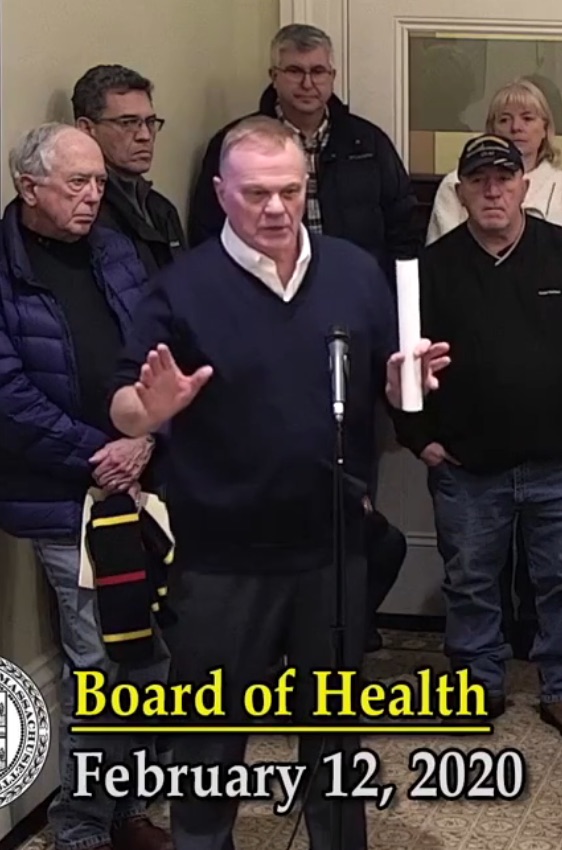
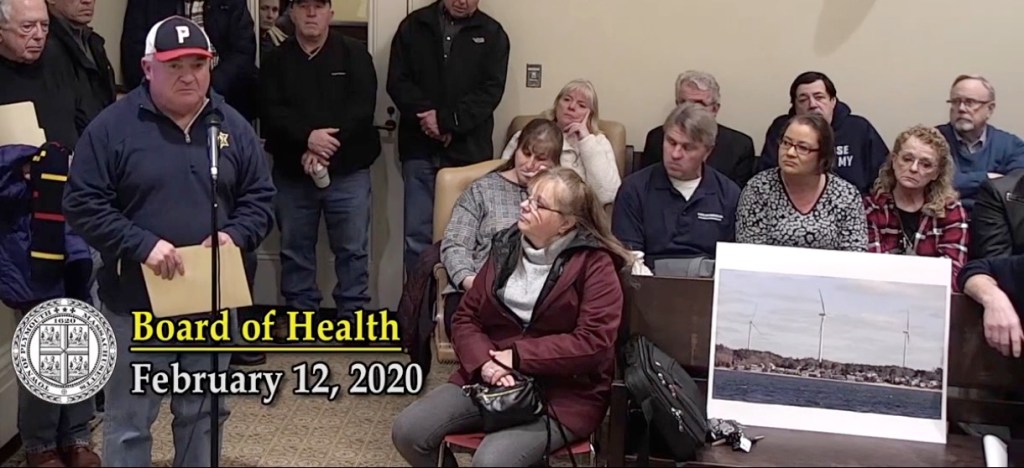
Click on the images to view video clips.


Above: Alberto Fernandez recounts health impacts. Right: Ian Davies describes what living with wind turbines is like on his property


Nuisance Turbines in Plymouth
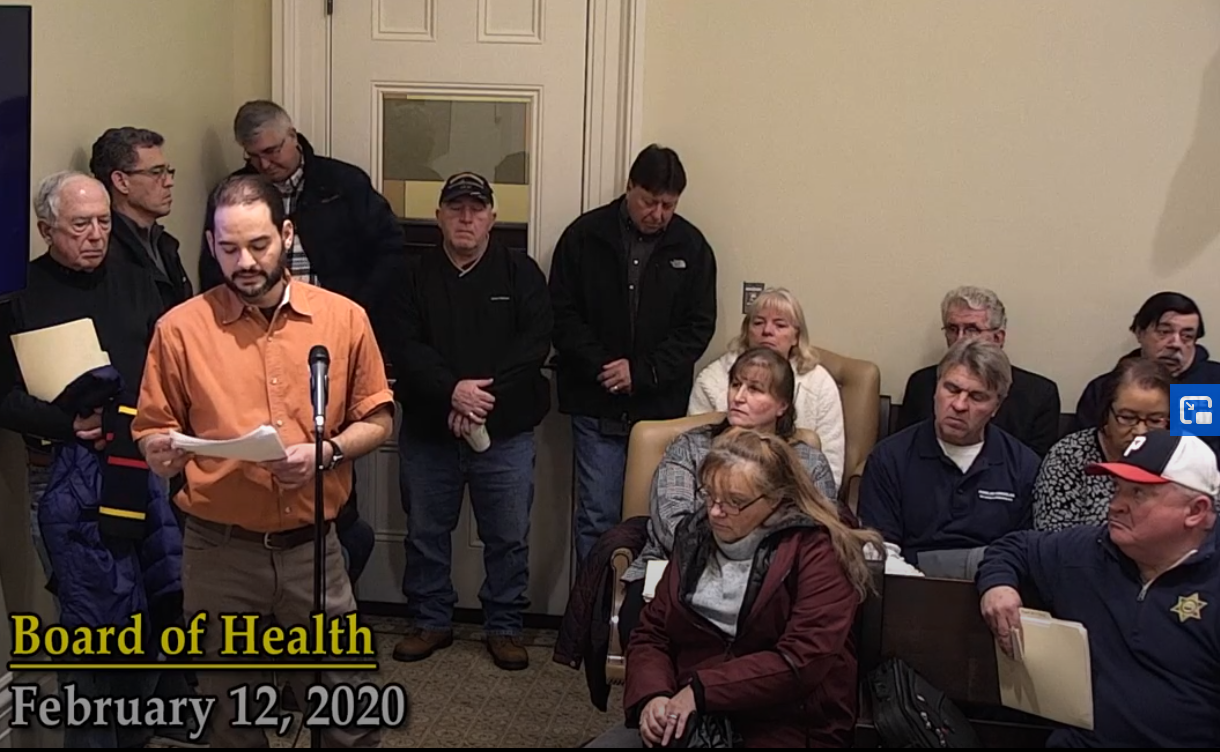
Plymouth residents who crowded into the Board of Health meeting on February 12 got an early valentine–the sweet satisfaction of being heard. According to the Cape Cod Times, “Residents have pleaded with several town boards in Bourne and Plymouth and with state officials for years for action to be taken on the turbines.”
“It is amazing to me that these turbines were built in a residential area,” board Vice Chairman Barry Potvin said. “This is clearly something the Board of Health has to take up, because we are sworn to protect the health and safety of the people who live in this area.”Much of what happened with the turbines came before many of the current members were serving on the board, member Jerry Levine said.“I feel your pain,” Levine said. “My intention is to look into it.”
Residents of Plymouth and neighboring Bourne have logged over 350 complaints of noise and sleep disturbance beginning soon after the turbines went online in 2016. The four turbines are 500 feet tall and as close as 1,450 feet to one residence.
“’We want to do justice to this and to all the parties involved,’ board Chairwoman Birgitta Kuehn said,” according to CCT reporter Beth Treffeisen (Plymouth board declares turbines a nuisance, 2/13/20).
Plymouth Community Access Television recorded the meeting. The wind turbine testimony begins at the one hour and 7 minutes point and continues for almost an hour.
When the “New Neighbor” is a Wind Power Plant
One man says, “I just want my way of life back.” Others mention the lost value on their properties since the “very heavy duty industrial power plant that has been dropped into our neighborhood” began to operate.
A Buttermilk Bay view of the 2 MW turbines in Plymouth’s Future Generation Wind project–here they tower over Bourne’s Hideaway Village.
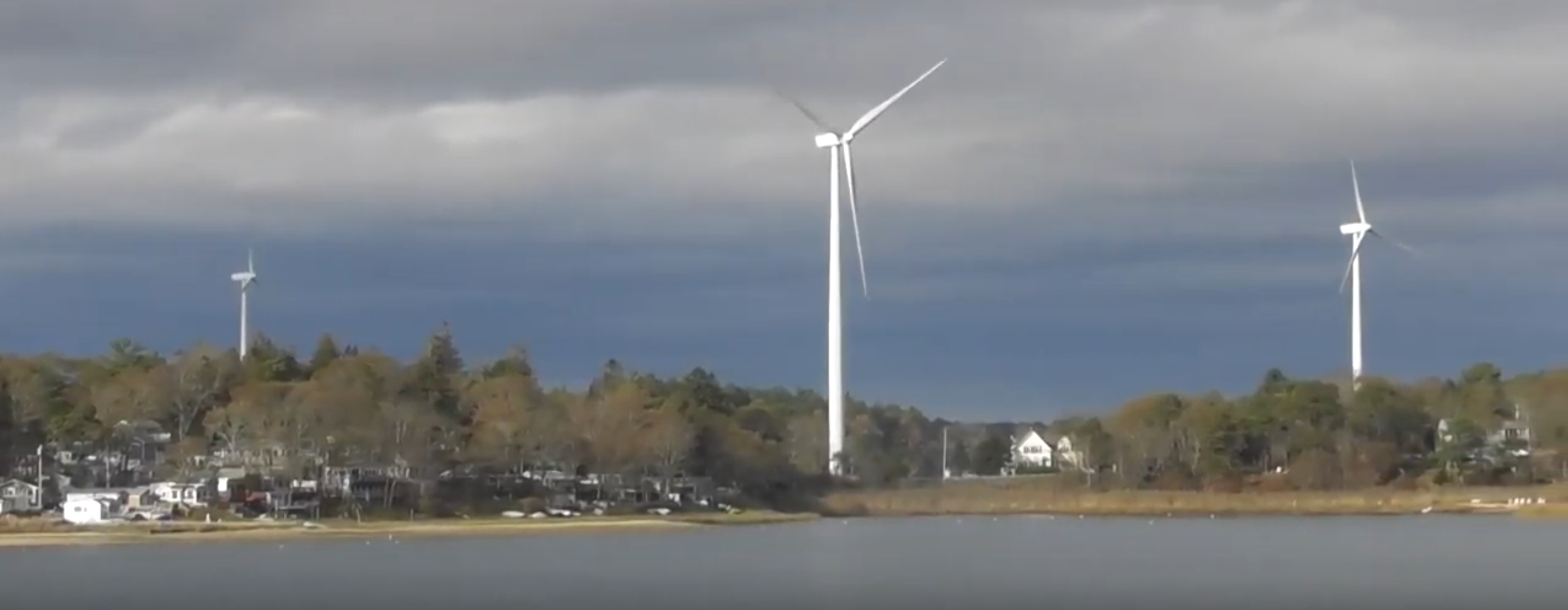
Three of the four turbines of Future Generation Wind in Plymouth tower over Bourne residents, too.

 Wind Wise ~ Massachusetts