Falmouth Health Board Won’t Act But Court Will
The town couldn’t justify the financial cost of shutting its two town-owned turbines off for 12 hours, so they turned them on again for 16 hours, only allowing uninterrupted sleep for wind neighbors from 9:00 pm to 5:00 am. On November 4th the Board of Health decided not to take action to change those hours. But 3 days later, the Superior Court in Barnstable restored the 12-hour relief from 7:00 pm to 7:00 am. This came in a tentative agreement between the town and the Andersens who had brought a successful “nuisance” complaint in 2012. In spite of this ruling, the turbines have still turned on at 5:00 am.
According to Heather Wysocki reporting for the Cape Cod Times (Factions reach accord on wind turbine hours, 11/7/13), the judge’s action pressed for a compromise between the town’s need for the income from turbine operations and Neil and Elizabeth Andersen’s request for an injunction stopping all turbine activity. Barnstable Superior Court Judge Christopher J. Muse said the “abutters were ‘injured in some way’ by the turbines” and had earlier denied the town’s request to throw out the ZBA’s decision–finding the turbines a “nuisance.” Another hearing, to finalize the agreement between the Andersens and the town, is scheduled for November 21, 2013.
This is only the beginning of the process, though, as Christopher Kazarian wrote in “Town Agrees To Reduce Operating Hours Of Turbines” (Falmouth Enterprise, 11/8/13)
As part of the agreement, the town will also direct building commissioner Eladio R. Gore to devise a plan to eliminate the nuisance. The first step in that plan will be to begin acoustic testing in a variety of conditions, with one turbine running and both running at various times.
….
While progress has been made toward a final resolution, Mr. Senie (representing several wind neighbors) said nothing has truly been settled. “There really isn’t any agreement that has been reached. There’s been a consensus that we should take a look at a possible global settlement of [four] different pieces of litigation. We have a long road to travel to get there,” he said.
Those four lawsuits, he said, include yesterday’s as well as two separate nuisance claims against the town, one brought forward by the Andersens and another by his clients, who live near the wind turbines. The fourth lawsuit is an appeal of Barnstable Superior Court Judge Robert C. Rufo’s decision in June that Mr. Gore did not need a special permit from the appeals board to erect Wind 1, which became operational in March 2010.
Dispatch from Canada
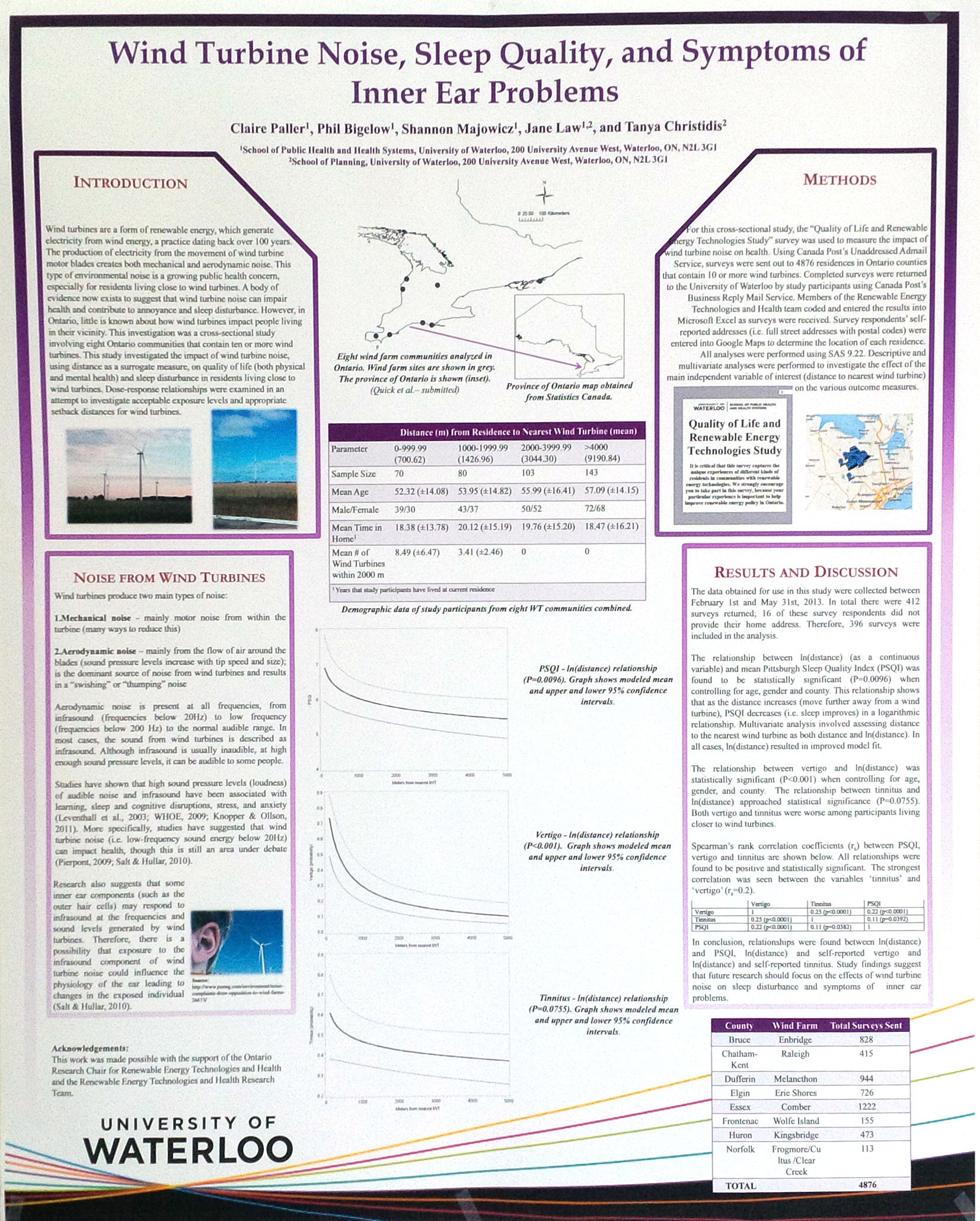 “..statistically significant” was the finding of the study “Wind Turbine Noise, Sleep Quality, and Symptoms of Inner Ear Problems.”
The research indicates statistically significant results for sleep, vertigo and tinnitus
according to authors Claire Paller, Phil Bigelow, Shannon Majowicz, Jane Law, and Tanya Christidis, who presented their poster at sessions on Oct. 24, 2013 (Symposia of the Ontario Research Chairs in Public Policy) and October 17, 2013 (symposium on sustainability held at York University, Toronto).
The research was funded by the University of Waterloo and the Ontario Ministry of Environment.
The responses from 396 surveys were included in the analysis.
Of note is the acknowledgement that as the distance from the IWT increases, sleep improves:
“The relationship between ln(distance) (as a continuous variable) and mean Pittsburgh Sleep Quality Index (PSQI) was found to be statistically significant (P=0.0096) when controlling for age, gender and county. This relationship shows that as the distance increases (move further away from a wind turbine), PSQI decreases (i.e. sleep improves) in a logarithmic relationship. Multivariate analysis involved assessing distance to the nearest wind turbine as both distance and ln(distance). In all cases, ln(distance) resulted in improved model fit.”
In addition the authors state that the relationship between vertigo and tinnitus worsened for those living closer to IWTs:
“The relationship between vertigo and ln(distance) was statistically significant (P<0.001) when controlling for age, gender, and county. The relationship between tinnitus and ln(distance) approached statistical significance (P=0.0755). Both vertigo and tinnitus were worse among participants living closer to wind turbines.”
The conclusion states:
“In conclusion, relationships were found between ln(distance) and PSQI, ln(distance) and self-reported vertigo and ln(distance) and self-reported tinnitus. Study findings suggest that future research should focus on the effects of wind turbine noise on sleep disturbance and symptoms of inner ear problems.”
Falmouth Human Rights Conference Highlights
 In Steve Ambrose’s homage to Back To The Future, Doc and Marty confer over the 7 studies produced for Falmouth. In every study–whether modeled or measured–the noise exceeded a) Mass DEP regulations and b) Falmouth noise limits. So, surprise surprise, the noise complaints have come rolling in as predicted by the chart developed by Ambrose and his colleague Rob Rand. (More about Steve Ambrose)
Audience questions about community response to wind turbine noise brought out some of the misconceptions about measuring noise and amplified Ambrose’s point that buried somewhere in every report was the telltale number that anticipated human impacts from Falmouth’s Wind 1. He has kindly shared his presentation.
Sarah Laurie was unable to attend via web conferencing, but her presentation,”Wind Turbine Noise, Adverse Health Effects, and Professional Ethics” was delivered in person by Fairhaven resident Curt Devlin. Waubra foundation research on infrasound, low frequency noise (ILFN) and vibration are revealing the causal agents of mental and physical health problems near industrial wind turbines.
Wellfleet resident Lilli Green described her collaboration in interviewing over 200 people in 15 countries about their experience of or research into adverse impacts of wind turbines.
Wellfleet Withdrawal Prompts Renewed Concern
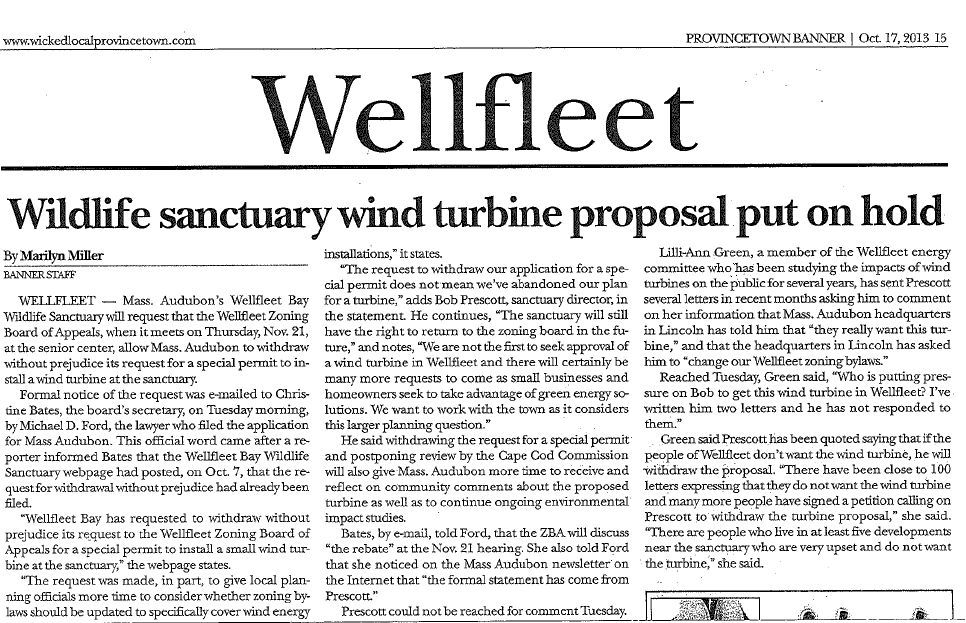
A petition drive against a wind turbine proposal at the Wellfleet Audubon Sanctuary seems like an unnecessary action, given the news “Wildlife sanctuary wind turbine proposal put on hold” (Provincetown Banner 10/17/13). Marilyn Miller’s article provides some clues: the Mass Audubon Society will ask the Zoning Board of Appeals to withdraw the special permit request “without prejudice.” This lack of a definitive finding will allow the sanctuary to bring the proposal up at a later date. Opponents believe that means they will try to get it through a different committee instead.

The petition is for anyone who lives or pays taxes in Wellfleet, or who visits as a seasonal resident or tourist.
According to Miller, MAS Wellfleet’s director Bob Prescott said “the request to withdraw our application for a special permit does not mean we’ve abandoned our plan for a turbine.”
Nearly 100 letters against the turbine have been sent to Mass Audubon, according to Lilli-Ann Green, who said that the residents of five developments near the Sanctuary have expressed their opposition.
Falmouth Conference on Human Rights
 On Saturday, October 19, 2013, the Human Rights Committee in Falmouth holds its 2nd annual conference. The program features Lilli Green, Sarah Laurie and Steve Ambrose. It runs from 10:00 am to 1:00 pm at the Falmouth Public Library in the Hermann Foundation Meeting Room (300 Main Street, Falmouth, MA 02540).
Neighbors are far better acoustic analyzers for determining the quality of their life versus any acoustic instrument left unattended by an expert.
(Stephen E. Ambrose, INCE, Bd.Cert. Acoustics, Environmental Sound and Industrial Noise)
Lilli Green: Around the World Findings and Wind Turbine Updates
The dream vacation–an around-the-world trip–changed dramatically when Cape Cod residents Lilli Green and Preston Ribnick began talking with people who lived near wind turbines. The two interviewed over 200 people in 15 countries. People living in close proximity of wind turbines, health care professionals, researchers, scientists, politicians, journalists, environmentalists, and advocates gave interviews. Key findings of the adverse impacts of wind turbines will be presented.
Sarah Laurie: Cumulative Exposure Results in Deterioration of Health
Contributing via web conferencing, Sarah Laurie will present her foundation’s research on infrasound, low frequency noise (ILFN) and vibration as causal agents of mental and physical health problems near industrial wind turbines.
Steve E. Ambrose: Back To The Future
Falmouth has been presented with many wind turbine noise studies, most reporting that the wind turbines comply and there is no foundation for complaints. With the majority of his recent work focused on communities with industrial wind turbine sites, Steve Ambrose will discuss minimizing excessive noise and adverse public health impacts.
There will be a question-and-answer period after each presentation.
For more information, contact David Moriarty 774-521-8474; e-mail: waveydavei@aol.com.
————–
 Green is CEO of a health care consulting and quality improvement company with a national reach which was formed in 1979. She has worked with teams of experts throughout the United States to develop educational programs in the health care sector. Her background includes directing an environmental education school and working for the National Park Service as a naturalist/interpretive ranger. Green has spent over three years researching the impact of wind turbines on individuals and communities. She created the film Pandora’s Pinwheels. It documents reports of adverse impacts from living in close proximity to wind turbines and presents experts who describe why the impacts of wind turbines are different from other industrial machines.

Laurie is the executive director of Australia’s Waubra Foundation. Formed in 2010, Waubra facilitates independent, multidisciplinary research into the new health problems identified by residents living near wind turbines and other industrial sites.
 Ambrose is a Board Certified Member of the Institute of Noise Control Engineering and a is a full member of the Acoustical Society of America. He has over 35 years of experience working in acoustics, environmental sound, and industrial noise control. His career started with Stone & Webster Engineering Corporation in Boston, Massachusetts. He was responsible for quieting large electric power stations and industrial / commercial facilities. He encourages businesses to coexist as good acoustic neighbors. Currently, he is an independent consultant practicing near Portland, Maine. He coauthored the Bruce McPherson Infrasound and Low Frequency Noise Study for Falmouth, Massachusetts, followed by a number of peer-reviewed papers and articles about wind turbine noise and adverse public health impacts.
Three Hearings Around the State on 10/7
In Peru, near Pittsfield, at the western end of the state, the Planning Board holds a hearing on Monday at 7:00 pm on a petition for a moratorium on issuing wind turbine permits until July 2015. The petition was signed by 168 residents (in a Berkshire town of 800). It calls for time to establish requirements for permits through the planning process and time to enact bylaws. The special town meeting on November 4, 2013 will vote on the moratorium.
In Kingston, the devastating effects of light strobing produced by the five turbines will be a topic during the a Board of Health hearing at 6:00 pm. Other turbine “issues” are also on the agenda. The BOH will interview only one of the two potential candidates offering to test for strobing: George Becker-Birck K2 Management, Inc.
The Falmouth Board of Health meeting at 7:00 pm will also discuss the town-owned turbine shut down hours–and the health problem of noise pollution from the turbines.
Mass Audubon’s Wellfleet Sanctuary Turbine on Hold for Now
 The Massachusetts Audubon Society sought variances from the town of Wellfleet and the Cape Cod Commission to build a wind turbine on its Sanctuary grounds. Just before the two hearings, Mass Audubon asked for delays. The November 21, 2013 Zoning Board of Appeals meeting would be the next opportunity for Mass Audubon to make its case for a variance of the town’s 65-foot height restriction. (The Audubon Society had also postponed a related hearing before a regulatory committee of the Cape Cod Commission).
Mary Ann Bragg, reporting in the Cape Cod Times, described the turbine proposal (9/19/13):
In mid-June the Audubon Society applied for two variances to the town’s zoning bylaws for the installation of a Gaia-Wind 133 wind turbine that would be placed on a 120-foot monopole tower, according to town records. The turbine has two blades and is typically used on farms or by small businesses or community projects. The society was seeking permission for the turbine as part of its commitment to use more renewable energy systems and conserve more energy. The variances requested were for tower height and diameter of the rotor.
 According to her article, sanctuary director Robert Prescott believes opposition to the turbine is because of the short timeline of the permitting process and that the project itself is not in question.
Contradicting that assumption are the many letters and editorial comments people who wrote to various Cape Cod publications. An article by Marilyn Miller appeared in the print Cape Codder and and in the online Wicked Local Wellfleet (“Many oppose Mass Audubon turbine plans” 9/8/13). It details the opposition that the Massachusetts Audubon Society has encountered while trying to erect the wind turbine in their Wellfleet Sanctuary.
In a guest commentary “Audubon’s turbine plan disturbing” (8/2/13), Mike Rice wrote:
…according to its website, Wellfleet Audubon’s woodlands attract a wide variety of wildlife, especially songbirds and shorebirds. Also according to its website, in order to avoid conflicts of nature there’s no hunting, fishing or trapping along with some motorized vehicles allowed at the Audubon as well. But apparently a wind turbine isn’t in conflict with nature? Really? That position strikes me as being totally indefensible along with being absolutely absurd!
In another opinion piece, “Wellfleet isn’t fooled by Audubon’s turbine spin” in Cape Cod Online (9/25/13), Eric Bibler wrote:
The proposed wind turbine would be much larger than ones in neighboring towns. And none of those other wind turbines have been erected in the heart of a wildlife preserve — which is one of the chief objections to the radical Mass Audubon proposal.
Bill Could Be First Step to Study Health Problems
Lilli-Ann Green’s Op Ed in the Cape Cod Times, “Find facts on turbines’ health effects” (9/26/13) reminds readers of the health effects people are experiencing and the continued absence of any public health or clinical case study in Massachusetts. A public hearing on H. 2048 was held in July and the bill remains in the Joint Committee on Public Health.
Many families and communities throughout Cape Cod and our commonwealth are being severely affected by land-based wind turbines. Individuals have developed health problems. Real estate prices have dropped. Otherwise peaceful towns are in an uproar over existing and proposed turbines.
There are concerns on both sides. Some people say that those living near wind turbines have become ill or can’t sell their homes, and that solar energy is more fiscally responsible and better for the environment.
Others say wind energy will save communities money and provides an appropriate source of renewable energy.
However, the fact is there are 21 confirmed locations in Massachusetts where people living close to wind turbines are reporting health problems they did not have before construction of nearby wind turbines.
The symptoms they report include sleep disturbance and deprivation, headaches, ringing in the ears, tachycardia (fast heart rate), dizziness, vertigo, nausea, visual blurring, panic and loss of concentration.
We need to know why these people are experiencing health problems. Over three years ago, I and other Massachusetts citizens requested that the Massachusetts Department of Public Health conduct a comprehensive study of the public health and safety impacts of the land-based wind turbines.
More than a year later, a panel was appointed by the Massachusetts Department of Environmental Protection. Following the department’s release of what it characterized at the time as preliminary findings were more than 500 comments with more than 4,600 pages. Most comments were highly critical of the limited literature review, the panel and the process. All meetings were held in secret with no public participation. No meeting minutes or accounts of any of the proceedings have been released.
State Rep. Sarah Peake has introduced a bill (H. 2048) that calls for the commonwealth to convene a health commission to study the health impacts from land-based wind turbines. This legislation is about conducting honest scientific and medical research, developing educational materials and developing training for health care professionals. Massachusetts citizens deserve no less.
H. 2048 is modeled after the highly successful Lyme Disease Commission bill, for good reason. In the early days of Lyme disease, just like the situation today with wind turbines, people who became sick and health care professionals did not have enough information to understand the problem. Many medical professionals told those who complained of health problems that the symptoms were psychosomatic. This assessment proved wrong.
It is time to quiet the rhetoric and make decisions regarding wind turbines by finding the real facts about the health impacts of the turbines.
Lilli-Ann Green of Wellfleet is CEO of a health care consulting and quality improvement company and a board member of Wind Wise — Massachusetts, a statewide organization, and Windwise — Cape Cod, a regional organization, both being alliances of grass-roots environmental groups and individuals.
More on the bill, testimony, and media coverage at these Wind Wise – Massachusetts posts:
- July 7, 2013 Independent Commission Bills Before Public Health Committee
- July 10, 2013 Strong Testimony Supports Independent Commission
- media: July 12, 2013 Gov. Patrick Discusses Independent Commission
- July 13, 2013 Independent Commission Supporters Testify–Sue Hobart
- July 13, 2013 Independent Commission Supporters Testify–Lilli-Ann Green
- July 14, 2013 Independent Commission Supporters Testify–Mark Cool
- July 15, 2013 Independent Commission Supporters Testify–Louise Barteau
- July 15, 2013 Independent Commission Supporters Testify-Tom Thompson and David Dardi
- media: July 17, 2013 Calling for a TRULY Independent Health Commission
Falmouth Selectmen Reconsider Curtailment
In a recent mailing, Malcolm Donald notes, “Selectmen will hear public comment Monday night on their four options to increase wind turbine operations and then will VOTE!”
While a packed agenda puts the public hearing at the end of the session, there will be no lack of passion. The prospect of running the turbines at night, one of the four options under consideration, will have significant impacts on those living within the range of turbine noise and vibration. Selectmen are convening in the Hermann Room of the Falmouth Public Library in order to accommodate a bigger crowd.
According to Christopher Khazarian writing for the Falmouth Enterprise (“Town Manager Urges SelectmenTo Act On Turbines” 9/10/13)
The scenarios include full operation of both turbines, estimated to generate just over $220,000 of revenue in the first year and $3.87 million over a 10-year period.
Another option would be operating both wind turbines 20 hours per day, which would generate just under $60,000 in the first year and $2.07 million over a 10-year period.
The third scenario calls for a 16-hour operation of Wind 1 and operating Wind 2 with no limitations, enough to generate $88,000 in the first year and $2.36 million over a 10-year period.
And the final one would have Wind 1 operating for 20 hours a day and Wind 2 operating with no limitations. That would generate $155,000 in the first year and $3.12 million over a 10-year period.
Under those scenarios the town would be able to generate enough revenue to support the creation of a mitigation fund that would address adversely impacted neighbors.
In his blog post of 9/13/13 (Letters (X2) – Falmouth E – Friday 13, 2013), Mark Cool presents two letters published in the Enterprise. In his letter, Cool points out that if one or both turbines operate at night, they are likely to violate the DEP’s noise limits. John Ford debunks the prospect of sound mitigation efforts. He describes installing specialty windows and additional partitioning but, he wrote, “In spite of these extraordinary measures, noise still penetrates. This is reality, not a projection, not a study. Home mitigation will not work.”
Donald’s email recommends these documents for reference:
Plymouth ZBA Denies Stop & Shop Turbine Permit
 The hot, noisy, long, and “sometimes confusing” hearing on September 11, 2013 was captured in Emily Clark’s Wicked Local article, “Plymouth Zoning Board of Appeals: Wind turbine permit denied.” Among others, Clark quotes Kerry Kearney from the town’s Energy Committee, who said the proposal is “the worst wind turbine site in the state.”
The most dramatic appeal, perhaps, came in the form of Edward and Sue Hobart, who said they have been forced to literally abandon their $500,000 home in Falmouth because of the health impact the wind turbine there had on them. They said they have been forced out of the home and must now sell it for $335,000.
“I have wind turbine syndrome,” Sue Hobart announced. “I was diagnosed by Mass. Eye and Ear. I hit the deck and fell flat on my face. I have an inner ear problem I never had before the turbine went up.”
Concerns were expressed that the residents of Algonquin Heights would suffer the greatest impacts with their homes within 600 feet of the proposed turbine. The turbine would have stood 275 feet high and produced 800 kilowatts of electricity, offsetting 75% of the store’s electricity–when the wind was blowing.
The vote was 3-2 against granting the special permit. Stop & Shop is not expected to appeal the decision.

 Wind Wise ~ Massachusetts