Actual “Flicker” Study to Dispel Phantoms?
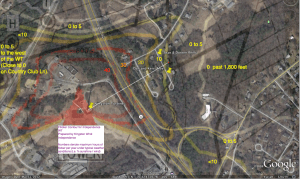
Two years after approval, KWI submitted a Google Maps “Flicker Contour” now located on the town’s Planning Department site.
According to Kingston Planning Board Chair Tom Bouchard, and Town Planner Tom Bott, there was no flicker “study” prior to the Independence Turbine being built, just “shadow flicker information” from the town’s Green Energy Committee.
In her Wicked Local Kingston article “Clean Energy Center explains how flicker study is conducted; Kingston town planner challenged, Kathryn Gallerani details the town’s admission that no pre-construction study had been done and explains the strobing study process. First the shadow effect is modeled, then field work is conducted based on the modeling. Catherine Williams, spokeswoman for the Massachusetts Clean Energy Center, described the process and said the CEC is coordinating a study that includes all five wind turbines in Kingston – the Independence, Mary O’Donnell’s three turbines, and the MBTA’s. A consulting firm will do the actual study.
Gallerani points out:
The question, was there ever a shadow flicker study done before the Independence was installed, has been a point of contention at public meetings as recently as last week. Town Planner Tom Bott, for one, has come under fire by Leland Road residents Doreen and Sean Reilly, among others.
When the Reillys met with the Planning Board last week, they demanded to see the shadow flicker study that the Planning Board cited in its site plan approval for the Independence. They say Bott had been misleading about whether there was an official flicker study and finally acknowledged there wasn’t one.
At the April 29, 2013 meeting, the Planning Board Chair said little information about flicker was known at the time, although the board based its citing recommendation (6/28/2010) on site plan information “based on the shadow flicker study.” He acknowledged that the information was more reading material and not a site-specific study. “In retrospect, [he said]…that probably should not have said shadow flicker study and probably should have said shadow flicker information”.
Bott said this week that he has provided more than 100 pages of information, including a document titled “Community Wind: The Future of Wind Energy,” dated Oct. 21, 2008, from the Green Energy Committee, to the Reillys to respond to their questions.
The MassCEC provided a grant of $137,860 to fund the Independence wind turbine, in spite of its website’s claim, “When providing funding for a project, MassCEC requires that shadow flicker be evaluated.” This requirement was noted in the Boston Globe’s story “Flickering shadows from wind turbines draw complaints” by Peter Schworm and David Filipov (4/5/13). They continue, “the MassCEC website states ‘Projects should ensure that shadow flicker impacts are minimized.’”
Falmouth–Heal Our Town–Vote Yes on 2
A new web page for Falmouth assembles videos of turbine shadow flicker, features quotes by town residents, and details the cost to taxpayers of removing the two town-owned turbines.

Heal our Town has FAQs, contacts–FalmouthVoteYesOn2@gmail.com–and more. The Noise page links to information developed by Chris Kapsambelis for Wind Wise~Massachusetts.
Is Going Green Destroying Lives? Special Report from Albany
“It’s a constant ringing and buzzing in the ears and I am head-achy in the back of the scruff of my neck.”
“It sounds just like a prop jet outside the house,” says Keith Dillenbeck, a dairy farmer in Herkimer County. He says wind energy is not only affecting his health, but the health of his animals as well.
“I never had this happen before until they erected the windmills,” says Dillenbeck.
Sending “Love” to Falmouth on Wind Turbine Removal
…Here are a few of the governor’s statements:
- He described the turbines as “2 older turbines”
- “They’re not working well, right?”
- “At least one of them needs to come down”
- “I’m sending love [to Falmouth] through this microphone”
- “Let’s see if we can’t close on it [getting State financial help] soon”
That’s right: There’s no typo above. The governor actually said that at least one of the Falmouth turbines “needs to come down”. He was also very enthusiastic about getting Falmouth some financial help to defray turbine removal costs.
Oddly enough, as the Governor was busy “sending love” to Falmouth, his administration was busy punishing the town.
First, the state rejected a request by Falmouth to assist with repayment of $5 million in debt incurred to erect Wind #1. Then the Massachusetts Clean Energy Center (MassCEC) rejected a request that it forgive its $1 million prepayment for Falmouth renewable energy credits.
Host Margery Egan referred listeners to the WGBH-TV2 “Greater Boston” program on the Falmouth Turbines reported by Adam Reilly and featuring Emily Rooney’s discussion with Eleanor Tillinghast and Megan Amsler.
Kapsambelis Tells CCT Danes Pay Dearly for Wind
In his letter to the editor “Wind will blow in electricity at 40 cents/kilowatt-hour,” Cape Cod resident Chris Kapsambelis points out an often-overlooked aspect of Denmark’s wind energy reliance–its cost.
In response to the April 6 letter “Cape Cod, look to Denmark for the possibilities of wind,” we do not want to follow in Denmark’s footsteps with wind energy.
Denmark pays some of the highest electric rates in the world. According to Wikipedia, it pays 40.38 cents per kilowatt-hour. We pay between 8 and 17 cents per kilowatt-hour. Denmark not only sells electricity to Norway and Sweden, but pays them to take it, and pays them to return it. They do this because without energy storage, which exists only in small quantities in most places, the power grid becomes unstable.
A better story on what is going on in Denmark and Europe in general can be found at New Europe Online at www.neurope.eu/blog/gone-wind.
Cape wind will increase the cost of electricity. Make no mistake about it.
Chris Kapsambelis, Pocasset
Chris Kapsambelis is a retired engineer and inventor who has served on Bourne’s Energy Advisory Committee and is author of “Acoustics and Wind Turbine Noise.”
Moving Forward in Falmouth but Stalled in Scituate
The town meeting chronology, from a failed warrant article to a ballot question to remove Falmouth’s town-0wned turbines, appeared in Sean Teehan’s Cape Cod Times article “Falmouth residents mixed on turbine vote” (4/13/13). The residents he quotes have views that range from support for the measure to begin the process of dismantling to opposing the question. In one case, the reasoning is that it would cost less just to stop running the turbines than to take them down.
For a detailed and colorful account of the three nights of town meeting, the Falmouth Enterprise report by Chrisopher Kazarian (“Voters To Have Say In Fate Of Town’s Turbines” 4/12/13) is must-reading. Quoting a sympathetic voice, Kazarian cited Michael Duffany.
He told Town Meeting that he had recently visited the neighborhood surrounding the turbines and equated the noise of the machines to a low-flying C-130. “I could not believe what I was hearing,” he said. “It just stopped me right in my tracks. At that point in time I didn’t need to read any more studies about sound levels that haven’t been established yet. Throw it all out the window. If you were standing there you would have said the same thing.”
Earlier in the week the Falmouth Bulletin carried Scott Giordano’s description of the process on the second night of the special town meeting (“Falmouth town voters to decide fate of wind turbines; Town Meeting passes amended Article 22” 4/10/13). Giordano quotes Selectmen Chairman Kevin Murphy:
No borrowing would occur unless we get the vote of the voters and then come back to Town Meeting and get the required 2/3 majority vote to borrow money at Town Meeting,” Murphy added. “In this period of time, we could find out what the costs are to dismantle the turbines and take them down and find out if anyone wanted to buy them. We would have the opportunity to have the authorization to go to the Legislature and see if the Legislature were to approve this act and allow the act to move forward. It will come back to Town Meeting. Incidentally, it would never come back to a Town Meeting until and unless, of course, the voters approved this.”
This item on the ballot will be voted on during Falmouth’s election day on May 21, 2013.
This week the “Scituate town meeting rejects resolution to shut down wind turbine” by a wider margin, according to Patrick Ronan’s report in the Patriot Ledger. The Scituate turbine has only been operating for one year.
Falmouth Town Decision Explored on “Greater Boston”
 Adam Reilly interviewed Falmouth residents Sue Hobart and Neil Andersen, and chair of the town’s energy committee Megan Amsler, for the set-up piece airing on WGBH-2 television’s “Greater Boston” in Falmouth Wind Turbine Debate (4/8/13). Then host Emily Rooney interviewed Amsler and Eleanor Tillinghast, a tireless advocate for conservation and to site turbines where they will not impact residents or delicate ecosystems.
The town of Falmouth has been on the leading edge of renewable energy. It boasts three massive wind turbines – one owned by a private developer, two others by the town itself. But some neighbors say the machines make their lives miserable – and now Falmouth is on the verge of tearing them down.
State Bears Responsibility for Windburn in Falmouth
Former State Representative Eric Turkington accurately analyzed the the dilemma facing Falmouth in his 2011 opinion piece in the Cape Cod Times. In “State bears onus in wind fiasco” (11/18/2011) Turkington says once the health impacts became publicly known, “the responsibility to fix the situation became the state’s, not the town’s.”
These are not costs that the town of Falmouth should bear. Along with the afflicted neighbors, the town, too, is an injured party here.
The town is the innocent purchaser of two industrial-size wind turbines that had been rejected by another Cape town. When Wind 1 was erected within a quarter-mile of a local neighborhood, it quickly became clear that neighboring residents’ health and well-being were being adversely affected.
The town was sold a bill of goods; industrial-size wind turbines cannot be safely located that close to residential areas. The state consultant’s representation that such a location would be appropriate, and would have no impact on the neighbors, was clearly wrong.
Blogger Mark Cool’s Firetower Wind site continually updates readers on the status of the discussion in Falmouth and from time to time recaps the sequence of events. He illustrates from his own experience and that of his neighbors on Blacksmith Shop Road. In a recent post he says:
Governor Patrick’s wind energy agenda has led Commonwealth communities into expensive capital expenditures. Now, agencies, under his watch, fortify his agenda and turn their backs on the community. Falmouth is left windburned and forced to fix itself.
Falmouth Officials Affirm Position on Removing Turbines
Scott Giordano, reporting in the Falmouth Bulletin, “Massachusetts Wind Storm” explains the intricacies addressed by the joint Selectmen, Finance Committee meeting.
Falmouth Board of Selectmen and the Falmouth Finance Committee held a joint April 4 meeting and unanimously stood by the selectmen’s prior vote to remove the town’s wind turbines, despite receiving none of their requested financial assistance from the state to do so. The latest estimate is that it will cost the town about $14 million to remove both Wind 1 and Wind 2 at the Falmouth Wastewater Treatment Facility.
The town is addressing a source of harm to some that is impacting the whole community. The sub-headline of the April 4, 2013 piece notes Falmouth “shows glimmers of courage/defiance.”
WBUR Reports on Anticipated Turbine Vote in Falmouth

Neil Andersen and John Ford know more than they want to about the impacts of wind turbines. Their disappointment and anxiety comes through the WBUR radio story “Falmouth To Vote On Removing Wind Turbines” reported by Bob Oakes and Kathleen McNerney (4/2/13).
According to Andersen:
“If I had the choice tomorrow I would move away and just hopefully never hear the word ‘turbine’ again in my life,” he said. But Andersen said no one would want to buy his house because of all the trouble he’s had living there since the turbines were installed.
For Ford, the choice is simple: “I don’t want to move. I like where I am. … I think the turbines should have to move.”
A special town meeting on 9th may decide the future of the two town-owned turbines. The Webb turbine powering a commercial property is not affected by this decision.

 Wind Wise ~ Massachusetts