Common Sense Urged in Hearing Testimony
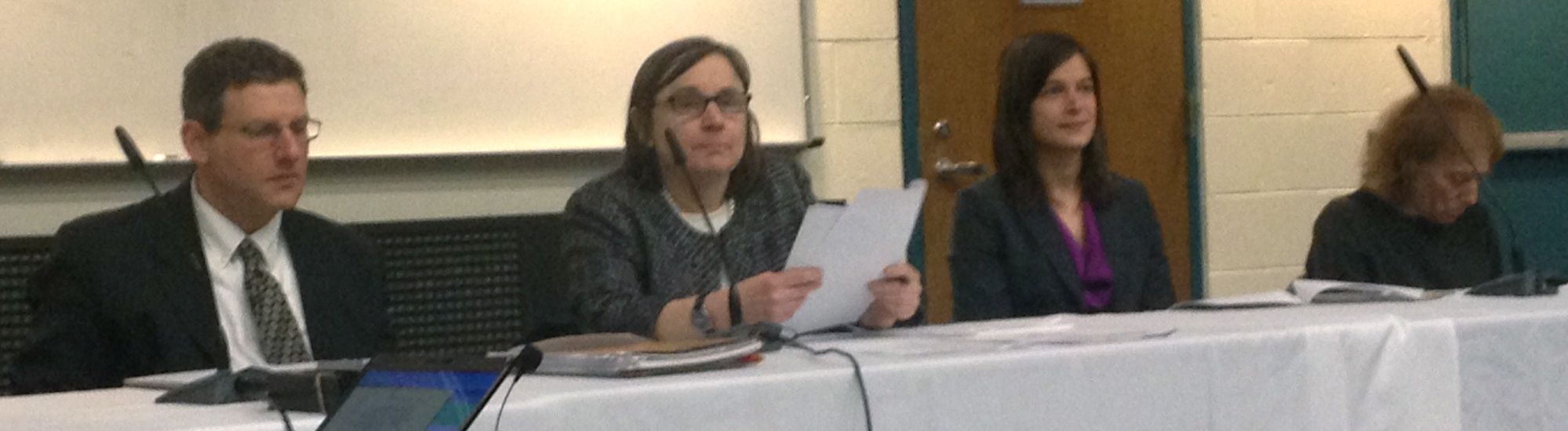
DPU panel members
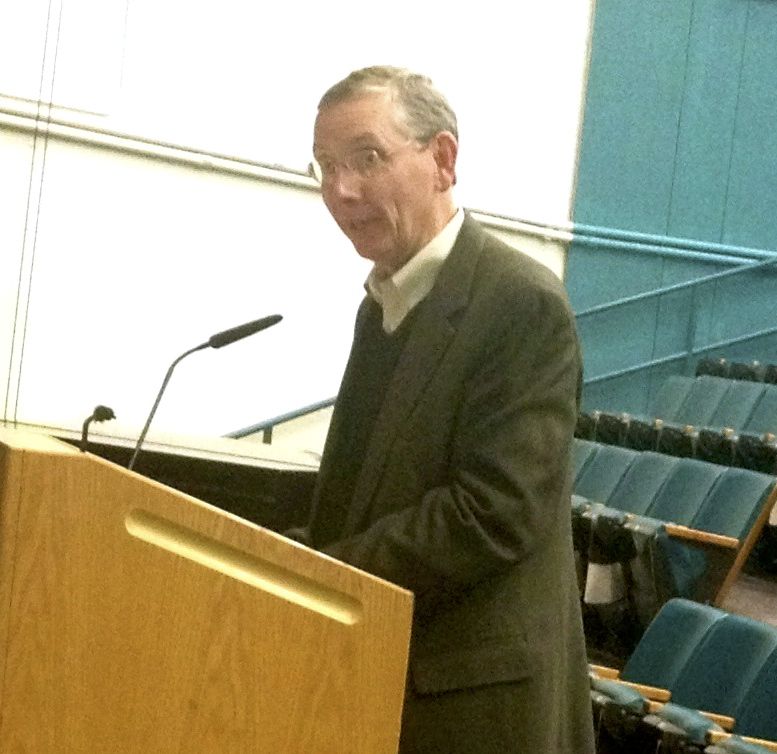 At the Bunker Hill Community College hearing on January 9, 2014, voices like Jim Aylward’s (below) joined testimony from impacted wind neighbors Karen and Chelsea Isherwood (see previous post).
My name is Jim Aylward, and I am here from Nantucket. In the early 1980’s, I was a Town Administrator for the Town of Boxford, Mass. Back then there weren’t any wind turbines proposed for my Town. I would like to give you my perspective, as if I were a Town Administrator now, on how I would look at a proposal for a wind turbine in my Town:
Number one, protect the public health of all citizens, including people who work and go to school.
Use common sense and avoid costly lawsuits by siting turbines where known harmful effects such as noise, flicker and strobing will not be imposed on any unwilling property owners or citizens. This can be done using 3D GIS models integrated with acoustical models to show how far and where noise, flicker, strobing, and other effects would likely travel from the turbines. I can give you more details on that if you like.
Protect tax revenues by not causing property values be diminished by siting wind turbines too close to residential, commercial, industrial or public property.
Enforce the laws of the State and the Towns and cause the turbines to be shut down if it exceeds state or local noise ordinances or maximum noise levels represented by the developer or the manufacturer. Give turbine owners time to fix the problems; if problems persist, turbines should be decommissioned.
Have the turbine developers pay to establish acoustical (or noise) monitors at half, 1, 1 1/2 and 2 mile radii from the turbine. Exceeding state or local noise laws should trigger automatic shut down for repairs.
Prior to the final approval of a turbine project, the turbine developers / owners (including a state or local public agency) should be required to post either a bond an evergreen letter of credit to cover all decommissioning costs, including removal and full site restoration.
These are a few of the things that I would do to protect the citizens, avoid lawsuits and ensure that decommissioned turbines are removed at no cost to the community.
Hearing Testimony
 |
 |
 |
| Karen Isherwood testifies before the MassDPU. | Chelsea Isherwood testifies at the hearing on January 9, 2014. | Louise Barteau testifies at the hearing held at Bunker Hill Community College. |
Karen and Chelsea Isherwood recently testified at a MA DPU hearing. They wrote the letter below to inspire others in our communities to testify, too.
For two years they have been denied a chance to speak in their town of Fairhaven, where the Board of Health has refused to hold a public hearing despite 624 formal health complaints from 60 families regarding the turbines.Most recently town officials, the wind developers, and representatives of the MA DEP and CEC, met to create a formal mitigation plan without ever hearing from the Isherwoods and the other families who are severely impacted. This “mitgation plan” only shuts the turbines off between the hours of 12 and 4 am under limited wind conditions, and clearly fails to meet the sleep needs of anyone, much less the requirements for infants and children.
Here is their letter.
Hello everyone,
This is Karen and Chelsea Isherwood and we would like to share with you our recent experience at the hearing in Boston at Bunker Hill Community College. On Thursday we went up to Boston with Louis to a hearing with the Massachusetts DPU, whom we learned later was a very important board to have the chance to stand in front of. We were unsure as what to expect and had heard only a few stories about how other hearings went. From what we had heard they could be brutal when members of Friends of Fairhaven are there, or green supporters who truly do not understand the complications of turbines.
When we arrived there were only a few people there, and the hearing board. It was actually a very powerful evening listening to everyone get up and explain what they have learned and experienced about the turbines. There were members of other Health Boards, scientists and neighbors. Louis, my mother and I were the last to speak. I think this worked out perfectly for us to end the night. Louis spoke of what she learned in all her research on the turbines and not only why the siting of the turbines does not work but how they are not green at all. She ended her talk with stories of our neighbor’s experiences with the turbines. My mother went next and then me in front of the board to offer our personal stories of what it has been like living next to the two turbines for a year and a half.
What was truly amazing was finally having the opportunity to speak and be heard. I mean whether we were truly heard will remain to be seen. However, we did discuss how nice it was to have people listen and to not feel crazy. I can say for myself that I felt the hearing board was listening. They looked at you while you spoke and they seemed to be moved and overcome with emotion.
It truly was a great experience and we learned that it is important for more of us to go to these hearings and share our stories. This is our chance to be heard, the chance where this important board is allowing us to speak and not be judged. A window has been opened for us that may lead to a door. Every little step counts, no matter what the outcome. This is our chance to make a big move!!!!
Best Regards, Karen and Chelsea Isherwood
The public hearing schedule and more information is found here at windwisema.org.
More Research on Wind Turbine Health Effects
 Canadian health professionals Roy D. Jeffery, MD, Carmen M.E. Krogh, BScPharm, and Brett Horner, BA, have published a literature review updating the the state of knowledge about health impacts of wind turbines. The January 2014 article “Industrial wind turbines and adverse health effects” is published in the Canadian Journal of Rural Medicine (CJRM).
The three have previously published in Canadian Family Physician. Their commentary, advising Canadian physicians about symptoms their patients might present, was published in May 2013 (“Adverse health effects of industrial wind turbines“). A subsequent letter to the Editor (Sep 2013), clarified points from their May article that were raised in follow-up letters from readers.
Dr Jeffery, Ms Krogh, and Mr Horner are on the Board of Directors for the Society for Wind Vigilance, an international federation of physicians, acousticians, engineers, and other professionals who share scientific research on the topic of health and wind turbines.
Latest Property Loss Study is Garbage In, Garbage Out
The MassCEC commissioned and funded a newly-released study, “Relationship between Wind Turbines and Residential Property Values in Massachusetts.”
This study is an embarrassment to the Patrick Administration and a complete waste of tax payer dollars. The methodology is flawed and much of the findings are very questionable.
Instead of paying researchers in California and Connecticut to determine the value of properties near wind turbines, the Mass CEC could easily have interviewed realtors, appraisers, and homeowners near the turbines.
Or they could have even looked at a previously published study by a nationally recognized appraiser that showed that, in Falmouth alone, homes near the turbines decreased by an average of 27 per cent.
The same independent appraiser, who has conducted more than 20 appraisals of homes near existing or proposed-land based wind turbine projects, has estimated that home values near the turbines plummet by 15 to 40 percent.
There are four obvious problems with the report commissioned by the Mass CEC:
- Neither of the researchers are licensed appraisers, so they have no expertise in assessing the value of property.
- There is no way to accurately compare the impact on the value of homes a few thousand feet from the turbines to those five miles away – which is what the study does.
- There is no evidence that they visited any community in Massachusetts.
- The Mass CEC is not exactly a disinterested party as that agency is a strong proponent of wind turbines in Massachusetts.
DPU Hearings Offer Public Forum on Wind
While the DPU initiative is an obvious effort of the executive branch to by-pass the Massachusetts legislature on wind turbine siting, the five public hearings in January give everyone an opportunity to raise the issues. Read more about the siting categories.
Even if each person has only a brief opportunity to speak, there are plenty of things to say about the turbines–large and small–that are wreaking havoc on individuals and communities.
The hearings are scattered around the state, allowing most people a venue that is close to them:
| Jan. 9 | 4:00 pm – 8:00 pm | DPU 13-165* public hearing | Bunker Hill CC, Boston |
| Jan. 13 | 7:00 pm – last speaker | DPU 13-165* public hearing | Mt. Wachusett CC, Gardner |
| Jan. 22 | 4:00 pm – 8:00 pm | DPU 13-165* public hearing | Hyannis |
| Jan. 27 | 5:00 pm – 8:00 pm | DPU 13-165* public hearing | Pittsfield |
| Jan. 29 | 7:00 pm – last speaker | DPU 13-165* public hearing | Gloucester |
*DPU 13-165 More info, Schedule and Directions.
Outlook on WT Noise Research
 The news for January 1, 2014–from a focus article in the journal Environmental Health Perspectives–affirms there is something to the claims of harm associated with wind turbines (“Wind Turbines: A Different Breed of Noise?“).
Nate Seltenrich, who reports on science and the environment, provides a round-up of recent publications documenting the issues: symptoms, claims of causation, and counter arguments. He introduces the science from the perspective of people whose well-being has been disrupted in Falmouth–Sue Hobart and Annie Hart Cool.
“The gold standard for proving causality of an exposure,” Seltenrich writes, “is the randomized clinical trial. But when it comes to testing the health effects of noise exposure on humans, such a study design is likely to be not only impractical and difficult to implement, but also unethical.”
Seltenrich quotes Jim Cummings, editor of Acoustic Ecology Institute’s blog (a site which gathers news and reports about sound), “There are some studies looking at whether wind turbine infrasound may have specific qualities that make it more apt to trigger health effects, especially nausea, than ‘normal’ infrasound from wind or waves or traffic, but these are still very preliminary.”
Cross-sectional studies, instead, are the most common type of research to date, and cannot pinpoint causality.
The next-best evidence would come from longitudinal field research, many researchers agree, such as long-term studies that assess the health of a community before a turbine project is ever proposed and then continue to follow up during operation. [Dr. Peter] Lercher notes that some effects of chronic noise exposure such as elevated blood pressure could take one or two decades to manifest at significant levels.
Seltenrich captures the concept of annoyance by its health science meaning rather than everyday usage:
Based on its standing definition of health as “a state of complete physical, mental, and social well-being and not merely the absence of disease or infirmity,” the WHO concludes that noise-induced annoyance “may be considered an adverse effect on health.”17 High levels of annoyance have also been shown to lead to stress responses and sleep loss, including attendant symptoms such as headache, gastrointestinal upset, anxiety, fatigue, and hypertension.18,19,20
The interest in wind turbine noise as a public health issue is mounting. Conferences addressing noise now feature “nearly as many sessions organized around wind turbine noise as in all categories of transportation noise combined,” wrote Seltenrich.
What’s Your Number?
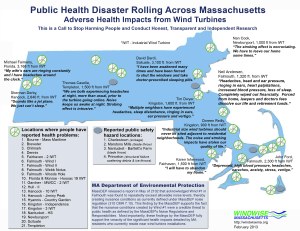 |
 Communities with health complaints about wind turbines. |
 |
wind turbine complaints submitted to the Fairhaven Board of Health since May 2011.(Not a single one has been answered or responded to.) |
 Number of complaints Mark Cool lodged with the Town of Falmouth Number of complaints Mark Cool lodged with the Town of Falmouth |
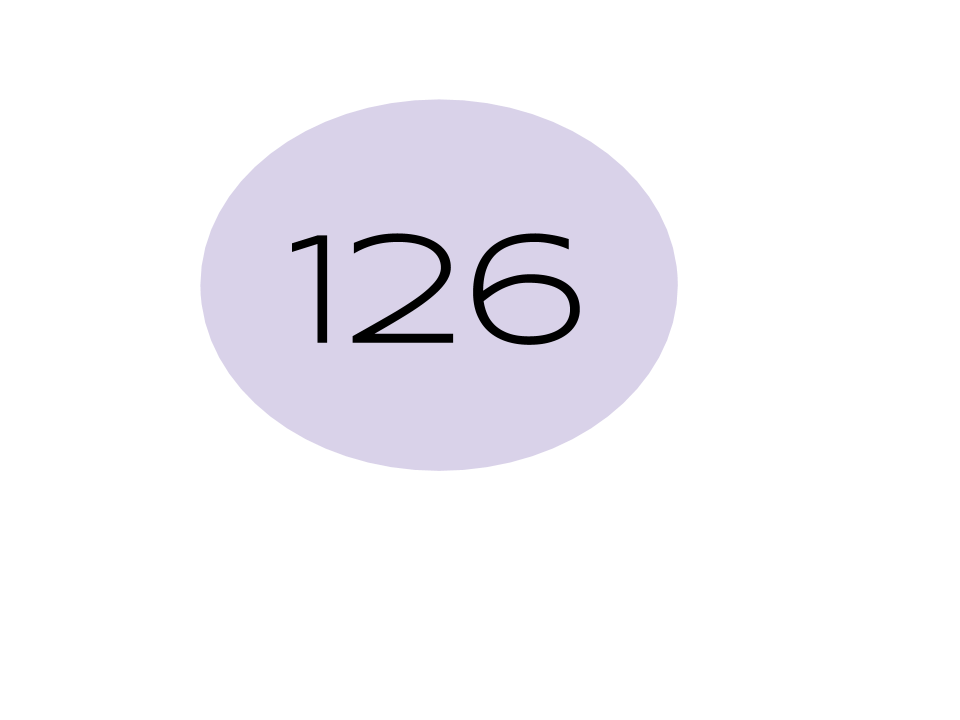 |
Please comment with a number that has significance for your community. |
|
Ambrose Reminds WNTAG Panel of its Mission
“WNTAG’s mission is to advise; protect public health, safety and well-being.” Not drag its heels waiting for more noise level measurements.
That is the message acoustician Steve Ambrose delivered to fellow members of the Wind Turbine Noise Technical Advisory Group (WNTAG), convened by the Mass. DEP.
WNTAG has yet to discuss wind turbine projects with site-specific complaints and noise level measurements.
…
[Because of a judge’s ruling] … recommendations may be viewed as “too little” and “too late.”
He concludes, “WNTAG must respect the public pleas for relief and now a judge’s decision.”
Watch the video of the first WNTAG meeting when Ambrose said “we have to end up putting at the top of our list human complaints–that’s why we’re all here. If we end up putting our instruments there, we’re not going to end up solving the human complaint problem.”
Noise Testing Protocol Offered at WNTAG
 Engineer Chris Kapsambelis introduced his proposed method (WT_Protocol) for testing wind turbine noise, based on the MassDEP limit for broadband sound increase to 10 dB(A) above ambient.
This methodology is designed to use a small number of samples that can be used in a protocol to derive ambient (L90) and Impact (Lmax ) sound pressure levels. To capture the full effect of Amplitude Modulation, the FAST meter setting shall be used along with a sampling rate of at least 8 samples per second. The objective is to derive these parameters with assurance that they apply to large segments of time in all seasons, under weather conditions deemed to be worst case for compliance.
He included a rationale for this protocol as it applies to wind shear–a common weather phenomenon when wind is high at the turbine’s hub, some 260 feet high and generating maximum noise, while calm at ground level, resulting in very low ambient sound levels.
Battery Storage Developer Underwritten by Crony Capitalism
MetroWest Daily News guest columnist Barbara Durkin finds a “‘Confluence of influence’ behind state energy grants” (12/13/13). Durkin finds that
Project merit does not appear to be the driver of the renewables’ sector in Massachusetts. The money trail reveals crony capitalists moving through revolving doors while they collect public subsidies.
In this case, part of the funding for the manufacturing plant in Marlborough for Ambri, the experimental liquid metal battery, is coming from electricity rate-payers through the Mass Clean Energy Center. The electricity surcharges are being added to the millions raised by the likes of Bill Gates, Khosla Ventures and “French oil and gas giant Total. The firm raised $15 million for its Series B round in May 2012” according to Sara Castellanos “Renewable energy firm Ambri opens manufacturing plant in Marlborough” (11/7/13).
Durkin notes:
Phil Guidice, the CEO of Ambri, is a confluence of influence and former chair of the Massachusetts Renewable Energy Trust, now part of the Massachusetts Clean Energy Center funding Ambri.Guidice has served as commissioner of the Department of Energy, and as Undersecretary of Energy of the Executive Office of Energy and Environmental Affairs. Guidice was appointed by former U.S. Energy Secretary Steven Chu to the U.S. DOE’s Energy Efficiency and Renewables Advisory Committee.Phil Guidice led the team that invested over $54 million in federal stimulus dollars in energy efficiency and renewable energy projects in Massachusetts. Prior to joining the Patrick administration, Guidice was senior vice president of EnerNOC, which was awarded 20 percent of the state’s ARRA stimulus for a $10 million contract, by Guidice’s energy department.
Ambri’s prototype development facility is expected to create 60 jobs, and lead to the development of a full scale production plant in 2015, employing 125 (according to Castellanos). Meanwhile two prototypes will be deployed in 2014 or 2015, one on Cape Cod and the other in Hawaii for First Wind. The previous battery installation of First Wind was destroyed in a fire in 2012.

 Wind Wise ~ Massachusetts