Noise and Health publishes peer-reviewed study
Why is the U.S. press ignoring the important findings of the peer-reviewed journal article linking industrial wind turbines to serious health impacts on people who live near them?
Wind Wise Radio interviewed Canadian Jeff Aramini, PhD, about the just-published article which describes validated impacts on health from industrial wind turbines. Aramini is the co-author with Michael Nissenbaum, a radiologist practicing in Maine, and Dr. C. D. Hanning, a U.K. specialist in sleep medicine.
The report has been noted in the British press, where Andrew Gilligan reported in the Telegraph, “Wind farm noise does harm sleep and health, say scientists,”
Wind farm noise causes “clear and significant” damage to people’s sleep and mental health, according to the first full peer-reviewed scientific study of the problem.
Earlier the Toronto Sun described the findings of the three researchers in “New study links wind turbines to ill health” (by Jonathan Sher of the London Free Press):
The study… found that a random sample of residents living within 1.4 km of wind turbines in two Maine communities suffered more from impaired mental health and sleep deprivation than those who lived at least 3.3 km away.
That was their finding, even though most of the closer residents had welcomed the turbines because they came with a financial benefit.
The report appears in the journal Noise and Health (2012, Volume 14, Issue 60, pp. 237-243): “Effects of Industrial Wind Turbine Noise on Sleep and Health” by
- Michael A. Nissenbaum, MD of the Northern Maine Medical Center, Fort Kent, Maine, USA
- Jeffery J Aramini, PhD, MSc, DVM, Intelligent Health Solutions, Guelph, Ontario, Canada
- Christopher D Hanning, BSc, MB, BS, MD, University Hospitals of Leicester NHS Trust, Leicester, United Kingdom
The study’s authors bring years of experience in their respective fields, lending extra weight to the significant findings of this research.
Carmen Krogh Headlines in Lee and Falmouth
Canadian health expert Carmen Krogh will discuss noise issues and property value losses connected with deployment of wind turbines in Ontario, Canada.
The free program for Lee will be held at Cranwell Resort in Lenox on Thursday, November 8, 2012 from 7:00 to 9:00 pm, with time for audience questions.
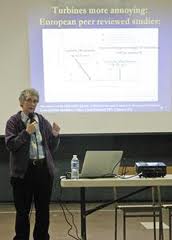 Ms. Krogh then appears at the Human Rights Conference in Falmouth on Saturday November 10, 2012.
Carmen Krogh is a retired pharmacist, who has worked with Health Canada, consulted on national and international threats to public health, and has recently published peer-reviewed studies on noise from industrial wind turbines.
The citizens group Wise Choices for Lee has been investigating a proposed wind turbine development in their community and is co-sponsoring the Lee program with Wind Wise ~ Massachusetts and Green Berkshires.
The Falmouth Conference on Human Rights is organized by David Moriarty of Falmouth and Marsh Rosenthal of Savoy. The forum runs from 1 :00 to 4:00 pm at the Falmouth Public Library at 300 Main Street. The free program is open to the public and refreshments will be offered.
For further information, to donate or help out, contact David Moriarty (waveydavei@aol.com or 774-521-8474) or Marsh Rosenthal (marshsue@verizon.net or 413-743-5256).
Wise Choices for Lee can be contacted at 83 Center Street, Lee, MA 01238.
Falmouth Turbine Complaints Continue
Barry Funfar wants an answer from the Falmouth Board of Health: why is the turbine “Wind 1” in operation long after its shut-off time of 7:00 pm? He deserves an answer. He is frustrated that he doesn’t even get an acknowledgement of his complaints.
The time is 9:40 PM on Friday, Nov. 2, 2012. Falmouth Industrial Wind turbine I is still in operation long after its 7:00 PM scheduled shut off time. My wife and I were watching the “Hurricane Relief Fund Raiser” on television and I was certain I could sense that telltale wind turbine affect in my chest that I call my anxiety center. A bit later going outside I could immediately hear the familiar stationary though fluctuating jet engine sound that the turbines so often make. Not believing it could be going, I went upstairs where we have a very clear view of the turbines. At 9:40 PM Wind One remained in operation with the loud characteristic noise that affects me severely. Only by popping a fist of prescription [medications] have I been able to hopefully head off another panic attack.
Now measuring, my pulse is already 142 with a blood pressure of 160/97 and rising. I am on medications for high blood pressure and palpitations with normal readings for me of a pulse in the 50s and blood pressure of 120/70.
The Falmouth wind turbines are KILLING me. I doubt if any one of you on The Committee has a realization of how intense the detrimental health effects caused by the turbines can be. I almost hope to die so my wife can bring the biggest lawsuit ever against the Town and anyone who had anything to do with constructing these horrific machines. They were sited improperly and by now I think everyone should realize this fact. Many studies on noise and proper setbacks had been accomplished by 2004 when the “Feasibility Study” for Falmouth was done. here were noise studies done by NASA in the 1970s that indicated a large setback was necessary.
Too bad no Falmouth Officials bothered to research the information that was out there rather than relying on The Massachusetts Technology Collaborative (now the CEC/Clean Energy Center) and the firms they hired and paid to do the early studies. No wonder the Town ignored the Special Permitting Processes. It is also no wonder that many of us victims have no faith or trust in the Falmouth Selectmen for their handling to date of this urgent problem. It would cost less to remove these machines than the cost overruns on the renovated high school.
[Why was] this turbine allowed to be in use at this hour? I make every effort to be away from my home when the turbines are operating—between your stated hours of 7 AM to 7 PM. I believe no one got back to me the last time I had a complaint with multiple runnings of the turbines well past their designated shut-off time.
Nantucket’s Town Meeting Votes Down Latest Turbine
Nantucket’s special town meeting of October 22, 2012 dispatched the latest wind proposal–a 100 kw turbine in Madaket–by an overwhelming voice vote. 
Barbara Gookin’s citizen petition to appropriate $620,000 for a 100 kilowatt wind turbine at the Madaket landfill was overwhelmingly defeated.
7:05 p.m. The Madaket wind turbine citizen petition, Article 5, was overwhelmingly defeated on a voice vote. A hand count was called for, but the sea of hands in the air to vote “no” led moderator Sarah Alger to declare the two-thirds majority against the proposal.
Jason Graziadei, reporting for the Nantucket Inquirer and Mirror, describes an especially large turnout of 632 people (7.5 percent of Nantucket’s total of 8,389 registered voters). Photo credit: Jim Powers.
Common Sense Nantucket (CSN) reports that member Karen Palmer addressed the meeting to explain how unsound the financial picture was for that turbine.
CSN hopes that the Town of Nantucket can now finally come together and work on energy efficiency and energy conservation to reduce our overall need and delay or eliminate the need for a third submarine electric cable from the mainland. The only way we can avoid a third cable is through these measures, not by spending huge amounts of money on inefficient wind turbines.
To view the educational materials Common Sense Nantucket created, click the links below:
Plymouth Moratorium Article Sends a Message
Plymouth’s October 20, 2012 town meeting considered an article to impose a 2-year moratorium on industrial wind development in residential areas. It failed to pass by only 3 votes, with the 68 “yes” votes narrowly missing the two-thirds majority needed (there were 39 voting “no”).
One of the visuals used to make the argument against giant industrial-size turbines demonstrates the strobing late afternoon light afflicting a street 900 feet from the “Independence” turbine in Kingston. The video is available from this link.

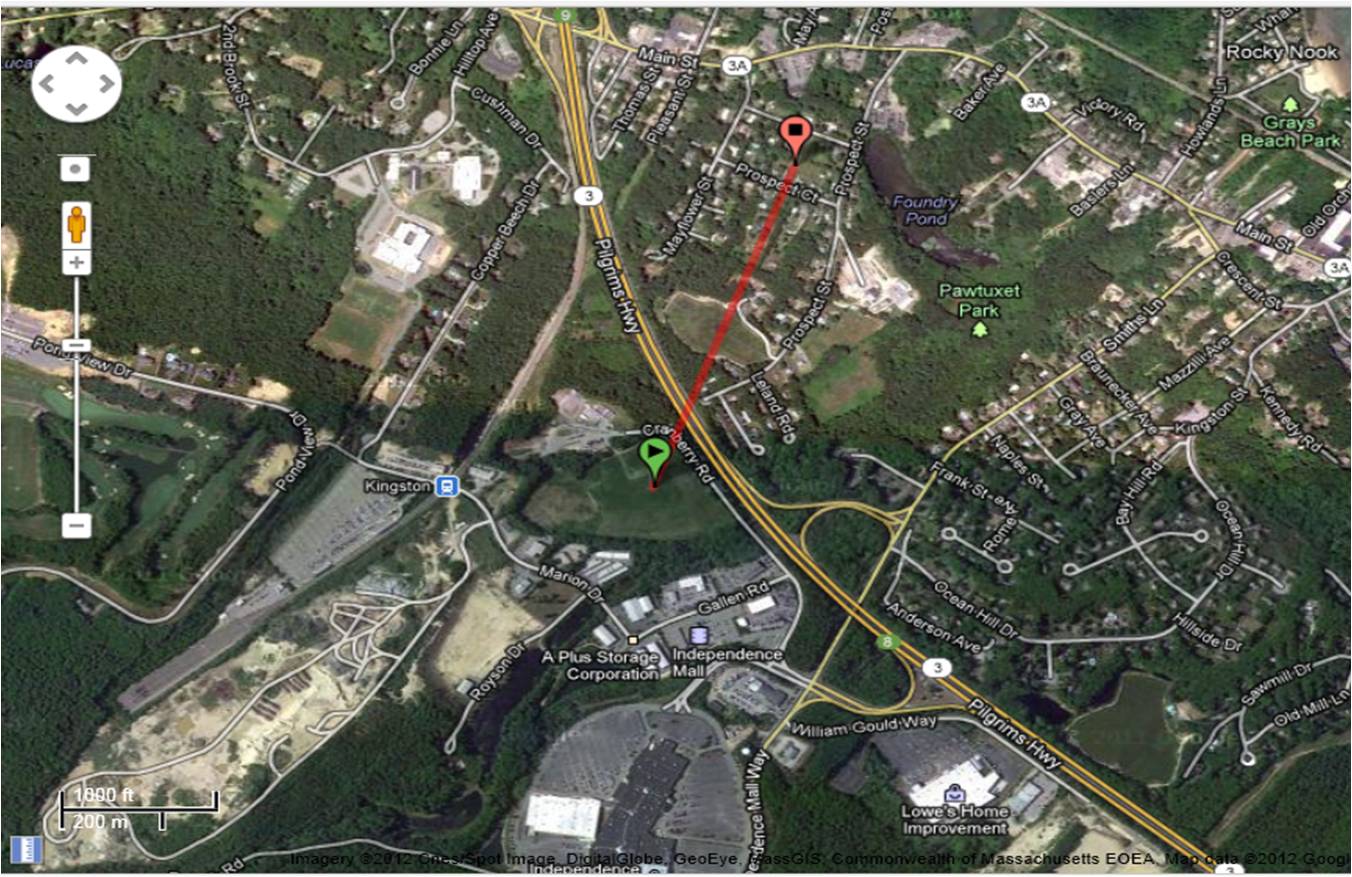 Kerry Kearney shot the video and used it in his presentation to town meeting members.
(The map on the right indicates the location of Leland Street in Kingston.)
An article on the town meeting appeared in Wicked Local Plymouth.
Ambrose and Rand Address Turbine Noise
Acousticians Stephen Ambrose and Robert Rand have become experts on industrial wind turbine noise. This fall they produced a report* for residents of Florida, MA living near the Hoosac Wind project, currently under construction. They reviewed the 2003 permit for the project and evaluated the related noise study, concluding that the project is likely to be out of compliance with MADEP guidelines. When the Hoosac turbines begin operating, they will probably lead to noise complaints similar to the ones raised in Falmouth, Fairhaven, Kingston, and now Scituate.
*”Advisory Comments on Noise – Hoosac Wind Project, Florida and Monroe, Massachusetts.”
Rand and Ambrose illustrated the turbine soundscape captured in testing Wind I in Falmouth in March 2012. In an unpublished letter to the editor, “Wind turbine noise being studied to death?” Ambrose and Rand included the chart as part of their response to an article appearing in South Coast Today in September.

The letter was never published because the editor declined to include the chart. National Wind Watch has since published the letter as it was intended.
In it, Rand and Ambrose express the frustration that
Neighbors are very concerned about the DEP and DPH studying IWT noise to death. They already have all the evidence they need. Now the Massachusetts DEP and DPH need to act to protect the public health, or just declare: IWT neighbors live in Public Health Sacrifice Zones.
(About Ambrose and Rand:
Stephen Ambrose and Robert Rand are members of the Institute of Noise Control Engineering and each have over 30 years’ experience. In 2009, they became concerned about the very vocal negative reactions by neighbors living near industrial wind turbine sites. They have visited and evaluated noise levels at Mars Hill, Vinalhaven, Freedom, Maine and Falmouth, Massachusetts. Their professional experiences and measurements have confirmed that neighbors are justified in their complaints. Citizen complaints are currently thwarted by regulatory agencies’ failure to protect neighbors from excessive noise and adverse public health impacts).
Fairhaven Bylaw Review to Limit Turbine Size
Fairhaven’s new bylaw proposal makes a start in the direction of reducing the threat of future wind turbines (Bylaw rewrite could halve turbine height, wattage in Fairhaven). It would limit total height to 265 feet and limit output to 600 kilowatts. But it falls short in having safe setbacks, an indicator that available data was not incorporated into the draft.
Windwise member Louise Barteau said she is encouraged by the town taking a second look at its existing bylaws but questioned the process involved.
“OK, so we cut the height and the wattage, but has anyone researched whether that is enough to stop the health problems in our town?” she said. “We can’t just be choosing arbitrary numbers. We need to ask ourselves are we making an assumption about turbines or are we actually making decisions about facts and data.”
Falmouth Conference on Human Rights
 There is no shortage of personal hardship when residents endure wind turbine development. Encounters from Australia to Canada to Cape Cod and Southeast Massachusetts will be explored at the Falmouth Conference on Human Rights on November 10, 2012. Science, medicine and engineering will all be called upon to explain the impacts of living too close to industrial wind turbines.
An international line-up of speakers includes Carmen Krogh of Ontario, Canada, and Dr. Sarah Laurie of the Waubra Foundation in Australia. Speakers from the U.S. include Dr. Nina Pierpont, John Droz and Curt Devlin. Local speakers Lilli Green and Preston Ribnik, from Wellfleet, will also talk about the human toll they captured in their documentary as they interviewed victims of industrial-scale wind.
Community panelists from turbine-impacted towns in Massachusetts will describe declining health in affected families and economic fallout–to homeowners and local governments–from wind development.
Organizers David Moriarty of Falmouth and Marsh Rosenthal of Savoy promise an unvarnished picture of this human rights concern. Moriarty said, the community panelists “are encouraged to tell the conference and the media about the extraordinary measures that they have had to take to engage attorneys and to communicate their plight to the larger public.”
The forum runs from 1 :00 to 4:00 pm at the Falmouth Public Library at 300 Main Street. The free program is open to the public and refreshments will be offered.
For further information, to donate or help out, contact David Moriarty (waveydavei@aol.com or 774-521-8474) or Marsh Rosenthal (marshsue@verizon.net or 413-743-5256).
Florida Concerns Over Hoosac Wind
Michael Fairneny and several of his neighbors brought noise concerns to a recent meeting of the selectmen in Florida, MA. In his North Adams Transcript article, “New wind turbines pose noise concerns in Florida,” Phil Demers reported Fairneny’s issue:
“All we’re asking is that an independent sound study be done,” Fairneny said.
While Iberdrola representative Neil Habig said the noise created by a wind development has to be evaluated after it becomes operational,
At the meeting’s close, Habig encouraged residents who, once the project is active, still have complaints to register them with Massachusetts Department of Environmental Protection (DEP). DEP would then be obliged to investigate and could require Iberdrola to fund a detailed study.
For a recording of the Florida meeting, go to the Hoosac Wind–Friends of Florida and Monroe website.
Wind Value Does Not Meet Expectations–Investigative Report
Reporting for Fox’s Channel 25 in Boston, Mike Beaudet tells viewers the turbines have been throwing “Money to the Wind” through delays in start-up and mechanical failures. They have been propped up by ratepayer surcharges. Not such a good investment, according to Brian Allen, General Manager of Princeton Municipal Light:
I would take whatever projections you have–and this is me, personally–and just cut them in half.
Ratepayers in Princeton are paying “one of the highest rates in the state” because of the two turbines, one of which had a catastrophic gearbox failure. The turbines are producing less electricity than anticipated, the price the market will pay has dropped, and the $7 million loan taken out to build the project is still in force. PML paid an additional $600,000o replace the gearbox.
Other problem turbines discussed are Forbes Park (a private development in Chelsea that has stalled), the MWRA turbine in Charlestown which needed a foundation rebuild, and the two turbines at the Department of Corrections’ prison in Gardner which have been off-line until grid improvements are completed.

 Wind Wise ~ Massachusetts