Scituate turbine impacts brought to Board of Health

Dave Dardi makes a point as Joanne Levesque looks on during the BOH meeting. Photo credit: Gary Higgins
In his Patriot Ledger article Neighbors blame windmill on Driftway for headaches, dizziness, Patrick Ronan reported the dilemma for Scituate posed by the Scituate Wind turbine, which has already caused headaches for residents. During the Board of Health meeting (11/14/12), a video clip of the strobing light that assaults the McKeever home on sunny days looped in the background.
Jessica Bartlett’s piece in Boston.com, Scituate turbine to remain on as Board of Health discusses next steps, also described the meeting, where two members would not support Francis Lynch’s motion to stop the turbines at night.
“It was pretty clear that the Board of Health, in not even providing a second to Mr. Lynch’s motion to at least shut it down in the evening, that there will not be any action in terms of a shutdown permanently or temporarily,” Tom Thompson, a Scituate resident and spokesman for the affected neighbors, said after the meeting. “As a community we will be considering how we want to respond to that.”
Instead the BOH voted to create a committee composed of BOH, resident, and Scituate Wind representatives to establish parameters for a new study of the turbines. Meanwhile, residents continue to suffer.
According to Driftway residents Mike and Lauren McKeever, the shadow flicker they experience three hours a day in their home, which is less than 1,000 feet from the turbine, is unbearable.
“You have no idea how difficult it is. We can’t go in any one of our rooms, we have to go in the basement or get out of the house. I’m so furious and so irritated by this. What am I supposed to do? What do you do? I have to leave my house from 1:30-3:30 every day it’s sunny out. That’s wrong… I’m a prisoner,” Mark McKeever said.
Opinions Offered and Needed
DR. RAYMOND S. HARTMAN has an opinion in South Coast Today‘s “Your View” on “Real science behind concerns over wind turbines.”
- Hartman finds Sumul Shah wrong on his assertion that the new study by Michael Nissenbaum (and others) is a first. Hartman lists 5 earlier peer-reviewed studies.
- He finds Brian Bowcock, chairman of the Fairhaven Board of Selectmen, ignorant in his suspicion that a 4500-foot distance from a turbine seems an excessive distance to experience turbine effects. Hartman lists 6 findings where setbacks should be greater, even up to 6 miles.
Thank goodness there are people with expertise out there to set the record straight.

The Globe’s Business Section promotional piece masquerading as news–showing Iberdrola’s Hoosac project turbines, and touting First Wind’s projects in New England–could use some correction.
Fire those opinions away. Take your pick:
- Not clean energy–the noise emissions you can’t see can still hurt you
- Not green–requires coal, nuclear backup and natural gas to smooth erratic production
- Not employing–you have to be on the construction crew from Maine who bulldozes and cements projects all over New England
- Not perpetual–gear boxes are already failing on installed machines; in California, they just abandon the rusting hulks where they sit
- Not raising revenue–promises far outstrip reality in First Wind’s Mars Hill, ME and Cohocton, NY projects

WBSM Radio Interviews Fairhaven Residents
 Listen to WBSM ‘s “More than Just Talk” radio show of November 14, 2012. Phil Paleologos discusses with Fairhaven residents Louise Barteau and Karen Isherwood their experiences with wind turbine noise.
Isherwood describes her struggle to bring the family’s sleep deprivation to the attention of town boards and Barteau talks about going out at night to observe the DEP’s noise testing in Fairhaven.
More on the turbines can be found at Windwise Fairhaven.
Ol’ Whistler is the New Turbine in Plymouth

Ol’ Whistler is the 1.5 MW turbine at Camelot Industrial Park in Plymouth. The 370-foot turbine owned by Balboni Energy was manufactured by Goldwind, the 2nd largest wind turbine manufacturer in China. The tower was built by Mass Tank.
The project got $240,000 from the MassCEC from the RET Fund (our utility bill taxes) and $585,000 in stimulus funding (ARRA) (our federal taxes). The project is described in a press release by Mass Tank and a story in the magazine Results published by the Federal Home Loan Bank of Boston about the three banks that financed the project.
Falmouth Town Meeting Talks Turbine Again
There will be a brief report from the Wind Turbines Options Process at the beginning of Town Meeting. Articles 3, 35, 41 and 42 are all turbine-related, on a warrant of 57 articles. Article 42 is succinct: Shut down Wind I and Wind II–it is also, unfortunately, non-binding. Article 3 is the new wind turbine zoning article. While the noise and complaint section is lacking, Falmouth turbine opponents recommend supporting this article. They recommend opposing Article 35, which adopts the State’s model turbine bylaw. Article 41 would support the Selectmen and WTOP.
Mark Cool knows what he’s talking about when he says, “Stop Feeding the ‘White Elephants.'” He’s lived with, been sleep-deprived by, and opposed continued operation of Falmouth’s two town-owned turbines.
Falmouth could validate its wind turbine moratorium by passing a zoning article at Tuesday’s town meeting, but passing it would conflict with relocating the two turbines to a less harmful location. This is according to Sean Teehan’s article in the Cape Cod Times.
Zoning requirements under the new bylaw would prevent Falmouth from moving two 1.65-megawatt town-owned turbines — “Wind 1” and “Wind 2” — at the wastewater treatment plant on Blacksmith Shop Road to a spot about two miles away from Camp Edwards on the Massachusetts Military Reservation.
Take-aways from Falmouth Conference on Human Rights
New Experts
People who report their responses, the health impacts they experience from industrial wind turbines, are the “new experts” (from Carmen Krogh’s description of work in Ontario, Canada). Krogh pointed out how many authoritative institutions–courts, national boards, and even the wind industry–acknowledge that turbines can disrupt sleep and contribute to stress.
When individual patients give their physicians information about health effects of wind turbines, the wind-afflicted are educating the medical doctors. This is happening in Australia (according to Dr. Sarah Laurie of the Waubra Foundation) and in Ontario.
“Receptors” are people
The recipients of turbine noise are not sound meters, but people. When modeling is reported or regulations are written, the term “receptor” means “person.” Noise is unwanted sound and it produces annoyance–referred to in Europe as disturbance. Annoyance is acknowledged to be an adverse health effect (Rob Rand and Carmen Krogh).
People can hear low frequency noise from turbines. Buildings resonate with low frequency vibration, amplifying the effect, often forcing people out or causing them to adopt other protective strategies (Rand).
A 38% property value reduction has been documented where turbines are sited (Krogh, McCann).
IWTs violate Human Rights
Health is a human right, recognized by the Universal Declaration of Human Rights and the World Health Organization constitution (and periodically reaffirmed by government departments in various countries). Health means “feeling vibrant, not just getting along,” as Robert Rand put it.
Freedom from unwarranted experimentation is also a right. Informed consent has not been asked or granted by lease-holders, abutters, or other residents, but in spite of this, the wind experimenters are putting people at risk. This mirrors the Tuskegee syphilis study where community members were not adequately informed of the risks (including death) that they faced. (Devlin).
Time to pause
There are so many unknowns about the effects of IWTs that, as Carmen Krogh suggested, it’s time for a pause in turbine siting. We know that distance is the only mitigator for noise and health impacts, but we don’t know what exactly is a safe distance. Depending on topography, it could be several miles. It’s time for governments and scientists to do that research before more harm is done.
———–
People who presented at the conference were: Carmen Krogh, Dr. Sarah Laurie, Rob Rand, Michael McCann, Curt Devlin, Barry Funfar, and Neil Andersen.
Organizers were Dave Moriarty, Marsh Rosenthal, with the help of many supporters.
Wind Wise Radio hosts Laura Israel, Judi Hall, Hall Graham
 Laura Israel joins Harley Keisch and Lisa Linowes to talk about the award-winning film “Windfall” and its reception in the European Union.
Also, Judi Hall and Hal Graham of Cohocton Wind Watch will be talk about their experiences and the problems with Clippers–the turbines deployed by First Wind in their rural farm community in western New York. Follow CWW on Facebook.
Lisa and Harley will also discuss the federal Production Tax Credit outlook now that election results are known.
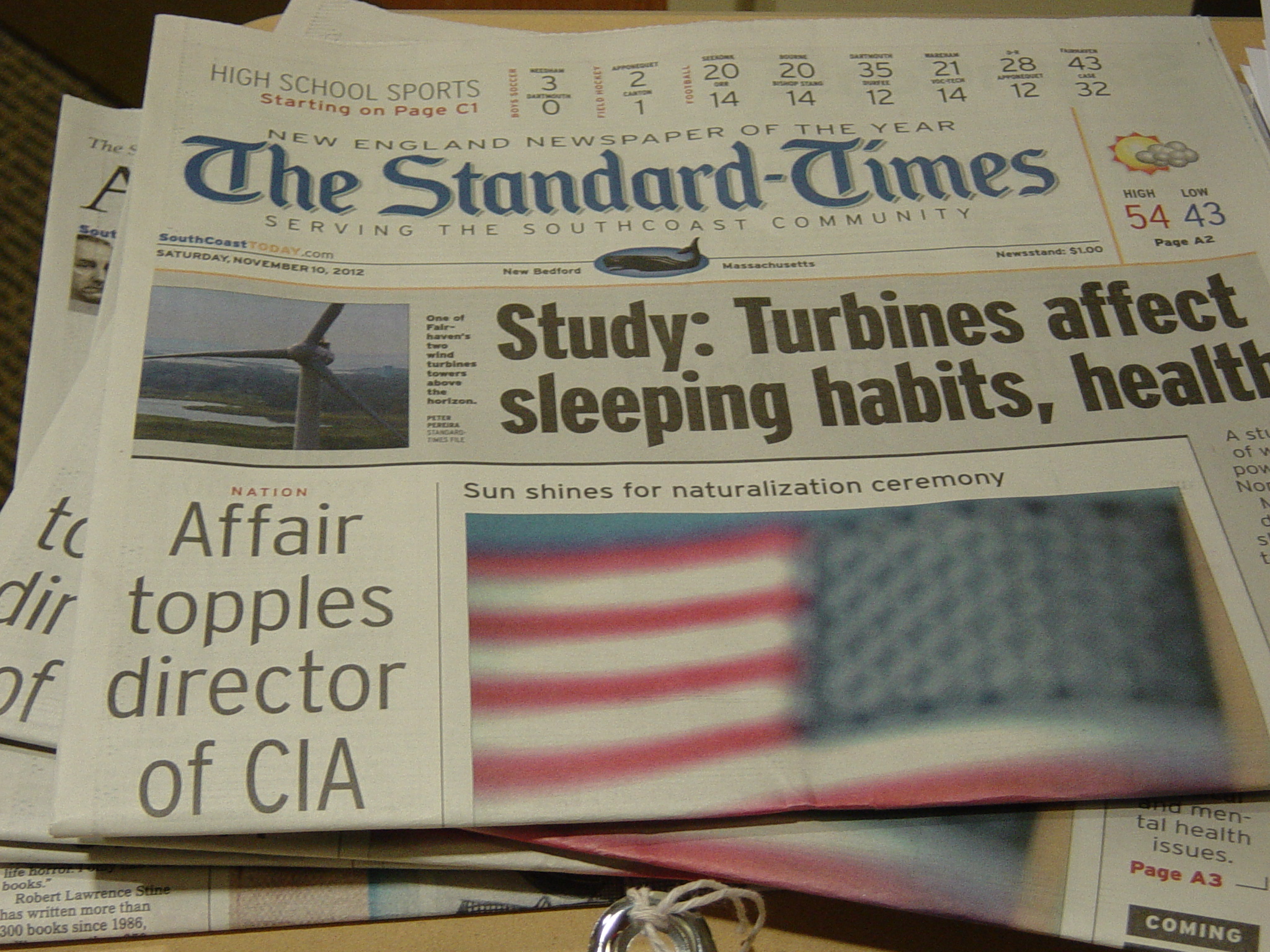 Ariel Wittenberg has scooped the U.S. press in reporting new research just published in the journal Noise & Health. The Standard Times of New Bedford headlined the study on the front page of the Saturday issue (11/10/12).
WWMA wondered just when the U.S. media would notice Effects of industrial wind turbine noise on sleep and health” by Nissenbaum, Armani, and Hanning. This is the latest study to describe the adverse health effects caused by industrial wind turbines cause the same symptoms wherever they are erected. This study provides a dose-response analysis, connecting the closeness of turbines to the impact on residents.
Falmouth Conference on Human Rights
International definitions for health and well-being–likely to be addressed in Falmouth on Saturday–featured in Carmen Krogh’s presentation for Wise Choices for Lee held at Cranwell in Lenox on November 8, 2012.
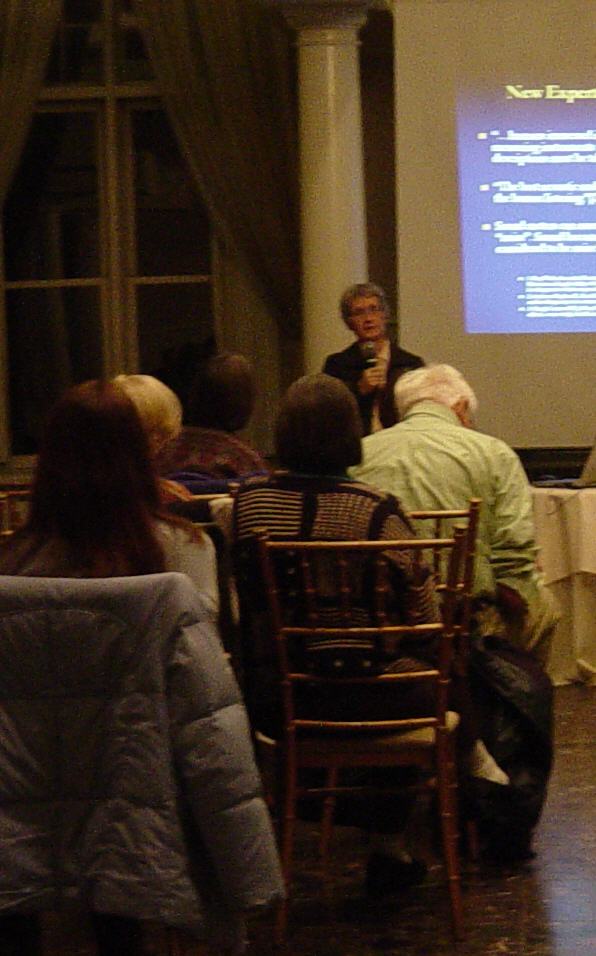 Canadian health expert Krogh will be part of an international panel of speakers for the Falmouth Conference on Human Rights on November 10th, including (by web conferencing) Dr. Sarah Laurie of the Waubra Foundation in Australia and American physician Dr. Nina Pierpont.
Join the organizations who participate in Wind Wise ~ Massachusetts at the Falmouth Public Library, 300 Main Street. The free program runs from 1:00 to 4:00 pm and refreshments will be offered.
“Our peace has been stolen”–Testimony to Kingston Board of Health
The Boston Globe has published Christine Legere’s report of Monday night’s Board of Health meeting, where Leland Road resident Doreen Reilly read her letter into the record. She was reporting on her experience and that of her neighbors when she said their lives “’have been turned upside down” since the Independence’s start-up in May.'”
“This has caused more anxiety than I have ever experienced,” Reilly said. “Our peace has been stolen from us. . . . We want our lives back.”
In contrast to the letter presented by wind developer Kially Ruiz, which discounted health complaints about the turbine, Board of Health member Daniel Sapir could offer his personal experience:
“I went to the Reillys’ home at midnight, and I heard the whoosh,” he said. “You may say it’s not physically possible, but it’s happening. It’s real.”
Sapir said he experienced the flicker effect while watching a Patriots’ game at a friend’s house. “It was so annoying I couldn’t enjoy the game,” he said. “The poor dog was cowering in the bathroom.”
The Board of Health is on the spot with residents like physician Piotr Lazowski, a resident who has complained about noise and flicker by lodging a formal complaint, asking: “’My question isn’t to Mr. Ruiz; my question is to our Board of Health,” Lazowski said. “What are you going to do?’” According to Sapir, the BOH is contemplating a variety of options.

 Wind Wise ~ Massachusetts