Falmouth Begins Deciding
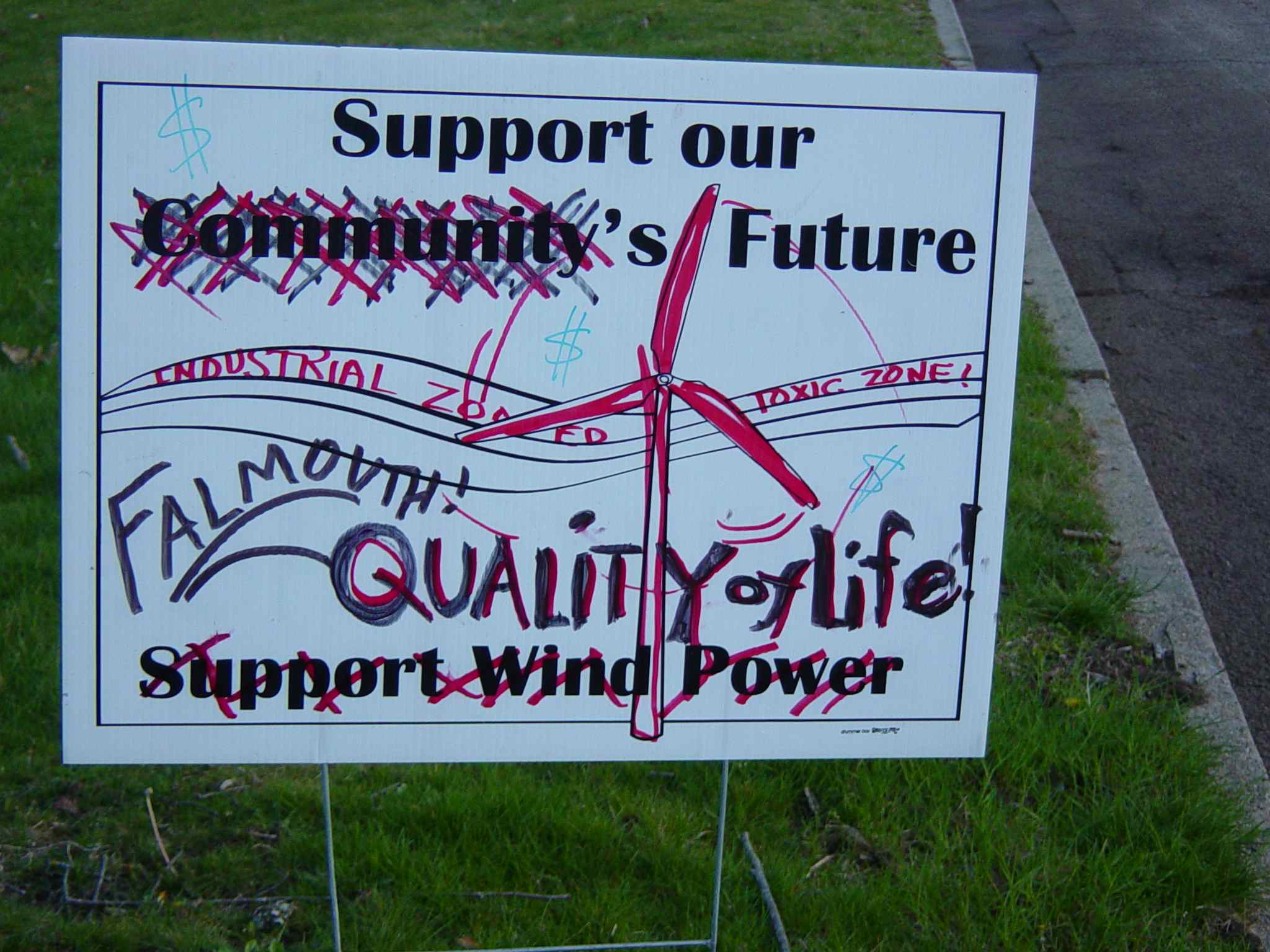
Photo credit: Virginia Irvine
At the selectmen’s hearing tonight, the town moves away from the past year’s study mode and into deciding what to do about its turbine problem. As the Wind Turbine Options Process revealed, there are no ideal answers.
If the turbines continue to operate, even at night-time and high wind curtailment, families experiencing health effects will be forced to leave. And they will be leaving not just dream homes, but also their businesses and community. They may never recoup the losses to their physical well-being or to their financial health.
The town, meanwhile, has the dilemma of lost revenue with curtailment, and other costs if the turbines are dismantled. There is a clear win for the wind neighbors if the solar option is pursued. But any solution is daunting.
Nothing will be decided today, but many decisions will be set in motion from this point forward.
Eagle Nest Removal in Ontario Stirs Vandalism
The Canadian press is reporting that a fire and graffiti vandalism to wind turbine components in the Summerhaven Wind project was prompted by the removal of a bald eagle nest in early January.
The incident happened sometime between Friday night and Saturday morning at a location on Walpole Concession Road 7. Someone painted graffiti on parts of the giant turbine while setting other parts on fire.
The turbine components belong to NextEra Energy Canada, sponsor of the Summerhaven wind turbine project.

Teri Pecoskie, reporting for the TheSpec.com wrote
Neil Switzer, chair of the West Lincoln and Glanbrook Wind Action Group, said about two dozen protesters came from as far away as Stayner, Ont., near the coast of Lake Huron, to try to stop the nest’s destruction.
A subsequent protest by Indian People in Haldimand County, ON occurred on January 17th, disrupting work.
A surprise native protest in southwest Haldimand Thursday disrupted work at two wind turbine projects near the Nanticoke Industrial Park.
Photo credit: @TwoRowSociety
As many as 30 natives in a convoy – some wearing traditional garb and waving native flags – interrupted work at several turbine and substation construction sites. At least one work crew gathered up its equipment and left for the day after they arrived.

In “Natives protesting at wind turbine sites” for the Simcoe Reformer, Monte Sonnenberg continues:
Some predicted that aboriginals from Six Nations would react badly to the nest’s destruction, which occurred Jan. 5. A young pair built the nest in November in an area slated for three turbines. Aboriginals in southern Ontario consider eagles sacred.
Aboriginals weren’t the only ones upset by the incident. Nancy Nicklan, owner of Floyd’s Bar & Grill in Nanticoke and a witness to two of the protests Thursday, says everyone in south Haldimand is “furious” about it.
“That was it,” Nicklan said. “Everyone has been losing their minds since.”
For more on the native protest, visit The Big Green Lie website where many more photos are posted. There is also a log of tweets describing the progress from one site to another through the day.
Falmouth: SPEAK OUT, STAND UP, BE HEARD!
The Falmouth Committee on Human Rights invites you to attend a public demonstration in support of wind turbine victims everywhere.
LIFE UNDER THE BLADES IS NO LIFE AT ALL
Families in Falmouth can’t endure any more torture. They need your help now.
On Wednesday, January 23, 2013 there will be public protest throughout the town of Falmouth. The demonstrations start at 2:00 pm in advance of the 6:30 pm Selectmen’s meeting.
Meet in front of the town hall at the Village Green parking area, Falmouth, MA. Contact Dave Moriarty, 774-521-8474 waveydavei@aol.com for more details.
The Board of Selectmen will be taking public comments on the newly released $388,000 report.
Unless the conversion to a solar installation is adopted from among the recommendations of the Wind Turbine Options Group, Falmouth will be complicit with the state of Massachusetts in continuing its unethical experiment on adversely affected wind turbine victims.
Turbine victims fear the report will be used to quiet citizen revolt against the failed energy policy of siting wind turbines near homes. If the town votes to continue operations, the result will be to extract residents from their homes.
Taxpayers and electricity customers of Massachusetts, who don’t want to see their hard-earned dollars used against their friends and neighbors, can make their comments known.
Towns Move to Prevent Noise Problems with Wind Turbines
Will towns be able to make regulations for wind turbine noise more stringent than the state standard? The 10 decibel over ambient (background) noise regulation is the current standard applied by the Mass Department of Environmental Protection. It is their role to protect people from air pollution, including noise. (For more about qualities of turbine noise, click on this chart.)
But a regulation being considered by Bourne, Falmouth, Scituate and Kingston would lower that level to six decibels for wind turbines. A draft regulation being considered by three of those towns would also include regulations to account for the “whooshing” nature of turbine sound, as well as regulations for infrasound, or sound that is inaudible to humans.
Ariel Wittenberg, writing in South Coast Today, notes Fairhaven’s interest in adopting a stricter noise ordinance. In Fairhaven health board member hopes for stricter turbine regulations, Wittenberg quotes health board member Barbara Acksen’s comments.
Acksen said that [DEP] approach is inadequate, adding that “even if the turbines don’t violate state law, people are still being affected.”
“Many people in different communities have found that this 10 decibel level is not appropriate to account for turbine noise,” she said.
The draft regulation being considered by Falmouth, Scituate and Kingston was written by Westboro-based attorney Christopher Senie, who often represents community groups in zoning disputes.
Scituate had an earlier regulation which limited noise levels to 3 and 5 dB(A), but changed it to the state standard. This was upon the recommendation of two current MassCEC employees, Andrew Brydges and Peter McPhee, who at that time were working as consultants for KEMA (an international energy consulting firm, now part of DNV KEMA). The change was encouraged in order for the town to successfully site a wind turbine.
| KEMA – Town of Scituate Community Wind Project Feasibility Study | April 2008 Tech Environmental Acoustic Study of Scituate |
| “The noise level allowances during turbine operation are 3 dB above ambient noise when ambient noise is 45 dB or below, and 5 dB above ambient noise when ambient noise is 45 dB or above. These noise level requirements are, in KEMA’s opinion, relatively strict and may lead to significant hindrances in the development of a wind turbine if they are not modified or waived.” (p.62)
“Considering changes to the Town’s existing wind energy conversion system bylaw in the areas of noise, using the Massachusetts Model Wind Bylaw as a reference. Specifically, the Town should consider setting allowable noise increases to 10 dB above ambient noise levels as measured at the nearest property line, consistent with DEP noise regulations” (p. 58). |
“The town of Scituate has recently amended their By-Law, Section 740.6 Noise Level Standards. It is now identical to the MADEP regulations…”(p.5)
“Project sounds should not be audible indoors anywhere.”* (p.1) |
*TV Interview with resident who is located 3,500 feet away from the turbines: “You can still hear the noise inside your home with the windows closed,” Scituate residents say wind turbine is too loud.
“More than typical noise requires more distance,” writes Chris Kapsambelis in his letter to the editor published in Thursday’s Cape Cod Times.
The Jan. 14 story on the Falmouth wind turbines reported that a state-appointed panel found no evidence that noise and flicker from turbines directly harms abutters.
The panel report states (Page ES-5) that the typical wind turbine generates 103 decibels. However, the noise dissipates quickly with distance and, at 400 meters (1,300 feet), the noise should drop to a safe level of 40 decibels.
Some abutters live closer than 1,300 feet, and the state measurements indicate that the wind turbines are generating more than the typical 103 decibels of noise.
Falmouth Options Process Outcome Goes to Selectmen
The long-anticipated meeting when the Falmouth Wind Turbine Options Process (WTOP) group presents its recommendations to selectmen is now scheduled for Friday January 18, 2013.
Reporting in the Falmouth Enterprise (“Turbine Group Recalculating Financial Projections Of Proposed Options ” 1/15/13) Brent Runyon explained what the WTOP group will present.
The report will give selectmen three options for handling problems with the two town-owned wind turbines at the Falmouth Wastewater Treatment plant: run the turbines as much as possible and compensate homeowners in the area; curtail the operations of the wind turbines; or remove the turbines and possibly install photovoltaic solar panels to produce renewable energy for the town.
The presentation was delayed while the group reviewed the production calculations and their projected financial implications. Before that meeting one member, Judith Fenwick, signaled concern about action taken by the selectmen to freeze zoning around .existing turbines to avoid effects of a proposed turbine bylaw.
But if selectmen are only interested in protecting the investment in the wind turbines, Ms. Fenwick said, “it calls into question why have we been meeting all this time.”
The delay in meeting with selectmen could have resulted in “Time Running Out For Decision On Turbines If Town Meeting Vote Is Required” according to Christopher Kazarian, writing in the same issue of the Enterprise. The selectmen noted at their Monday meeting that the warrant for the Annual Town Meeting closes on Monday, January 28.
The board had a brief discussion on whether to allow public comments at that first session. [Selectman Douglas H.] Jones, who has served as the board’s liaison to the Wind Turbine Options Process group, said the intention was to not allow comments. “It is a conversation between the group and the board, as a group,” Mr. Jones said.
Selectmen agreed to a meeting on Thursday, January 24, at town hall to take comments from the public.
In another piece in the same issue, Runyon tallied up the price tag for the WTOP. According to “State Paid For Turbine Options Process,”
Falmouth Wind Turbine Options Process’s report to the Falmouth Board of Selectmen this week cost the Massachusetts Clean Energy Center $388,000 to produce.
The MassCEC may also be funding sound testing to be included in the final version of the report.
Three Studies Update IWT Health Effects
As turbine neighbors face courts and town boards with accounts of their experiences and worries, they have solid ground to stand on with three scholarly studies on wind turbine health effects appearing in 2012:
- 2012. Ambrose, S., Rand, R., and Krogh, C. “Wind turbine acoustic investigation: infrasound and low frequency noise – A case study.” Bulletin of Science, Technology & Society 32(2) 128-141. 2012. [abstract only available]
The DEP-DPH “expert panel” called the preliminary Ambrose and Rand McPherson 2011 study “gray literature.” Now the authors have a peer-reviewed study with Carmen Krogh added as a third author for her expertise in the health impacts. The earlier preliminary study is: Ambrose, S.E. & Rand R. W., (2011, December). The Bruce McPherson Infrasound and Low Frequency Noise Study: Adverse Health Effects Produced By Large Industrial Wind Turbines Confirmed.
The earlier preliminary study reviewed by the DEP/DPH panel was Nissenbaum, M., Aramini, J., & Hanning, C. (2011). Adverse health effects of industrial wind turbines: a preliminary report. Paper presented at the 10th International Congress on Noise as a Public Health Problem (ICBEN) London, UK.
Dr. Alec Salt’s work presented at the 2012 Internoise Conference is providing new research subsequent to earlier peer-reviewed work: Salt, A.N. & Kaltenbach, J.A., “Infrasound from wind turbines could affect humans,” Bulletin of Science Technology & Society, August 2011 vol. 31 no. 4 pages 296-302.
Peer review is an important and necessary process for the scientific community. The process verifies that research findings have been based on sound principles. As scientists continue to publish, they build on previous studies, so these should be retained while the newest research should be prominent.
While the science related to human impacts from wind turbines is just developing, the “new experts”–those who live, work, and study in proximity to wind turbines continue to be unwitting experimental subjects. Their testimony of what they hear, experience, and suffer informs us of unintended health impacts.
| UPDATE: Although the judge denied the McKeevers’ request to shut down Scituate turbine operations, their plight has been noted. Like many abutters who receive compensation for living with the nuisance of a wind turbine, the McKeever’s had no idea what they were getting themselves into. Usually gag clauses prevent wind neighbors from publicly disclosing the health effects. |

Photo Credit: Malcolm Donald
Sufferers in Scituate will have a longer wait while the judge hearing the suit in Plymouth Superior Court on January 14th ponders the arguments of the McKeever family who is suing the Scituate Board of Health. Other residents and interested people from Falmouth attended the hearing, according to Jessica Bartlett reporting for Boston.com (Fate of Scituate wind turbine uncertain, after hearing with judge).
Tom Thompson, who represents a group of Scituate residents who say they are also suffering from the turbine, also attended the hearing.
“Clearly the town, even members of the Board of Health, has been primarily focused on the economic impacts of the town. There hasn’t been enough concern regarding the health-related impacts of anybody,” Thompson said. “it’s been a dollars-and-cents discussion so far.”

Doreen Reilly represents neighbors at Kingston BOH hearing 1/14/13.
Photo Credit: Louise Grabowski
Later in the day in Kingston, during a 3-hour evening hearing before the Board of Health, “No shut down vote tonight” was the Tweet from Wind Wise ~ Massachusetts member Louise Grabowski. The Board plans to ask the developer to provide a response.
Three Hearings–2 in Court, 1 in Town
 Monday January 14 is set to be a 3-hearing day with a morning court hearing on Cape Cod, an afternoon court hearing in Brockton, and an evening Board of Health hearing in Kingston. The two later hearings scrutinize health effects of operating turbines, while the morning session is about a company who wishes to put one up.
Janet Wu reported for WCVB-TV Channel 5 “Wind turbine causing headaches, nausea, Scituate family says.” The hearing at 2:00 pm in Plymouth Superior Court in Brockton will consider Mark and Lauren McKeever’s request for a restraining order against the town of Scituate, whose turbine brings strobing light into their home and disrupts sleep.
“We can’t sleep, my children wake up in the middle of the night because of the noise and humming, and then they go to school where they can’t concentrate because they are sleep deprived,” said Mark McKeever.
Jessica Bartlett’s notice in the Boston Globe Metro “Court to hear request to shut down Scituate turbine” notes the McKeevers filed a motion Friday to ask for immediate shutdown of the turbine owned by Solaya Energy and Scituate Wind.
Both pieces appeared on 1/12/13.
Kingston’s hearing is before the Board of Health at 6:00 pm at the Kingston Town House in room 200. The public hearing relates to wind turbine complaints and possible enforcement action. Writing in Wicked Local Kingston, Kathryn Gallerani reported the on-again, off-again progress of residents’ efforts to be heard: UPDATE: Kingston Board of Health turbine hearing is back on (1/4/12).
The morning’s court hearing is an effort by the Aquaculture Research Corporation to overturn a ruling of the Regional Old King’s Highway historic commission in order to reinstate an approval by the Dennis OKH commission. The back-and-forth progress of ARC’s proposal now has the town siding with the corporation in bringing the suit. While the hearing begins at 9:00 am in Orleans on Monday Jan. 14th it is expected to continue all week.
The authority for the commission is the Old King’s Highway Regional Historic District Act, Chapter 470 of the Acts of 1973. The Act provides protection for visual character and setting so that all exterior changes to buildings, signs, and other construction are reviewed for congruity, compatibility, and appropriateness with the historic character of the District.
Frustration in Falmouth
In Firetower Wind’s recent post, Clouding the Wind Issue in Falmouth, mjoecool comments, “The catalyst for Falmouth’s wind turbine review process are serious concerns for resident’s basic health and living conditions.” Furthermore,
The Falmouth WT problem is not a noise problem. It’s a pronounced and significant Health problem that needs immediate attention from the local government body responsible for the HEALTH of the community.
Like others in Falmouth, Cool is impatient with a side-lining of the health issue in a concern over costs to the town. These red herrings lead to interest in sound testing (needing more evidence) and relocation (reducing harm to current wind neighbors). As he suggests, more evidence was needed at the start, at a time when “The noise models and wind experts in the Falmouth projects did their marketing well. They painted a rosy picture that we all bought.” Now the facts are there–ill health and lowered quality of life.
The [turbine options] report will soon be in front of Selectmen. Falmouth has done itself a disservice by making a health problem a political issue. The Falmouth Board of Health needs to wrestle the problem away from Selectmen and back into the arena it belongs — Health.
FALMOUTH — A Falmouth selectmen’s meeting came to a head Monday night when the board chairman asked police to escort a resident out of the room.
When the selectmen voted to ratify Town Manager Julian Suso’s reappointment of Frank Duffy as town counsel without public discussion, Malcolm Donald, 60, took issue.
“Alternatives to the single town counsel exist,” Donald said in a phone interview Tuesday. “I thought it would be appropriate for the public to weigh in on it.”
After the board took the vote, Donald approached the lectern, insisting the board allow him to speak.

 Wind Wise ~ Massachusetts