 [Update: With a special recount held on April 5th, the election results for the Board of Health seat remain in doubt although the election night winner, John Wethington, has since been sworn into office. Mark Curtis reports for ABC6 in Providence, RI: “Fairhaven Board of Health Election Still in Dispute.”]
Ariel Wittenberg reporting in South Coast Today “Fairhaven selectman, health board incumbents ousted,” wrote on April 1, 2013 “Election night in Fairhaven saw challengers in the boards of health and selectmen win over multi-term incumbents.”
Incumbent selectman Brian Bowcock lost to Geoffrey Haworth by 356 votes. The Board of Health race was much closer, with incumbent Peter DeTerra losing to newcomer John Wethington by just three votes. Soon after votes were tallied tonight, DeTerra vowed he would ask for a recount.
WBUR (90.9) Boston has been working on a story regarding the Falmouth wind turbines. It will air Tuesday, April 2nd during Morning Edition. Here’s the opening:
FALMOUTH WIND/Oakes: Falmouth could make history when it votes this month on whether to tear down both of its municipal turbines, after criticism from some neighbors who say the spinning blades are making them sick.
WATD Radio FM 95.9 on the south shore will interview Tom Thompson of Scituate at 8:30 a.m. the same morning regarding why the neighbors have engaged their own acoustical engineer to test along side of the Developers’ consultant.
Scituate Instructed on Turbine Impacts
 Reporting for 95.9 WATD radio, Charles Mathewson described Saturday’s informational session “Scituate: Wind turbine neighbors try to educate the community” (3/24/13). The program featured acoustician Rick James, sleep disorder specialist Dr. Jeffrey E. Silver, and a demonstration of the strobing light experienced in the McKeever home.
The community group had previously asked the town for a health survey, a shadow flicker study and a study of non-audible sound effects. The Scituate Board of Health has asked for bids from acoustical study companies to conduct an audible sound study only.
Rick James addressed audible sound and infrasound. Mathewson’s audio report quotes Mark McKeever’s emotional description of the upheaval in their home since turbine operations began. McKeever’s concern focuses on his children’s health.
 . It was hosted by the Neighbors of the Scituate Turbine. (They have several additional videos on their “fordiscussion” page). The video was produced by BlueStar Media.
Topics Included:
- The South Shore / Scituate Experience
- Acoustics 101: (Rick James, Principal Consultant at E-Coustic Solutions) Min 13.11
- Light Strobe: A Real Life Experience (Mark McKeever) Min: 48:42
- Health and safety: (Dr. Jeffrey Silver, MD. Beth Israel Deaconess Medical Center. Certified by American Board of Internal Medicine in the subspecialty of Sleep Medicine.) Min: 1.07:29
- Green Community Legislation: Leaving Communities Black and blue
- Reasons for and request for support of Town Meeting Warrant # 28 -rescind special permit granted to Scituate Wind. Min: 1.42:20
Background: Organizers hoped to draw residents from other areas of the Town who are not directly impacted by the noise and strobing light emanating from the industrial wind turbine. The event’s goal was to shed light on the real health and safety impacts being experienced by folks living too close to this inappropriately sited industrial wind turbine, and with accurate information in hand, encourage our friends and neighbors to understand, support and advocate on behalf of the negatively impacted residents.
Letter to DEP, DPH Cites New Research
The report commissioned by the Mass DEP and MDPH has never been finalized–despite hours of oral testimony and reams of written responses. Wind Wise ~ Massachusetts asked the DEP to revisit the original findings. The main text of that letter is reproduced here. It concludes:
In order to protect the health, safety and well being of the citizens in Massachusetts, it is critical that when a final report is issued it incorporates the conclusions of the three peer-reviewed reports, as reviewed by selecting experts in the authors’ fields of study. We believe it is also critically important that the report acknowledge a full scope of the testimony by people who live with and work in the proximity of wind turbines.
There is more about health and adverse impacts from wind turbines on WWMA’s health page.
Dear Commissioners:
We are writing to inform you of important new peer-reviewed research studies involving the
heath impacts of industrial wind turbines that have appeared since you held public hearings and a comment period for your Wind Turbine Health Impact Study. We believe these studies
contradict some of the Study’s findings and, we believe, it would be advisable to examine them before releasing a final report.
The new research is particularly important in light of the fact that the panel only reviewed
selected literature on the health impacts of the wind turbines and stated that there was a dearth of peer-reviewed literature on the subject. We believe that these new studies will significantly change your final recommendations.
New Research Findings
The peer-reviewed studies have added to the growing evidence that individuals living near
industrial wind turbines face significant health risks. The three studies:
The authors conclude that “noise emissions of IWTs [industrial wind turbines] disturbed the sleep and caused daytime sleepiness and impaired mental health in residents living within 1.4 km of the two IWT installations studied.”
2012. Ambrose, S., Rand, R., and Krogh, C. “Wind turbine acoustic investigation: infrasound and low frequency noise – A case study.” Bulletin of Science, Technology & Society 32(2) 128-141. 2012. [abstract only available]
Ambrose, et al. found infrasound and low frequency noise (ILFN) or “dynamically modulated low-frequency and infrasonic energy” was produced by a 1.65 MW industrial wind turbine. Also “there was a strong correlation with wind speed, power output and health symptoms.” “This acoustic study suggests that health effects reported by residents living near wind turbines may not be exclusively related to audible sounds.” But “inaudible amplitude modulated acoustic energy can be detected by the inner ear and can affect humans more at low ambient sound levels, consistent with complaints of worse conditions indoors than out near IWTs.”
The Salt and Lichtenhan paper concludes that “there are potential mechanisms by which low-frequency sounds could influence vestibular physiology which are being ignored by some.” Salt and Lichtenhan report that their “measurements showing that the ear generates large electrical responses to low-frequency stimulation suggest that the effects of low-frequency sound on people living near wind turbines should not be dismissed by those with little understanding of how low frequency sounds indeed affect the ear.”
Review new studies before issuing final report
The Nissenbaum (et al.) and Ambrose (et al.) studies were reviewed when they were in a preliminary or draft form and were inappropriately dismissed by the “expert panel.” The fact that they have since been peer-reviewed and published indicates that they should not be dismissed in making your decision.
Avoid civil litigation and criminal penalties
Our governmental bodies and even the wind energy industry should be protective of human
health. Failure to assess the effects of wind turbines on neighboring properties is the premise of a lawsuit brought by 60+ plaintiffs against Iberdrola, two consulting firms and a professional engineer at the Hardscrabble wind project in New York. The largest wind project in Massachusetts, Iberdrola’s Hoosac project was built this year. Will it result in similar litigation?
A recent lawsuit has received international attention in the scientific community. Members of an Italian earthquake risk commission – four scientists, two engineers, and a government official – have been sentenced to prison terms.
“Prosecutors didn’t charge commission members with failing to predict the earthquake (in L’Aquila Italy) but with conducting a hasty, superficial risk assessment and
presenting incomplete, falsely reassuring findings to the public.”[our emphasis added] (Science, Vol. 338, pp. 184-188, 451, 452).
A review of wind energy feasibility studies prepared in numerous communities around
Massachusetts where wind turbines have been sited finds many major discrepancies between
predicted (modeled) and actual noise and flicker effects.
To conclude, Massachusetts government officials and the “experts” responsible for the MA
Study have given the public a false sense of assurance that there are no health impacts from wind turbines. The studies certainly differ from that impression.
In addition, it is critical that the written submissions and personal testimonies of the life-altering experiences of those most affected by the wind turbines – the people living and working near the wind turbines – be incorporated into the final report in order to provide a more comprehensive picture of the impact of the turbines on the lives of individuals.
In order to protect the health, safety and well being of the citizens in Massachusetts, it is critical that when a final report is issued it incorporates the conclusions of the three peer-reviewed reports cited above, as reviewed by selecting experts in the authors’ fields of study. We believe it is also critically important that the report acknowledge a full scope of the testimony by people who live with and work in the proximity of wind turbines.
Kingston Strobing Stalls Daily Life
The video posted by Bradford Randall for the Kingston Journal captures the Leland Road experience by “Going Inside Kingston’s Shadow-Flicker Zone.” As the strobing light flashes around the room and across his face, Dan Alves responds to the reporter’s question: what would he say to someone who claims he is a NIMBY.
My wife was trying to make a cake on Saturday and she couldn’t finish it because of the flicker… You can’t concentrate, you can’t read a book, you can’t read the paper, you can’t relax. I couldn’t go out in my back yard right now and just do normal everyday activities. If they had it in their back yard, I don’t think they’d be happy. And not only that, I think they’d be looking for support–as we are–from other residents in town who really don’t realize what’s going on.
Even with the venetian blinds shut, the strobing is invasive, slicing into the bedroom of the 14-year-0ld resident of the house who has epilepsy. Alves reminds his son to leave the room during the hour-long episodes of pulsating turbine shadow. When the parents are not at home, a neighbor has been enlisted to watch out for the youth.
The Kingston Board of Health has scheduled a hearing for April 1, 2013, according to Charles Mathewson, reporting on 95.9 radio WATD-FM. In her reporting (“Kingston Board of Health requests state help” 3/15/13) Kathryn Gallerani captured the town’s disarray as residents questioned the Board of Health’s lack of action. Meanwhile the two other board members directed Chair Casna (also the Selectmen Chairman) to pursue action the board had voted at a previous meeting.
Property Value Studies – Summary
Michael McCann Literature Review
Summary: Wind Turbine – Property Value Impact Studies |
||||||
Independent Studies |
||||||
|
Author |
Type |
Year |
Location |
Method |
Distance |
Impact % |
| Lansink | Appraiser |
2012 |
Ontario |
Resale(1) | < 2 miles | (39%) Avg. 23%-59% |
| Sunak | Academic RWTH Aachen University |
2012 |
Rheine & Neuenkirchen |
Geographic Weighted Regression (2) | 2 Km | (25%) |
| Heintzelman Tuttle | Academic Clarkson University |
2011 |
Upstate NY |
Regression Resale & Census Block | 1/10 to 3 miles | Varies to > (45%) |
| McCann | Appraiser |
2009 -2012 |
Illinois, (3) MI, MA, WI |
Paired Sales & resale | < 2 miles | (25%) 20% – 40% |
| Gardner | Appraiser |
2009 |
Texas |
Paired Sales | 1.8 miles | (25%) |
| Kielisch | Appraiser |
2009 |
Wisconsin (4) |
Regression & Survey | Visible vs. not visible | (30-40%)(24-39%) |
| Luxemburger | Broker |
2007 |
Ontario |
Paired Sales | 3 NM | (15%) $48,000 |
| Lincoln Twp. | Committee(5) |
2000-2002 |
Wisconsin |
AV ratio 104% v. 76% | 1 mile | (24%) |
Wind Industry-Funded Studies |
||||||
| Canning & Simmons | Appraisers (CANWEA) |
2010 |
Ontario |
Regression Paired Sales | Viewshed(6) | (7%-13%) (9%) |
| Hinman | AcademicISU ‐ REP Student thesis |
2010 |
Illinois |
Pooled Regression Realtor survey | 3 miles1/2 mile | No SS (11.8%) (7) |
| Hoen | USDOE-funded LBNL |
2009 |
9 states |
Pooled regression | 5 miles 3k ft – 1 mile | Increases (5.6%) (8) |
Sources
About Michael S. McCann:
- 30 years appraisal & consulting
- Most types of commercial, industrial & residential property
- State Certified General Appraiser
- Certified Review Appraiser (CRA)
- Member – Lambda Alpha International
- Qualified & testified as expert witness in 21 states, circuit courts & federal court
- Appraised variety of property value damage situations
- Consultant to governmental bodies, developers, corporations, attorneys, investors and private owners
- Appointed by Federal Court as a Condemnation Commissioner
- Evaluated & consulted 20+ utility scale wind projects in over a dozen states
Media Finally Digging Deeper
 ABC6 investigative reporter Mark Curtis exposes “tainted” testing–which the DEP now says must be done over. A few hours earlier, on WBSM radio‘s Phil Paleologos show, Louise Barteau explained the process of noise testing in Fairhaven and the questions that have since been raised about its accuracy.
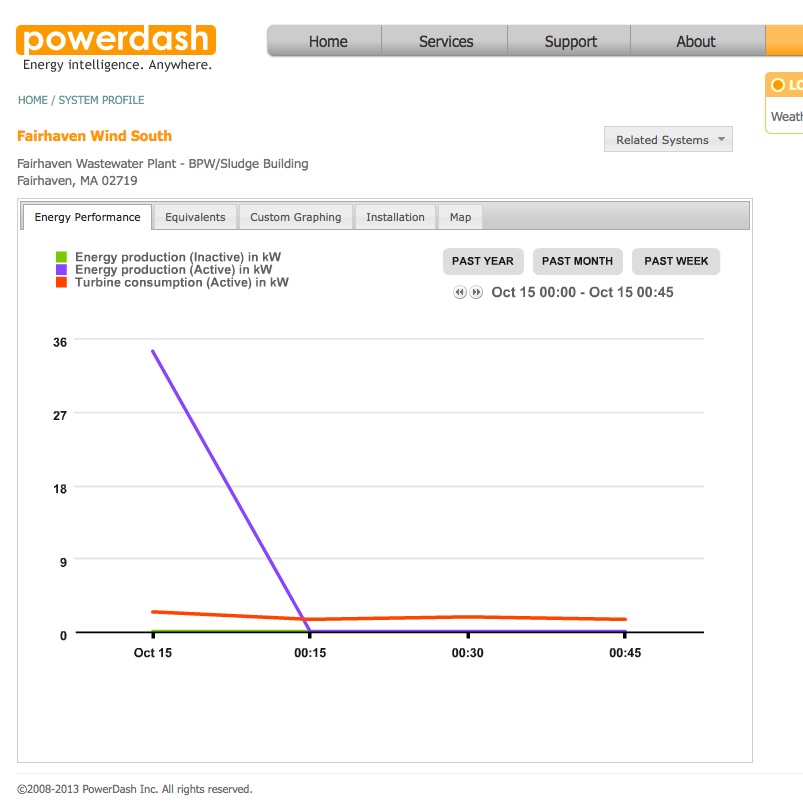
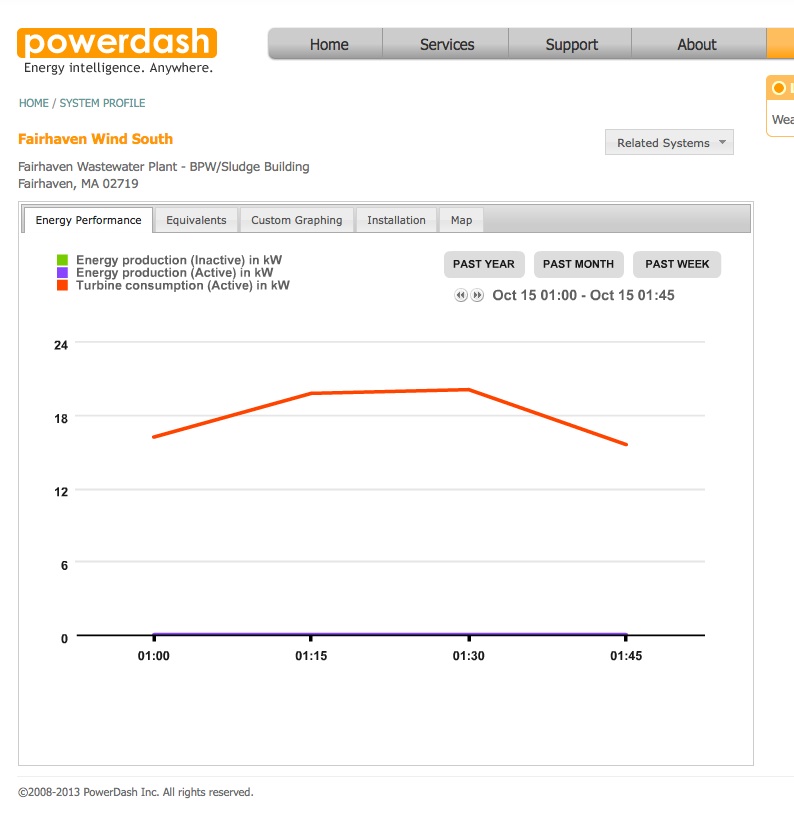
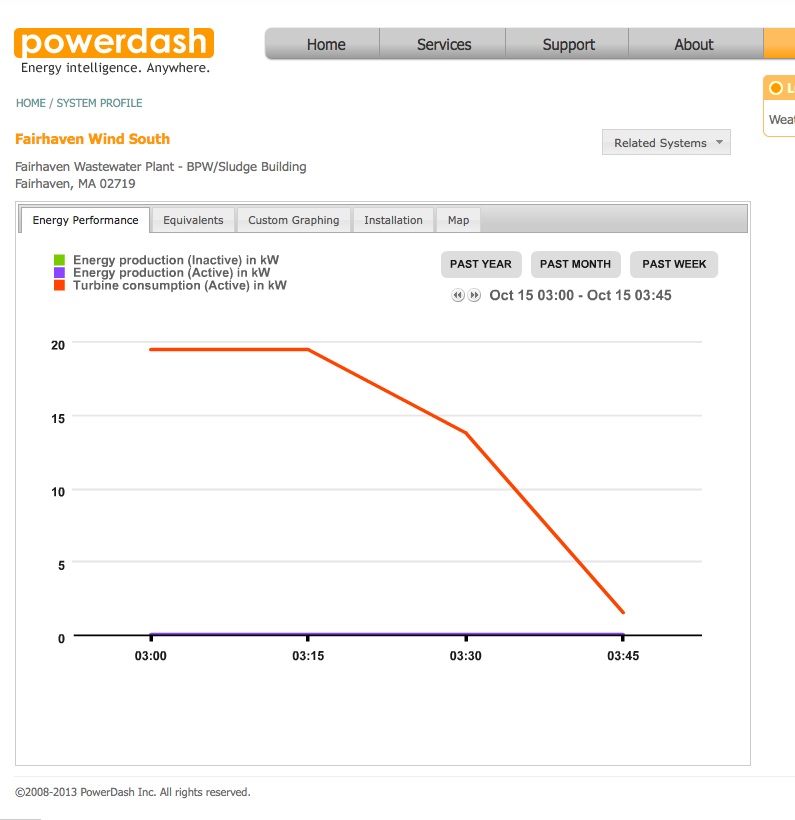
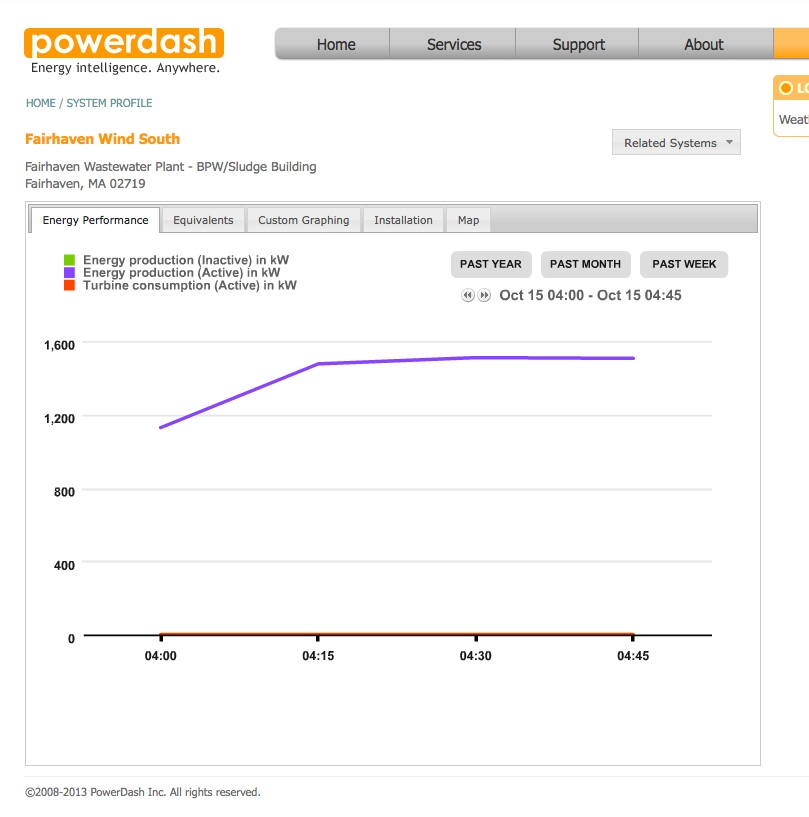
The testing was conducted by the DEP’s Laurel Carlson and Barteau observed. Only later did she uncover the power dashbooard that revealed a reduction in power output during the testing period. If the turbine is not producing power, the turning blades will not emit the same level of noise as it would during normal operations.
A letter from Fairhaven Wind’s Gordon Deane to Commissioner Ken Kimmell maintains that the turbine was not producing power because of human error.
The dashboard Barteau references in the video is found at the site www.powerdash.com.
|
Turbine powered down |
still uses AC from the grid to power control systems |
End of testing period–power usage goes down |
End of testing period–power is produced again |
Meanwhile the health concerns and noise complaints continue. Reporter Curtis captures quotes on camera:
Homeowner Peter Goben spoke of the wind turbines saying, “They are bothering me. I just keep waking up, waking up, waking up.”
Neighbor Chelsea Isherwood said, “If you could at least shut them down at night, so people could get some sleep around here that would be a blessing to me.”
Last week, Peggy Aulisio reporting for the Advocate (2/21/13) quoted resident Linda Kellish:
For one thing, she says, the town’s wind turbines have made it impossible to sleep.
Based on her experience, Ms. Kellish said communities should be very careful about where wind turbines are placed.
“I don’t think anyone realized it was going to be right here,” she said of the turbines that loom over her backyard. “You’ve got people all over saying they’re good,” of the turbines. “Well come over to my house and try to sleep.”
Health Concerns Dominate Wind Turbine Debate
Heath’s Due Diligence Trumps Editorial’s Assumption
Our work on wind
In “My Turn” in the Greenfield Recorder, two members of the Heath Renewable Energy Committee explain their report.
By Steve Ryack and Bill Lattrell
The committee in Heath charged with researching industrial scale wind, was profoundly disappointed with the editorial of The Recorder (Feb. 7) regarding the committee?s report. Our concern is not so much with its rejection of the report?s conclusion, to wit that industrial wind should not be allowed in the Town of Heath, but rather we were dismayed at the editorial?s lack of response to the data and the logic of the argument behind the conclusions reached. Indeed, we have to wonder whether the editorial writer even bothered to read the report.
And so, for the benefit of the readers of The Recorder who may want to go beyond the derogatory acronyms and the cliched refrain of the editorial, the committee would like to summarize the main points of its report.
Analysis of Department of Energy maps and graphs for Massachusetts and Heath, in particular, show poor to marginal wind resources available to power industrial wind turbines. At best, land-based wind turbines in the state would be able to displace fossil fuel generated electricity by 5 percent and reduce CO2 emissions by 1.5 percent, a minimal contribution to the reduction of global warming.
The documented evidence from cities and town across the state shows adverse health effects related to the high amplitudes and very low frequencies of the sound waves characteristically emitted by industrial turbines. The former are associated with chronic sleep deprivation, stress and anxiety as evidenced by elevated cortisol output. The latter are associated with peripheral nervous dysfunction, including ringing of the ears, rapid heart rate, vertigo, and motion sickness. The committee studied the reports from Falmouth, Fairhaven, Scituate, Kingston, Newburyport, Hyannis, Nantucket, Hancock, Florida, Mass., and Lowell, Vt. Some of us met with the aggrieved neighbors of these industrial machines and bore witness to stories of broken and shattered lives.
Because wind turbines can not be encased in sound dampening structures, the only way to mitigate these health impacts is to interpolate distance between the turbine and the nearest non-participating property line. The committee examined studies and graphs of noise attenuation as a function of distance, and determined that 1½ to 2 miles would be required before noise levels were to drop off to 5 decibels above the ambient noise level of the town. The 5 decibels above ambient is the criterion recommended by the ISO (International Standards Organization) for avoiding widespread community complaint to noise. It is equivalent to the doubling of loudness perceived by the human ear.
The committee?s analysis of the geographic distribution of our population and land parcels showed that setbacks of this size could not be achieved in the town.
The committee reviewed 20 studies of industrial wind turbine impacts on property values. Except for two which were funded by the wind lobby and a state government with a wind agenda, all indicated a devaluation of real property within a two-mile radius of any turbine site of about 25 percent. Given that the area generated by such a radius is 12.6 square miles and that the total area of the town is only 24.9 square miles, the properties in over half the area of Heath would be subject to a potential 25 percent reduction in value. The de facto effect on tax assessments is explained more fully in the report, but in general, the tax assessments of that half of the town sufficiently distant from the site of a wind turbine would be increased to subsidize the lower tax assessments of the other half close to the turbine, in order to meet the fixed revenue needs of the community.
In sum, the committee determined that the cost of industrial wind turbines in terms of the depreciation in the value of our citizen?s homes and the adverse effects on human health, could not be mitigated by achievable safe setbacks, nor offset by any benefits to the urgent cause of reducing CO2 emissions. The cost-benefit ledger was determined to be negative. On that basis, the committee recommended excluding industrial wind from our town.
The opening sentence of our Committee report stressed the ?necessity of ?transition(ing) to non-fossil energy sources,? but also cautioned ?that not every ? source ? (is) equally available in all locations or equally benign in its impact.? That the committee found industrial wind too ineffective and too costly for Heath to permit, in no way preludes our commitment to other energy alternatives. Only five months ago, the town passed an industrial solar bylaw to foster solar installations, complementing our long tradition of encouraging distributed solar. A pluralistic approach in which an energy technology is adopted based on its efficacy in a particular environment and minimum adversity to a community is far more rational and humane than the one-size-fits-all approach of The Recorder editorial.
The committee regrets that The Recorder chose to ignore these and other details of our report. Instead, it repeated the tired charge of NIMBYism and infantile anti-corporatism. There is no substitute for reasoned and enlightened discussion of the issue. Unperturbed by the attempt to stifle dissent from political correctness, we stand by our study and invite others of good will to due diligence before making a decision of such import.
Steve Ryak and Bill Latrell, wrote this on behalf of the Heath Renewable Energy Committee. The other members are Jan Carr, Andy Draxler, Bill Gran, Rol Hesselbart, Heather Row, Peter Row, Rebecca Sampson and Bob Schultz.
Hoosac Spawns Complaints

Hoosac Wind turbines can be seen above the homes of George Berne, right, and Michael Farineny on Moores Road. (iBerkshires)
Residents in Florida, MA seem to be bearing the brunt of turbines in Monroe with the two-town Hoosac project impacting their quality of life.
Tammy Daniels reported on the press conference in iBerkshires on February 12, 2013 (“Hoosac Wind Neighbors Complain of Turbine Noise“) and Diane Broncaccio, reporting in the Greenfield Recorder the next day (“Turbines lead to complaints”) captured the wind neighbors’ dismay:
“My quiet, peaceful, serene world and home has been turned into a reeling of unending noise, annoyance and constant dealing with those in charge to help us,” said Fairneny. “My wife’s ears are ringing constantly. When I’m home, I have headaches around the clock.”
Irving Mullette remarked that the family cat “went crazy” when the turbines first started up. “She went racing around, couldn’t find a place to sit and calm down.”
“I never had headaches, but since they’ve started this up, I’ve had headaches every day,” he said. “We’ve been to our doctor and we’re concerned about whether we will be able to stay in this house.”
Berne says he is deaf, but still is affected by the sound. “It reverberates from Spruce Hill (behind the house) to the front of the house.” He said the windmill is about 2,000 feet from his home.
He said his grandchildren, ages 11 and 12, have had trouble sleeping and have been bothered by the “pulsating” red aviation warning lights, an effect caused by the wind turbine blades passing in front of the red lights, intended to alert aircraft to the turbines’ presence.
Berne pointed out that he “hasn’t seen a deer or moose” around his property since the turbines were turned on. “It’s just wrong to put (the turbines) this close to people,” he said.
His neighbor, Mark Lavariere of Moores Road said the noise is worse between 7 p.m. and 3 a.m. He described it as “two helicopters hovering.”
“I’ve experienced headaches, as Mr. Mullette has, and sinus-pressure headaches,” said Lavariere. “When I leave my house and go to my workplace, that’s when the headaches go away. When I go home, I really don’t want to go to my house anymore.”
Reporter Broncaccio added her own observation:
the wind turbines located near the Moores Road home of George Berne, created a sound resembling wind gusts from an approaching storm. The sound of rushing wind exceeded any visible wind that could be seen in the nearby trees.
Kingston Seeking Relief
 “We can’t live like this. We need help. This is torture. We are suffering,” were the exclamations of Doreen Reilly to Fox 25 reporter Crystal Haynes in the broadcast “Wind Turbines Cause Controversy in Kingston” on February 4, 2013.
Even the blizzard of 2013 brought no relief from turbine torment on Friday night. Doreen Reilly posted to the Kingston Wind Turbine Watch Facebook group page
“No electricity no white noise tonight – just torture by the Independence turbine which is still on!”
This, in spite of the request Joseph Casna, the Chairman of Kingston’s Board of Health, emailed to Kially Ruiz, co-manager of the KWI Turbine. Bradford Randall filed the story on Casna’s request in the Wicked Local Kingston article “Casna asks Ruiz to shut down KWI Turbine during Winter Storm Nemo.” Read more…

 Wind Wise ~ Massachusetts