Hancock to Sue Brodie Mountain Power Coop
 The small Berkshire community of Hancock, population 775, is not taking a change in their reimbursement lying down, not while they negotiate a new agreement for payment in lieu of taxes (PILOT) with the Berkshire Wind Power Cooperative Corporation.
Sherman Derby, left, is chair of the board of selectmen. Reporting in the Berkshire Eagle (“Hancock, Brodie Mountain wind power firm at odds over payments” 3/4/15), Scott Stafford quotes Derby:
Green energy is great, but when they have to pay green money, it’s a problem. They’re making more money than they thought they would, but we’re not getting anything.
The issue for Hancock is to hold out for a PILOT value of $156,600 to match the original agreement which expired in 2014. The Berkshire Wind coop of 14 communities has paid $147,000, but the select board voted to return the check.
iBerkshires staff writer Stephen Dravis indicates that Hancock believes the cooperative is getting a deal with its proposal (“Hancock Suing Berkshire Wind Over PILOT Payments” 3/3/15).
Derby said that while it is true personal property—like the turbines—depreciate, the utility is generating more power from the 10 turbines than it projected before they were built and if it agreed to another three-year PILOT, it would be able to lock in the current tax rate.
“Do you think Hancock’s tax rate is going to be $2.48 three years from now?” Derby said. “They’re getting the benefit of that rate for three years. That would make up any depreciation they got.”
The ongoing dispute escalated on Tuesday when the Hancock board voted to authorize a suit against the power cooperative, WAMC radio’s Jim Levulis reported March 4th in “Hancock Suing Berkshire Wind Cooperative Over Payment Disputes.” Listen to the Midday Magazine report.
According to their own press release, issued November 2014, the Berkshire Wind Power Cooperative is doing very well.
Wind speeds atop Brodie Mountain average about 8 meters/second, making it one of the best inland wind sites in Massachusetts. The project achieved its expected average capacity factor of 40% during the past year, meaning it produced about 40% of its potential output, which is above wind industry standards.
The 10-turbine, 15-megawatt project began operation at Brodie Mountain in Hancock MA in 2011.
Dropped Data Raises Concerns
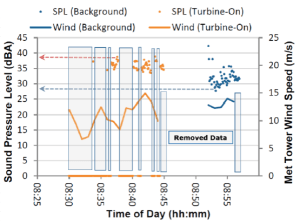 Iberdrola missed a few deadlines on its way to meeting a self-imposed schedule to bring its turbines into line with the Mass. noise limits. As a result, the DEP issued a consent order with mandated deadlines, followed by a fine of $1000 per day if the violations continue. To comply with the order, Iberdrola must respond to complaints about noise. A recent complaint brought a less-than-stellar response, as indicated in the report.
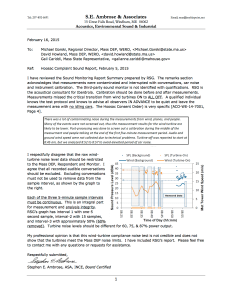 Analysis by acoustician Stephen Ambrose noted the data gaps, which he detailed in a subsequent letter to the Mass. DEP.
My professional opinion is that this wind-turbine compliance noise test is not credible and does not show that the turbines meet the Mass DEP noise limits.
Click on the images to see the letter and the RSG report data.
Observers have noted that whenever sound monitoring is done at the Hoosac, significant data points are eliminated from the report findings.
Wind Turbine Noise–Complaints Easy to Understand
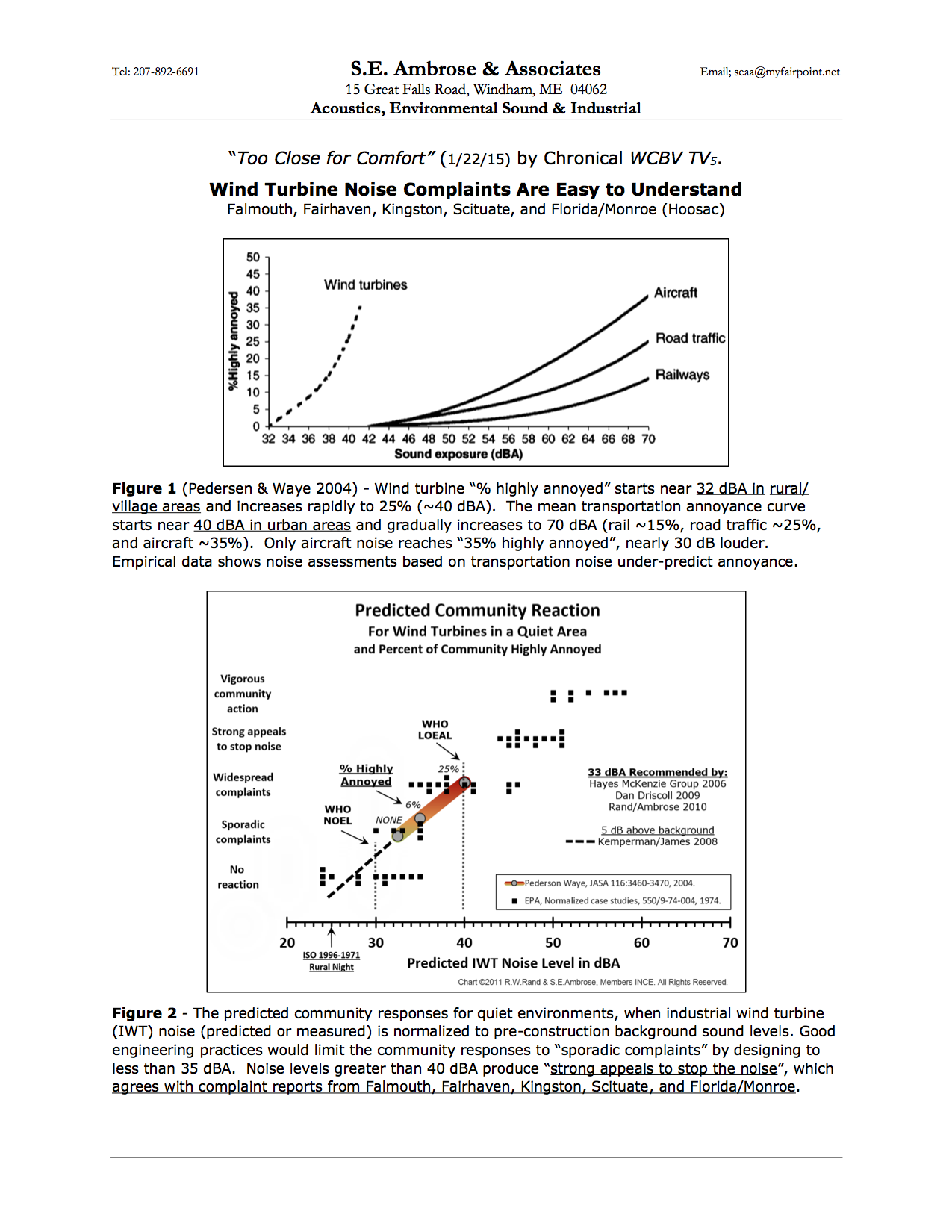
Wind turbine noise is different from other types of noise, as acoustician Stephen Ambrose explains through two charts. The first is from the study done in Sweden in 2004, when Eja Pedersen and Kerstin Waye illustrated their findings with the top graph below. In the second chart, Ambrose and Robert Rand developed a schematic to show the results of numerous studies which independently echo the lived experience of wind turbine neighbors. Too loud, which often means too close, is predictable from the volume of complaints. For more on turbine acoustics, click on Wind Turbine Noise Complaint Predictions Made Easy, or link to the “Too Close for Comfort” segment of Chronicle.
Australian Research Yields Insights on Wind Turbine “Signature”
Acoustician Steven Cooper was commissioned by the Australian utility, Pacific Hydro, to investigate the complaints of families near the wind plant at Cape Bridgewater, Australia. The Cape Bridgewater Wind Farm Acoustic Study is a 235-page report, packed with data, including six appendices which amplify and detail the findings of the study.
According to the Waubra Foundation’s analysis (“Acoustic Engineering Investigation at Cape Bridgewater Wind Facility” 2/1/15),
The purpose of the investigation was simply to find out what was causing the symptoms and sensations, resulting in sleep disturbance and health damage, reported to Pacific Hydro between 2009 and 2014 by the residents of three homes sited between 600 – 1600 metres [from just over 1/3 mile to 1 mile] from wind turbines sited at the Cape Bridgewater Wind Project in Victoria, Australia. [see maps below]
In The Australian “Turbines may well blow an ill wind over locals, ‘first’ study shows” (1/21/15), Graham Lloyd reported :
Funded by wind farm operator Pacific Hydro, the study was conducted at Cape Bridgewater in southwest Victoria where residents have long complained about headaches, chest pains and sleep loss but have been told it was all in their minds.

Waubra’s image of Cape Bridgewater Wind plant ( part of Pacific Hydro’s Portland Wind Energy Project)
There were several “firsts” to this study.
- Cooper took a variety of measurements in and around the three homes during both times when the turbines were operating and when they were shut down–with the cooperation of Pacific Hydro.
- The measurements went beyond standard dB(A), to capture harmonics peculiar to wind turbines as the blades pass by the stationary mast. This yielded new readings, branded by Cooper “wind turbine signature” or WTS.* Infrasound below the audible range was captured, as well.
- The residents kept continuous diaries, recording their experience of noise (which can be heard), vibration (which can be felt), and sensations (which were considered to be reactions to infrasound). The diary entries were later correlated with recorded measurements.
Wicked Local Kingston Picks up Chronicle Story
 The WCVB TV5 Boston news magazine, Chronicle, noted the issues raised by wind plants for turbine neighbors in Kingston (“Too Close for Comfort” 1/22/15). Noise and strobing are the tangible effects, but lack of transparency in the siting process and in the production output is also cited as a factor in the piece.
Reporter Kathryn Gallerani revisited the piece in “Channel 5 program focuses on Kingston wind” in Wicked Local Kingston (2/2/15), giving readers the quotes from the piece, which are absent from WCVB’s transcript.
“Our quality of life is important, and I don’t think the town of Kingston took the residents into consideration that would be the most affected by the turbine,” she said. “I don’t think anybody did it maliciously. I don’t think people realized what they were actually voting on. Even the people in charge didn’t realize what they were doing. They weren’t educated.”
Chronicle‘s J. C. Monahan interviewed wind neighbor Doreen Reilly and wind booster Tom Bott, Kingston’s Town Planner. Predictably Bott labeled suffers as being annoyed. Monahan offered push-back, “for people in that situation it’s more than an annoyance, it reduces their quality of life.” Neither brought up the technical/medical use of the term “annoyance” to mean severe impacts such as sleep disruption, headaches, nausea, vertigo and other health effects attributable to industrial wind turbines.
For more on the cost of wind power plant development and on the findings of noise testing at multiple locations, click over to Wind Wise Massachusetts’ Facebook page.
Bills Submitted in the new Legislative Session
Bills introduced in the new legislative session address wind turbine impacts, costs to rate payers and communities, and adverse health effects. The text of these bills is on the Legislation WWMA Supports – 2015-2016 page. The bill numbers link to the text at the Massachusetts Legislature pages.
H2032 ———– (sponsored by Representative Peake)
H2919 ———– (sponsored by Representative Vieira)
SD1755 ———-(sponsored by Senator Tarr)
H2914 ———– (sponsored by Representative Smola)
H2913 ———– (sponsored by Representative Smola)
H2883 ———– (sponsored by Representative Heroux)
H733 ————- (sponsored by Representative Peake)
H758 ————- (sponsored by Representative Smola)
To find the name and contact information of your state senator and of your state representative, go to www.malegislature.gov and click on Find A Legislator in the upper center of the screen.
| Bill | Information |
| H2032 | Resolve to establish a commission to study the health impacts from wind turbines to protect the health of the citizens of the commonwealth (Representative Peake). |
| H2919 | “Wind Energy Relief Act” (Representative Vieira) establishes a fund to compensate people, businesses, and municipalities adversely impacted by wind turbines, and another fund to help compensate municipalities to remove or relocate wind turbines. Both funds are supported by monies already deducted from our electricity bills. |
| SD1755 | An Act relative to the green communities act (Senator Tarr) requires an investigation of the impact of the Green Communities Act, including a review and analysis of current and future benchmarks. It also requires that the findings be made public. |
| H2914 | An Act relative to accountability of public funds used for wind turbines (Representative Smola) requires the Massachusetts Clean Energy Center to post monthly updates of public funds spent for wind turbines. It also requires that the information be made public. |
| H2913 | An Act Promoting Transparency in Wind Generated Electricity Production (Representative Smola) requires wind projects to submit production statistics (megawatts per hour) if the project received public funds. It also requires the audited production statistics to be published. |
| H2883 | “The Electricity Bill Transparency Act” (Representative Heroux) establishes a framework to ensure electricity rate savings by requiring annual, public reports of ratepayer cost and benefits under the Green Communities Act. It also requires that costs for programs and policies under the Green Communities Act be itemized on electric bills. |
| H733 | An Act Relative to Noise Pollution (Representative Peake) includes low frequency noise, infrasound and aerodynamic amplitude in MassDEP’s power to regulate noise. |
| H758 | An Act Relative to Noise and Air Pollution (Representative Smola) includes low frequency noise, infrasound, and Aerodynamic Amplitude Modulation in the definitions of noise and air pollution regulated by MassDEP. |
Memo to Gov. Baker: Stop New Wind Projects

In response to the Globe South’s question “Should the Baker administration support wind energy?” Joanne Levesque argued that
Our state’s energy policy should never sacrifice the rights of private property owners or promote public harm. Current support for wind power projects is premised on allowing harm to our neighbors. Violation of the law is not how a civil society should adopt solutions to climate-change challenges.
A resident of Duxbury, Levesque serves on the Wind Advisory Committee. She urged the Baker administration to
immediately do what 44 Massachusetts cities and towns have done in the past 10 years — that is to deny the construction of new land-based wind projects. The new administration should also do what Falmouth has been forced to do by a Barnstable Superior Court judge who ruled on the evidence: reduce the operational hours of existing turbines to protect their neighbors from further harm.
The pro/con discussion appeared in the Boston Globe’s metro South edition on January 10, 2015.
Bourne Meeting Reminded of Falmouth Effect
 “Haven’t we learned anything from the town of Falmouth?” asked John McMahon at Bourne’s Board of Health meeting on the wind project to be sited in neighboring Plymouth. His comments were reported in The Enterprise: “Bourne Residents Speak Out Against Plymouth Turbines” (by Michael J. Rausch on 12/12/14).
John T. McMahon of Morning Mist Lane in Buzzards Bay was outraged that Mr. Mann was even considering his project. Mr. McMahon held in his hand a report from the Falmouth Board of Health that showed 47 people suffering from health problems due to wind turbines.
According to the news report, the audience had plenty to say about potential harm from the proposed project beyond its compliance with BOH wind turbine siting regulations (quoted later in the post).
In an effort to deflect noise concerns, Keith Mann of Future Generation Wind, said the project will use newer turbines. This drew an online comment from Mark Cool, whose Firetower Road residence is impacted by the Falmouth turbines. In his post (Bourne Resident Deals Wind Developer “Falmouth Experience” Trump Card 12/12/14), Cool debunks assumptions that newer turbines are quieter.
The International Electrotechnical Commission [IEC ~ the international standards and conformity assessment body for all fields of electrotechnology] has sound rated ALL patented industrial wind turbines. The IEC-reported sound power levels range from 102dbA – 107dbA for industrial turbines. The IEC’s rating methodology IS NOT, in any way, shape or form, correlated to or distinguished by the age of the turbine.
The Plymouth project consists of four 476-foot, 2-megawatt Gamesa turbines with potential impacts on residents of Bournedale. In their Op-Ed in the Cape Cod Times, “Let’s not bargain with the devil,” (11/21/14), Lilli-Ann Green of Wellfleet and Yvonne Relin of Brewster urge Cape communities to get the facts before signing municipal power purchase agreements (“net metering”) that will allow the project to advance. 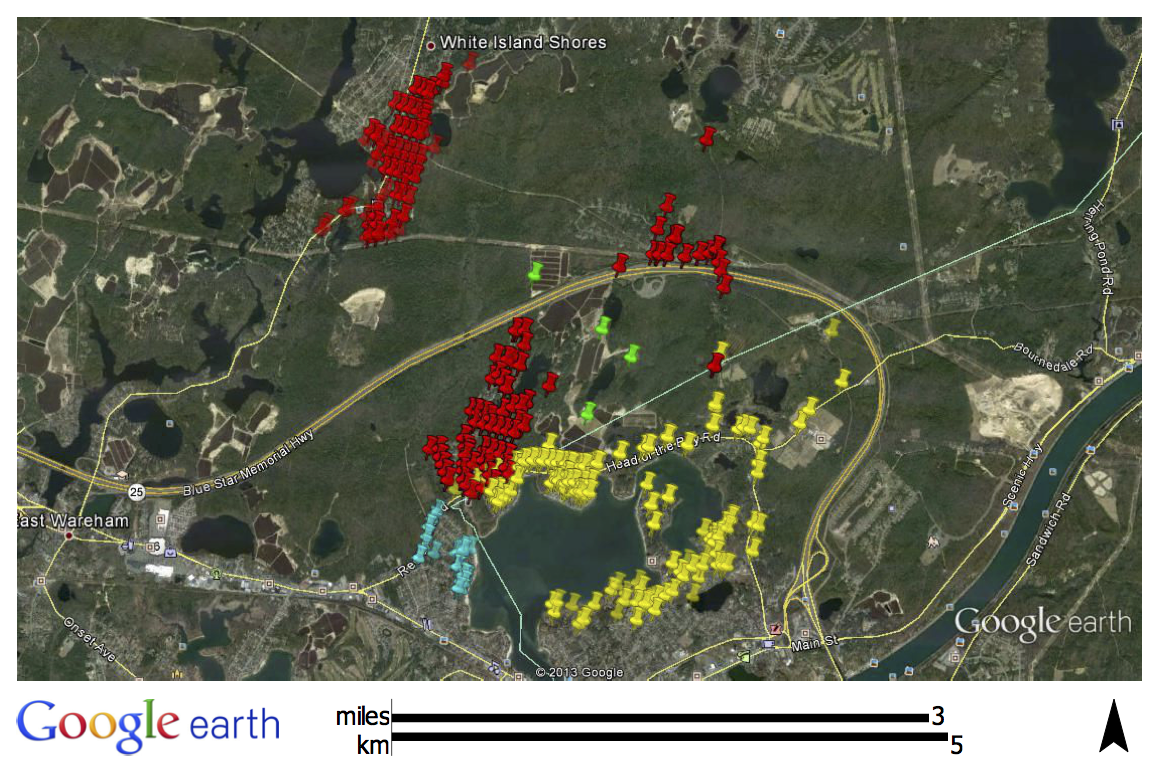
Bourne passed regulations for “Wind Energy Conversion Systems” to protect residents from turbine noise:
A. Noise.
Daytime: The noise generated by a WECS shall not exceed 6 dB(A) above ambient or and with a cap value of 65 dB(A) at the closest property line. The Board may allow a greater dB(A) where the applicant has demonstrated proven at a public meeting no inhabitants will be adversely affected.
Nighttime: The noise generated by a WECS shall not exceed 6 dB(A) above ambient and with a cap value of 40 dB(A) at the closest property line. The Board may allow a greater cap value of 65 dB(A) where the applicant has proven at a public meeting no inhabitants will be adversely affected.
B. Modulation.
The amplitude modulated noise measurable in overall A-weighted sound pressure level shall not exceed 4 dB peak to trough at the closest property line. A higher AAM may occur only of [sic] the applicant has demonstrated to the Board of Health that no inhabitants will be adversely affected.
Support Brown County WI Board of Health Declaration
 Brown County Citizens for Responsible Wind Energy is asking for your experience with wind turbines to submit to their Board of Health in support of the Shirley Wind Human Health Hazard Declaration.
If you or others you know have experienced negative health impacts from living in close proximity to industrial wind turbines and would like to share that experience along with your words of support with the Brown County Board of Health, please do so.
The address is BOHsupport@bccrwe.com
BCCRWE welcomes and encourages individuals, organizations, and governmental agencies from around the world to send their words of support regarding the Board of Health’s action. BCCRWE will pass your emails on to the Brown County Board of Health as support for their courage, integrity, responsibility, intellectual honesty, and care in declaring the industrial wind turbines at Shirley Wind to be human health hazards.
Will Serrated Edges Slice Turbine Noise at the Hoosac?
UPDATE 12/8/14: According to a letter Michael Fairneny sent to the DEP, serrated edges have not reduced turbine noise:
The new additions DID NOT help the noise coming at us last night…VERY LOUD still …Is there going to be follow up testing to see if this project is under state guidelines? How will you evaluate is further testing is not scheduled…? This project still continues to bother us…and not just when there is icing condititions….but I’m telling you …these serated edges did not diminish the noise comming at us much ….if at all??
Please plan more testing , and not just during icing
Thank You–
Michael Fairneny, hoosacwindproject.com, Friends of Florida & Monroe

Credit: Larry Lorusso, used with permission
As the installation of new turbine blade edges began in Monroe last week (October 25, 2014), residents of Monroe and Florida can only hope that the saw-toothed edges will make a dent in the turbine noise plaguing them. An industrial-sized crow’s nest allowed technicians to apply GE’s experimental fix for Iberdrola’s out-of-compliance turbines. The blade being worked on in the photo at left is in the top middle of the frame. Below is a close-up of the “Serrated TE” GE uses to reduce blade noise.

Credit: Larry Lorusso, used with permission
According to a letter and report from Iberdrola to the MassDEP, the violations at the Hoosac ranged from 10.2 dBA above background in January 2014 to 17 dBA in February. The Serrated TE reduces broadband noise by 2 to 4 dBA according to Totaro & Associates of Houston Texas.
This is the first time an attempt has been made to mitigate turbine noise in Massachusetts while keeping the turbines running. Previous orders have required shut downs for certain hours of operation. The serrated trailing edge retrofit allows the wind turbine operator to continue to produce electricity while testing an unproven noise reduction technology.
According to Jim Cummings in”Addressing Wind Farm Noise Concerns” (Acoustic Ecology Institute, Dec 2012):
Aerodynamic noise from the trailing edge of turbine blades is the primary noise source of most modern turbines. This is generally a broadband noise, though most notable at frequencies of 700Hz to 2kHz. A range of design modifications are being developed by most turbine manufacturers, including shape of the airfoil, tip modifications, vortex generators along the fin’s crest, and porous or serrated trailing edges. Serrated edges appear to be the most widely studied, with overall noise reductions of 3-8dB being reported (Barone, 2011). However, many studies have found that these reductions are frequency-dependent, with reductions in low-frequency noise and increases at higher frequencies (over 2kHz). Serrations may be less effective at low or moderate wind speeds; in some situations, this can be when neighbors find turbine noise most audible.
Residents have filed multiple complaints to the MassDEP regarding the noise experienced West of Bakke Mountain, in Florida and Clarksburg, and on Moores and Tilda Hill roads in Florida and Monroe. However Iberdrola is only installing serrated edges on half the turbines on its industrial wind complex, meaning that those affected by Bakke Mountain turbines will not benefit.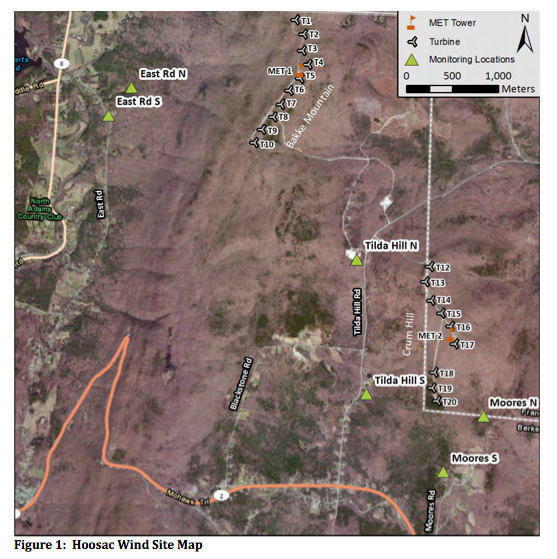
Although noise and the consequent lack of sleep are the primary concerns for people living near the turbines, there is growing evidence that turbines also affect people through low-frequency emissions. Photographer Larry Lorusso, who lives one mile west of the turbines in Clarksburg, states that he is awoken in the night by the turbines. Michael Fairneny and his wife report adverse health effects at their home on Moores Road, one-half mile from the turbines. The health effects were so severe for Tim Danyliw and Nancy Shea that they abandoned the home they were renovating on Tilda Hill Road.
Serrated edge applications were made to the turbines operating in Vinalhaven, Maine as a beta test. No other turbines with noise violations in Massachusetts have used this technology.

 Wind Wise ~ Massachusetts