Commenters to DEP–RSG Study Unfinished
“Frustration was the sentiment felt when I reached … SUMMARY AND CONCLUSIONS, in RSG’s ‘Research Study on Wind Turbine Acoustics,'” commented Marie J. Stamos.
A lot of time, manpower and taxpayer money ($491, 986 To RSG and $68,821 to Consensus Building Institute as of September 2015), were used, in essence, to create one-half of a report, and we are left, still, with a lot of questions unanswered, and many gray-area assumptions and an uncertain path ahead.

Stamos included compelling photos of the latest wind turbine project underway in Bourne. She emphasized in her submission:
The most disturbing fact, and this cannot be said often enough, is that … none of the Massachusetts wind turbine victims have been called upon to give their “testimony” and the facts and knowledge they have about the coming of the industrial wind turbine into their lives, into their homes and creating an unhealthy environment. The testing completed in the RSG Report, one would assume, was to give a better understanding and insight into the Massachusetts wind turbine complaints, identify the problem-causing entity, resolve the problem, and establish a protocol, based on fact, that would avoid issues in the future. Instead, infrasound and low frequency sound have been swept under the rug, gagged and tied and held harmless, but Something is harming people and must be identified before the industrial wind turbine agenda is allowed to continue in any location in the State of Massachusetts.
 With the meetings of the Wind and Noise Turbine Advisory Group (WNTAG) concluded, the MassDEP opened a comment period. Among those submitting their response was Lilli-Ann Green who said in her overview:
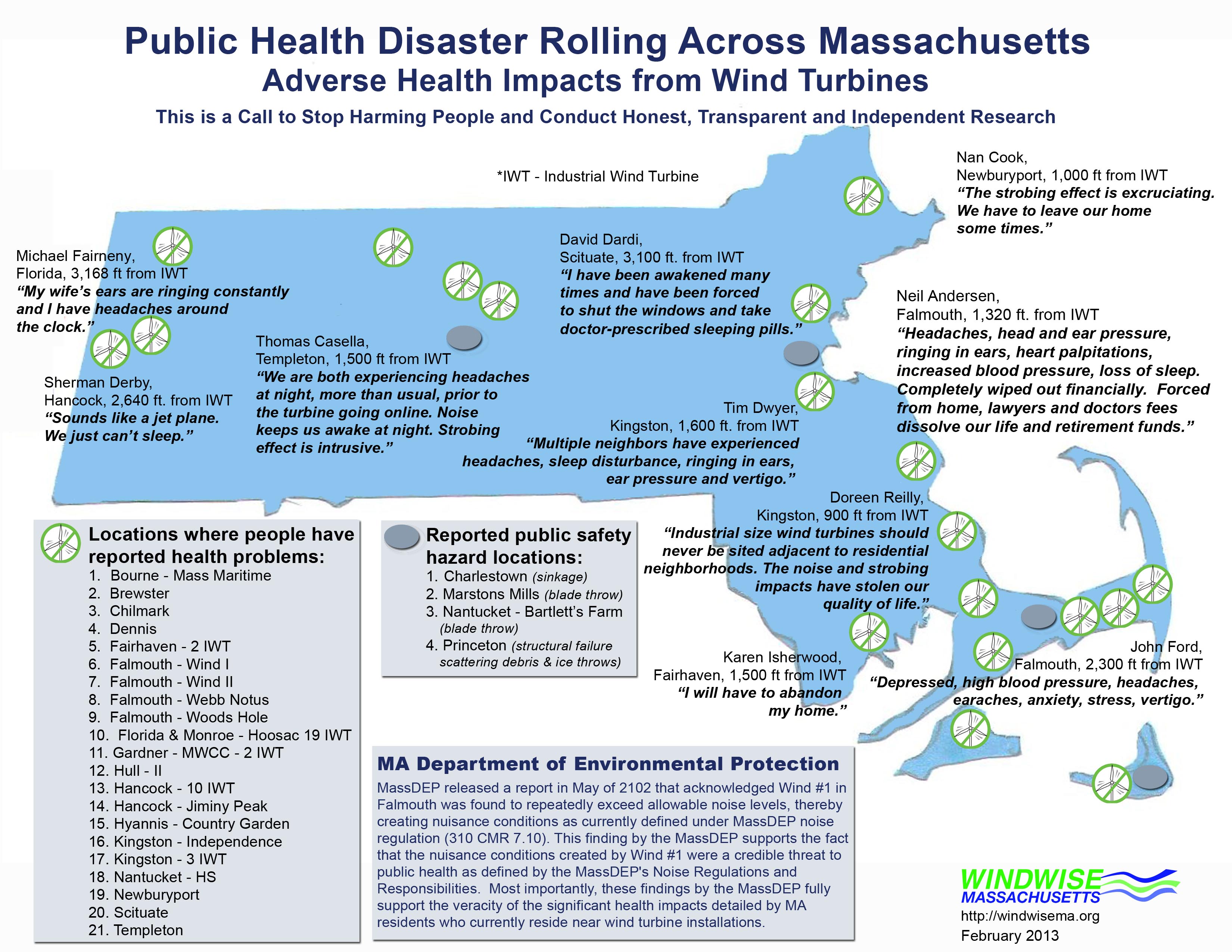
There are at least 21 wind turbine locations in Massachusetts where people living near wind turbines have reported health problems since 2010. The people did not experience the health problems they now report prior to wind turbine construction. When they leave their home, they do not experience the health problems. When they return to their home, they experience the symptoms. They report the symptoms become worse over time. The problem is not going away. The citizens of Massachusetts deserve to be returned to good health. The source of their health problems needs to be addressed and as soon as possible. It is not fair or right to knowingly harm people living in Massachusetts. The foundation of our democracy is that minorities have rights and the health of citizens should be protected.
To date no wind turbine has been permanently shut down by any Massachusetts agency. Some Massachusetts agency needs to step in and take action steps to help the people suffering if local boards of health are not protecting and helping people in their cities and towns.
Read the full comment
Her conclusion asserts
…the next logical step is assessment of health problems for people living and working near wind turbines who had originally filed noise complaints. This will help determine what symptoms remain and what next steps are in order to eliminate the health problems.
New Regs or Policies? Weigh in on Noise!
Update: The comment period has been extended to May 13, 2016.
As a result of the series of meetings held with the Wind and Noise Turbine Advisory Group (WNTAG), new regulations, guidelines, or policies may be in the cards. And while the deck has been largely stacked against wind neighbors, this is an opportunity to throw down the aces: include infrasound, set L-90 low, use fast meter settings, recognize amplitude modulation. Play the wild card, too: anticipate wind shear.
Public comments are due April 8, 2016. Send them to the MassDEP’s Deputy Regional Director Laurel Carlson (Laurel.Carlson@state.ma.us) and to the Consensus Building Institute’s Senior Mediator Stacie Smith (stacie@cbuilding.org).
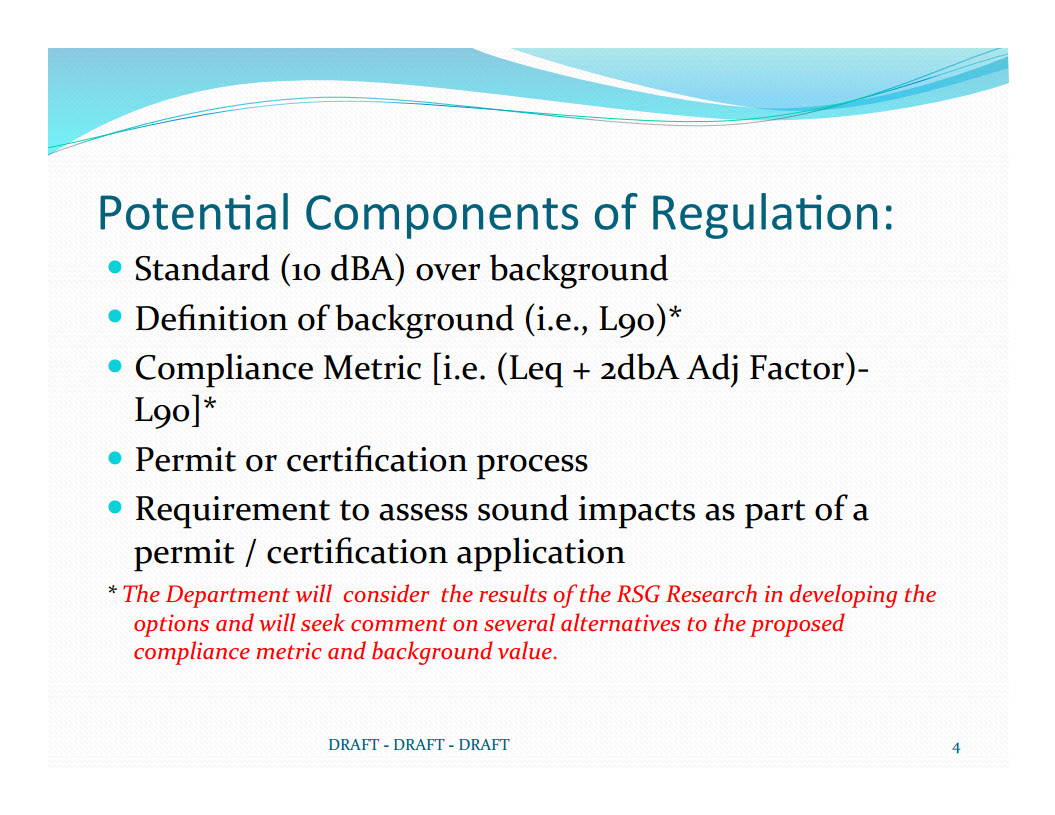
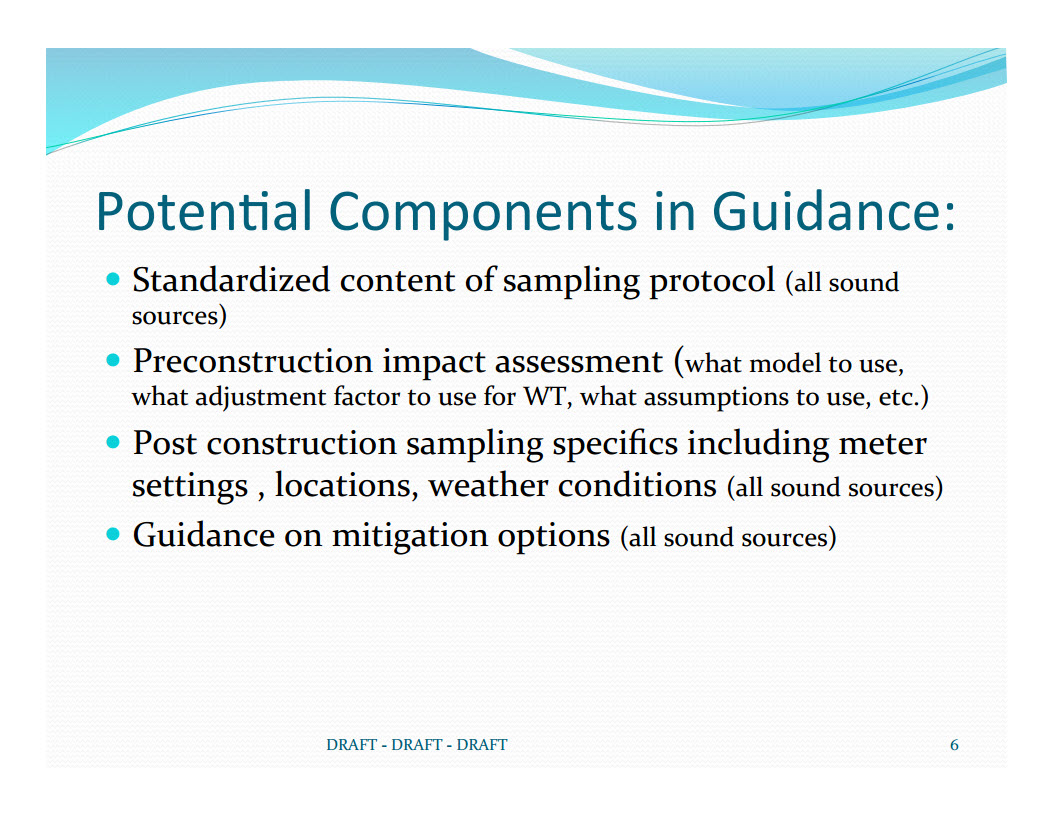
This table shows the relevant slides on potential regulation and guidelines. Click on a slide to view it or access the whole draft at Scope of Possible Noise Regulation and Policy.
 |
 |
 |
 |
 |
 |
 |
 |
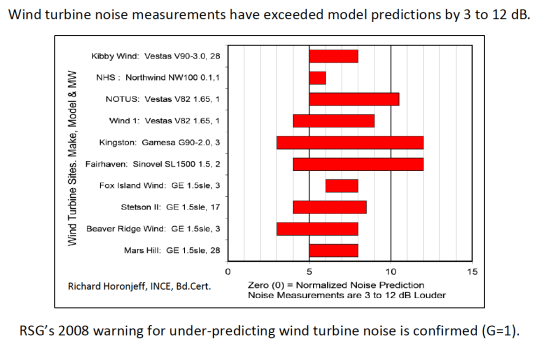
If models low-ball noise, will ears cooperate?
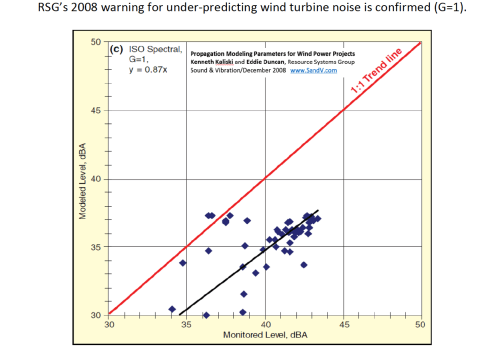
Acoustician Stephen Ambrose has released a one-page illustration (with the two graphs shown here) of the difference between modeled noise and the experience of measured noise as described in an RSG report from 2008. Modeling the current class of industrial wind turbines turns out to be a poor predictor of noise, either as recorded by instruments or as heard by the humans who come into contact with it.
Ambrose’s reminder comes at a time when the Wind and Noise Turbine Advisory Group (WNTAG) is about to have it’s “final” meeting, which will feature the “final report” the DEP plans to issue. According to Bethany A. Card, Deputy Commissioner for Policy and Planning of the MassDEP, in an email on March, 14, 2016:
The March 18th meeting is to provide an overview of the final report. In addition, MassDEP will also present ideas for possible revised noise policies and regulations. We will accept comments on that presentation and the ideas until early April and any on-going work related to possible regulation changes will provide additional opportunity for stakeholder and public involvement and comment.
Wind 1 Going out of business

No published decision today, but Sean Driscoll reports in the Cape Cod Times that the “Falmouth turbine permit (is) headed for denial.”
The majority of board members found fault with the application on more than one front, including the zoning requirement that the turbine known as Wind 1 will not have “adverse effects” on either the neighborhood or the town. Throughout the permit hearing, which stretched over a half dozen meetings and several months, neighbors of the turbine presented evidence on multiple fronts, including personal testimony, in an attempt to show the negative effects of the turbine.
While Wind 1 has not been operating since September 2015, the final decision will assure that it does not start up again.
For a better understanding of the permit status, read Mark Cool’s Firetower Wind post, “Falmouth Turbine Found Not Eligible for Permit” (3/5/16).
Filing Frenzy-Kingston & Bourne Take Turbines to Court
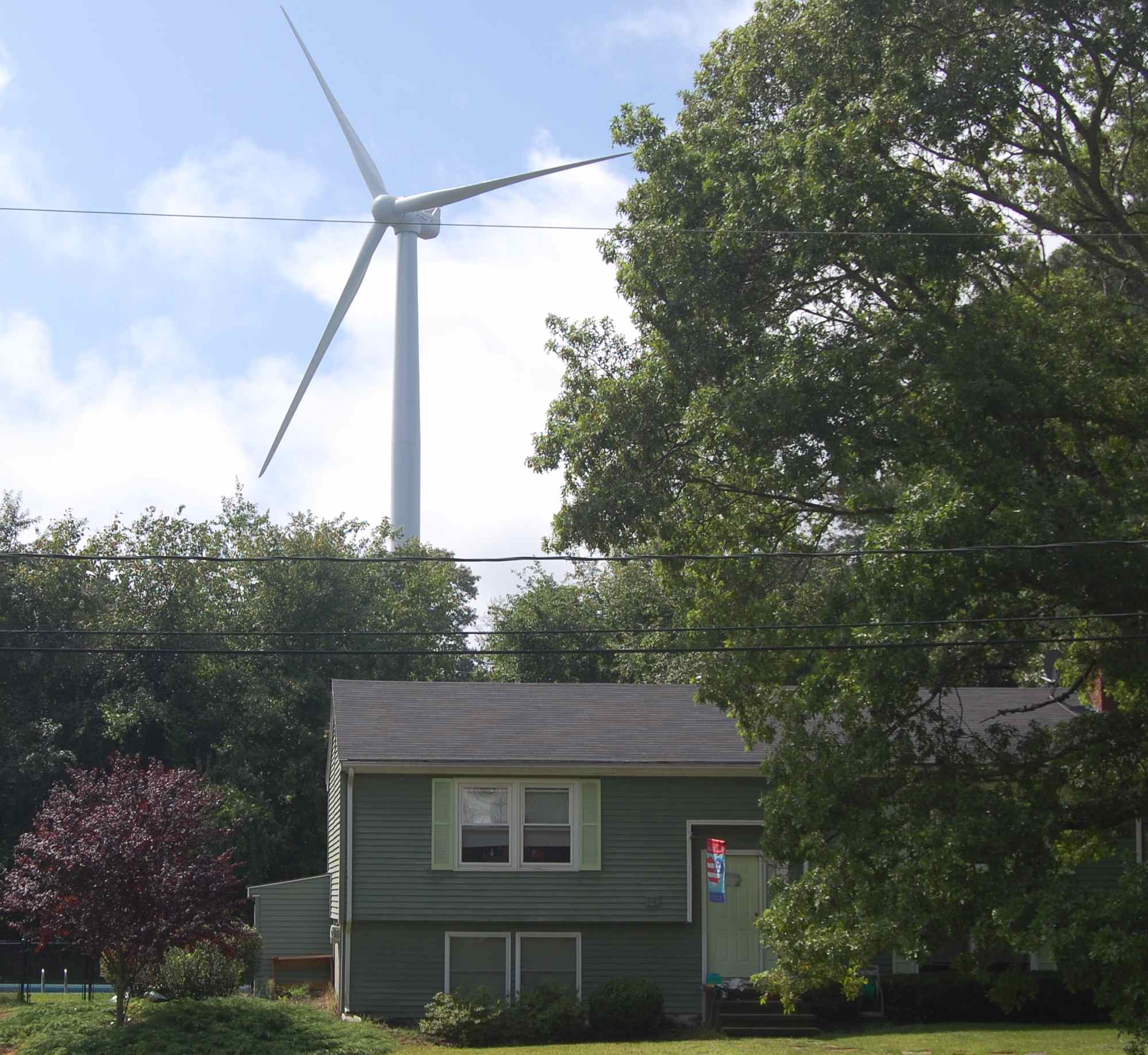
A KWI turbine lurks behind a Kingston home
Kingston finally took action against the KWI project that has spawned frequent complaints. On January 27, 2016, the town filed a countersuit to the one brought by Kingston Wind Independence in late December (“Kingston Wind Independence appeals turbine abatement order“). In the suit, the town asserts KWI has breached its contract: “with respect to the requirement for compliance with governmental standards for the operation of the turbine” and
As a direct result of such breach of contract, the Town and its residents have suffered severe injury and damage while KWI has continued to be unjustly enriched by the operation of the turbine.
Oh, and by the way, they haven’t paid their rent.
This is the first time the town has put any teeth behind either the Board of Health’s first abatement order or its more recent order (October 2015). The town is asking for an injunction as part of the suit.
Meanwhile “Bourne plans lawsuit against wind energy company” according to Cape Cod Times reporter Ethan Genter, who filed his article on January 27th. The Bourne Board of Health has previously found that the turbines under construction in Plymouth could affect Bourne residents. The article reports that town counsel Robert Troy asked people to wait for comments until the litigation has been filed in Barnstable Superior Court–in a matter of days.
Wind Wise Backs Open Records
In the experience of Wind Wise – Massachusetts, trying to get some response to a request for public records is met with delays, blacked-out text, or demands for ransom ($18,000 demanded for activities of the Mass. Department of Environmental Protection). That’s why organization President Louise Grabowski urges the Senate to pass “An Act to Improve Access to Public Records” (S.1676).
This bill could expedite request responses by sending records in electronic form if they already exist in electronic form, limit the use of redaction to “exempt” matters in the existing law, and lower fees for public records to nominal levels.
Here is the Wind Wise statement: Publicrecordsbill_Senate.
Peru’s Garnet Hill feasibility study is one location where the data in a table has been redacted.
Bourne Selectmen Support BOH Action

Photo: Ron Schloerb, Cape Cod Times
Selectmen in Bourne authorized the Board of Health to meet with town counsel to pursue an injuction against Future Generation Wind.
After over an hour of debate, the selectmen authorized the Board of Health to meet with the town counsel and discuss filing an injunction against Future Generation Wind.The logistics and budget of doing so remain unknown, but residents expressed overwhelming support for the move.
Bourne-Act Now or Lament Later
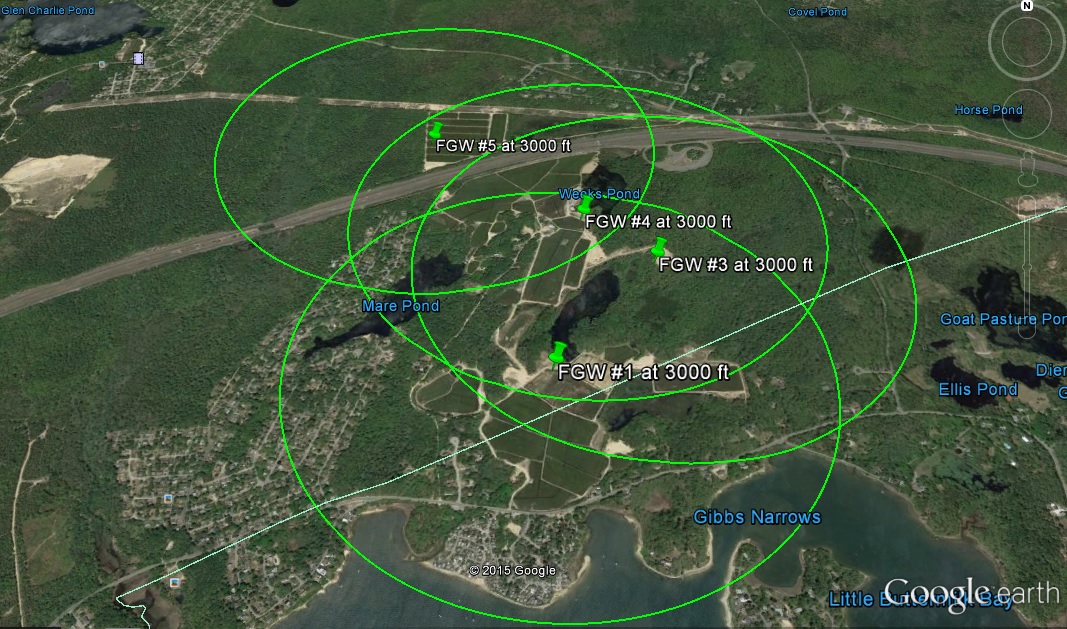
The Bourne Board of Health could take action to protect residents from wind turbine pollution in the neighboring town, Plymouth, if it heeded the evidence of other towns with turbine issues. These are laid out by Bourne resident Chris Kapsambelis in the message he sent this week to the BOH.
The Future Generation Wind project will most likely produce widespread complaints, as did similar projects in Falmouth, Fairhaven, and Kingston. These complaints will compel authorities to investigate, and conduct studies that will find violations leading to orders for curtailment. Any curtailment of operations on these wind turbines will destroy the project profit margin.
He notes that distance from turbines is key to avoiding harm to neighboring residents, and the Future Generation Wind project in Plymouth is too close to some Bourne residents.
Kingston Board of Health Expands Shut Down Periods

Stephen Ambrose’s commentary on aspects of the HMMH report
Is Kingston becoming a little more responsive to resident noise concerns?
Kathryn Gallerani reported in Wicked Local Kingston that the October 19, 2015 meeting of the Board of Health selected wind speed as the criterion for stopping the night-time operation of the “Independence” turbine (Kingston Board of Health modifies Independence wind turbine abatement order 10/19/15).
Wind direction will no longer be a determining factor dictating when the turbine will be shut down, and the turbine would need to be shut down for an additional hour a day under certain conditions.
The order requires that the turbine be shut down year-round between the hours of midnight and 4 a.m. when wind speeds reach at least 7 meters per second at the turbine hub, regardless of wind direction, and between 11:30 p.m. and 4:30 a.m. when wind speeds exceed 9 meters or more per second, also regardless of wind direction.
As Kingston continues to grapple with the discomfort of wind neighbors, the “final report” issued by HMMH was on the agenda for the Board of Health on October 19th. The original noise monitoring report left out a significant amount of relevant information that was later released. Wind Wise published a series of commentaries on the findings by noise expert Stephen Ambrose (beginning in June 2015). He recently faulted the MassDEP and other agencies for failing to protect communities around wind turbines (letter to MassDEP 9/28/15):
Neighbors’ complaints have clearly shown that wind-turbine feasibility noise studies are flawed; too large, too loud, and too close as evidenced by Falmouth, Fairhaven, Scituate and Hoosac. After five years reviewing flawed wind-turbine noise assessment reports, I conclude that unaffiliated non-windindustry consultants (e.g. independent) are ignored by Massachusetts agencies committed to fund and support wind turbine development. I have found there are no state agencies wanting or willing to protect public health and welfare from wind turbine emissions. Instead, they collectively respond with blind eyes and deaf ears in order not to acknowledge causing public harm.
In a letter to the Board of Selectmen after the October 19th meeting, Kingston residents Doreen and Sean Reilly pointed out the inaction of one town official who was receiving updates on the HMMH report:
We were extremely disturbed to learn, at last night’s Board of Health Public Hearing, that several Peer Review analyses performed by Board Certified Institute of Noise Control Engineer, Stephen Ambrose which were received by Town Planner, Tom Bott, were never shared with the Board of Health.

 Wind Wise ~ Massachusetts