FOR IMMEDIATE RELEASE
Falmouth Board of Health Hears Loud and Clear from Neighbors but Holds Off Turning Off the Wind Turbine
Contact: Malcolm Donald 508.566.5830 MD@Zefarus.com
June 5, 2012
Falmouth Wind Turbine Neighbors called on the Board to Shut Down Falmouth’s Wind Turbines Before Any More Harm is Done
Falmouth, MA – After an emotional plea from a distraught neighbor who has resorted to sleeping in her car to escape the turbine noise in her home, and a tirade by a former candidate for Falmouth Selectman, the Falmouth Board of Health heard clearly and calmly from affected wind turbine neighbors at last night’s meeting.
Board Chairwoman, Gail Harkness, an epidemiologist herself, opened the subject of wind turbine health issues by reading a compiled list of health effects from testimony received from its public hearing. In order, from most complaints to fewest, were loss of sleep to contemplating and attempted suicide.
Harkness told about 40 people at the meeting that the BOH was reviewing the large volume of testimony on adverse health impacts from Falmouth wind turbines, compiled from the May 24, 2012 public hearing. The BOH will be sending that testimony on to the MA Department of Public Health from which it seeks guidance on the health problems around two of the Town’s industrial wind turbines and two private machines.
In light of unanswered requests by the Board to the state going back as far as March 2011, wind turbine neighbor, Mark Cool, asked why the board would expect an answer to this request. In response, Board Member George Heufelder went into lengthy detail about how, as the questions to a bureaucrat become more specific, the likelihood of a response becomes better.
Neighbors asked the Board whether it believes there is a serious health risk? Board members responded by saying they have yet to read all the testimony.
If the Board does agree that there is a serious health risk, neighbors wanted the Board to know that it has the responsibility to prevent further harm.
Neighbors recognized that the Board of Health has the authority to shut the turbines down while the Department of Public Health’s medical authorities review the situation and provide the required guidance.
With the turbines off, affected neighbors told the Board that they will join the consensus-building panel Falmouth Selectmen have put together. Town Meeting voted in April both to turn the turbines off and carry on with that consensus process.
The Board heard numerous calls for turning off the turbines. Chairwoman Harkness told the disappointed crowd that the next step would be for the Board to meet and compile the testimony, hopefully within a week’s time. Another neighbor, Annie Cool, asked “How long do I have to endure the health effects from the turbines before the State would make a determination? Is it weeks, months or years before we are to get relief? You (the Board Members) can go home to a quiet house, we cannot.”
Fairhaven BOH Votes to Ask DEP for Noise Study

Watch the video on Windwise TV
Turbine victims shared their experiences and concerns at a tense BOH meeting last night in Fairhaven. The Board of Health has received upwards of 130 complaints in less than one month from people who live in close proximity to the turbines.
Peter Goben shared video of the flicker effect at his house at Teal Circle which lasts for 45 minutes in the morning. His concerns with the flicker were echoed by Brian McKenna and Joe Rosa. Joe Rosa found he had trouble driving after 45 minutes of the flicker in his house. He is concerned about his ability to earn his living under these conditions, which is especially worrisome as he is a single parent. Others spoke of being woken up, being unable to sleep, feelings of pressure in the head, nausea, vomiting, and the heartbreak of watching their children suffer the same symptoms. Citizens expressed frustration with the speed of the process that Chairman Peter Deterra reccomended.
Peter DeTerra, Chairman, made a motion to share the complaints with Fairhaven Wind, giving them three weeks to come up with a mitigation plan. This incensed most of the citizens who demanded that the Board of Health act promptly to declare a health emergency and expressed frustration that they will have to continue to live under appalling conditions going forward. Dr. Barbara Acksen suggested splitting the Chairman’s motion into two motions. One motion would contact the DEP to do a noise study and another to send suggestions for mitigation based on Falmouth to Mr. Shah of Fairhaven Wind. When Jeanine Lopes stated that she would not vote on Dr. Acksen’s submitted mitigation plan as she had not seen the mitigation suggestions, a member of the audience expressed frustration with her for repeatedly referring to the affected citizens as “you people.”Dr. Acksen’s motion to contact the DEP for a noise study was approved by the board. Peter Deterra will continue on his plan to have Mr. Shah respond to the complaints with a mitigation plan. He repeatedly stated that it is their responsibility “as they own the turbines.” John Methia objected on the grounds that other complaints such as leaking sewage or party noise would be shut down immediately by the police or the Board.
Later, at the Board of Selectmen’s meeting, other citizens of the town were treated with the utmost respect as they protested the extensive tree removal associated with a road work project. Their concerns were listened to and the plan was amended to reflect their concerns. The irony of this was not lost on the many turbine victims who came to the Board of Selectman’s meeting to support Selectman Bob Espindola. Mr. Espindola had been instructed in his first meeting as a member of the three person Fairhaven Select Board to seek advice from Town Counsel as to whether he must recuse himself on any turbine matters before the Board of Selectmen. Mr. Espindola who wished to consult other counsel than Crotty, gained the support of the third Select Board Member, Mr. Charlie Murphy, when he was able to arrange the same financial rates with another highly reputable law firm that specializes in municipal law. Mr. Bowcock cast the only dissenting vote. A small victory, perhaps, but a victory nonetheless.
 Video from the Board of Health hearing in Falmouth on May 24, 2012 is available online thanks to the efforts of Falmouth Community Television.
In towns across Massachusetts, volunteers and support from community access organizations and committees have made public meetings like these available on local channels or online. They deserve our support–and even better, our time offered as volunteers.
Brent Runyon’s piece in the Enterprise, also captures testimony in “Residents Tell How Turbines Have Impaired Their Health.”
An overflow crowd of more than 80 people packed the selectmen’s meeting room at Falmouth Town Hall last night to give and hear testimony about the impact to the health of residents who live near the largest wind turbines in Falmouth.
A total of 30 residents gave testimony about a range of problems, including sleep disturbance, depression, abnormal heart rhythms, ringing in the ears, weight gain, and the increased stress, anxiety, irritability and anger they attribute to their proximity to the town-owned Wind 1 and Wind 2 turbines, the privately owned Notus Clean Energy turbine and the Woods Hole Research Center turbine.
The BOH chair’s prepared remarks in advance of the hearing repeatedly characterized the experience in Falmouth as “unique.” This is a claim promoted by wind developers who resist any efforts to reveal resident health impacts or allow independent noise measurement. This “anomaly” refrain is evident in the Boston Globe piece, “Both sides praise wind turbine halt in Falmouth,” by Robert Knox.
“We’re actually glad the state is doing something about that one machine,” said Brian Kuhn of Associated Wind Developers of Plymouth. “It’s almost a case of one bad apple spoiling the whole bushel.”
Clearly any complaints in other communities will be met with assurances that this is a local issue, not an industry or technology problem.
Wind Wise Radio hosts news roundup
This Sunday, in a new format at 7:00 pm, WWR features Lisa Linowes and other experts who dissect the week’s headlines.
Steve Ambrose and Virginia Irvine offer observations on recent DEP finding that Falmouth’s turbine is exceeding noise regulations.
WWR will also be talking with Kevon Martis, a spokesperson from Interstate Informed Citizens Coalition, about Lake Township in Michigan. Voters recently rejected by 2 to 1 changing their zoning laws to allow wind turbine development. Now the town’s board is considering giving 40% of their township to the neighboring township which has very lenient zoning standards.
Last week’s edition featured Stand Against the Wind, Chris Braithwaite. State Senator Joe Benning.
Falmouth, Shelburne Hearings
Fear and Loathing in Falmouth
The Falmouth Board of Health’s public hearing on adverse health effects from Wind-1, Wind-2, Webb/Notus, or the Woods Hole Research Center turbines in Falmouth begins at 7:00 pm on Thursday in the Selectmen’s meeting room in Town Hall.
The Board is interested in firsthand testimony of adverse health impacts experienced by neighbors who live near the turbines or people who work near Falmouth’s turbines.

NBC 10 video: Residents fight town over wind turbine noise
But even those not medically affected by the wind turbines, or who choose to submit written testimony only, can show support for the wind turbine neighbors by attending.
Falmouth residents suffering adverse health effects from the two town-owned wind turbines have declined to be driven to consensus-building discussions before their health concerns have been addressed.
Shenanigans in Shelburne
The Mt. Massaemet wind proposal is off the table again, with developer Fred (Don) Field withdrawing his plan. But the Zoning Board of Appeals has the opportunity to decide whether they will view the withdrawal “with” or “without prejudice.” This has implications for a possible 2nd resurrection despite the moratorium on siting approved at the town meeting.
The Shelburne Zoning Board of Appeals meets Thursday, May 24th at the Buckland-Shelburne Elementary School at 7:30 pm to act on the withdrawal and at 8:00 for a previously-scheduled public hearing on the industrial scale wind project.
A copy of the application and the Zoning Bylaws that the Board must consider can be found at www.shelburnewind.info.
ZBA Chairman Joseph Palmeri told reporter Diane Broncaccio, “I don’t quite know what’s next,” he said. “We may vote to accept the withdrawal. I’m trying to talk to legal counsel now.”
Palmeri said some people want the ZBA to accept the withdrawal “with prejudice,” which would mean Field could not resubmit a new plan for at least two years. “Without prejudice” would mean a new plan could be resubmitted at any time. However, unless the Planning Board’s rejection of a subdivision application for the turbines was appealed and overturned, new plans would fall under the town’s ban and moratorium bylaws.
David Abel’s May 21, 2012 Boston Globe article “Wind turbine noise is targeted in Mass” describes the noise issue raised when the MassDEP found one of three Falmouth turbines exceeded acceptable levels. Abel writes:
The state might also conduct sound studies in other communities, such as Fairhaven and Kingston, where residents, as in Falmouth, have complained about newly installed turbines, officials said.
Studies of places where residents have reported health impacts are long overdue. But it is not enough to model or test audible sound. “I think it’s a great idea that all wind turbines are tested before they’re built or permitted,’’ said Eleanor Tillinghast, a steering committee member of Windwise Massachusetts, which has opposed wind projects around the state.”
“The problem is that the state’s testing doesn’t capture the infrasound, what you can’t hear, which is what’s affecting the body.’’
Tillinghast and other wind power critics say churning turbines and resulting flickering light and vibrations from infrasound – low-frequency sound waves below the range of human hearing – can produce dizziness, nausea, depression, or anxiety, a set of symptoms they call “wind turbine syndrome.’’
Wind Wise ~ Massachusetts issued a press release noting the many individuals in communities all over the state who have experienced disturbances related to turbines in their vicinities.
Abel also interviewed John Methia, whose home in Fairhaven is located about 2,000 feet from two 1.5-megawatt turbines just started up this month. “The sound is pretty much unbearable,’’ he said.
“The siting of these things in residential neighborhoods is absolutely ridiculous,’’ he said. “I found it reassuring what the state did in Falmouth; I hope they’ll do the same kind of testing here.’’
Harley Keisch, host of WWR, interviews Ileene Anderson, Biologist and Public Lands Deserts Director for the Center for Biological Diversity, and Miriam Raftery, Editor and Founder of East County Magazine. The live program airs online Sunday night May, 20, 2012 at 7:00 pm ET.
The Center for Biological Diversity staff page notes:
Ileene Anderson coordinates campaigns throughout the southwest deserts, while focusing on conservation projects in the deserts and urban wildlands of Southern California. Her project areas include all public lands in the California deserts and the Santa Ana River Watershed, western Riverside County, Tejon Ranch, and the Santa Clara River Watershed. She holds a master’s in biology from California State Northridge and is a research associate at Rancho Santa Ana Botanic Gardens.
 Miriam Raftery is the editor and founder of East County Magazine. Her story for May 19, 2012 alerts readers to the authorized “taking” of endangered bighorn sheep in the path of the Ocotillo Express wind project.
As a journalist and editor, Raftery has the distinction of editing a prize-winning publication that does nonpartisan reporting for San Diego County, CA. and has been honored by the American Society of Journalists & Authors with a national award for community journalism. The magazines’ website notes that she had also received awards from the Society of Professional Journalists, National Women’s Press Club, and San Diego Press Club before founding ECM and subsequently received nine more awards in 2009, for stories published in ECM.
According to South Coast Today reporter Ariel Wittenberg, “Officials caution against comparisons between Fairhaven, Falmouth turbines.”
Falmouth’s Wind 1, the turbine shut down by the DEP, is a “stall-regulated turbine,” which Shah said “are louder than pitch-regulated turbines.”
Sumul Shah is the developer of Fairhaven Wind. At a blade-signing publicity event in March, Shah refused to comment on a resident request that he post a bond guaranteeing no health effects on abuttors. Shah maintains that Fairhaven’s turbines will not exceed noise regulations. Wittenberg goes on to describe Shah’s comments,
…different kinds of turbines are louder than others depending on the type of mechanism that controls rotor speed and blade tilt. Both Fairhaven turbines are “pitch-regulated,” as is Falmouth’s Wind 2, also built and controlled by Shah.
….
DEP Commissioner Kenneth Kimmel confirmed that different types of turbines operate at different noise levels and that turbines from different manufacturers also differ in noise level.
Howard Gostin’s analysis of pitch- vs stall-regulated turbine noise based on DEP report data
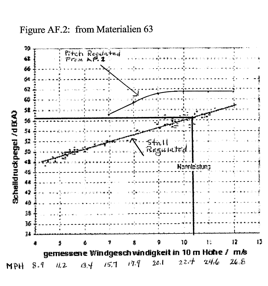
What the article fails to do is find an independent party who can comment from expertise. While not uninterested, chemical engineer and researcher Howard Gostin refuted these claims with the DEP’s own data*, demonstrating that pitch-regulated turbines are actually louder than stall-regulated. He offered his evidence in testimony at the hearing in Bourne on February 16. Gostin’s analysis has been confirmed by acousticians Robert Rand and Stephen Ambrose.
*The graph is derived from information in Appendix A and Appendix F and discussed in the text on page 5 of the report.
The Boston Globe has finally taken notice of the noise pollution produced by industrial wind turbines. David Abel writes, “The state Department of Environmental Protection, in a long-awaited response to Falmouth residents’ complaints about noise from two turbines, released a report Tuesday finding that one turbine less than 1,500 feet from the nearest home repeatedly exceeded allowable noise levels.”

DAVID L. RYAN/GLOBE STAFF
The questions for towns like Falmouth are:
- What are the fines for exceeding noise levels?
- Because the turbines were pushed by state agencies, is the town on the hook for costs or will the state step up?
- Are other turbines sited near residences being tested and is the same protocol being used?
Falmouth’s Wind I Exceeds Noise Limits
Cape Cod Online’s Sean Teehan got the scoop on Senator Therese Murray’s announcement of the findings: “DEP: Falmouth wind turbine is too loud.”
“I’m glad that the results of DEP’s study will provide residents affected by Wind 1 with some relief. This is an issue that has divided the community,” Murray said in a statement. “I believe that industrial size wind turbines do not belong in residential neighborhoods, but we should not remove wind energy from the renewable energy mix in Massachusetts.”
Selectmen voted in favor of shutting down Wind 1, one of the town’s two 1.65-megawatt turbines off Blacksmith Shop Road, from 7 p.m. to 7 a.m. each day.
Teehan’s article is updated in State: Falmouth’s Wind 1 is too loud and expanded with resident reactions. The DEP’s conclusion of excess noise is based on the findings of a 65-page report included with a letter forwarded to the selectmen on Tuesday May 15th. (Click here for an interactive description of L90 and other noise readings).
On May 8, 2012, Falmouth’s Board of Health voted unanimously to hold a public hearing to document adverse health impacts. According to Brent Runyan reporting in The Enterprise (Board Of Health To Take Public Testimony On Health Impacts Of Wind Turbines), BOH chairman Gail A. Harkness “said the wind turbines that could be affected by an emergency order are the two town-owned wind turbines, Wind 1 and Wind 2, and the Notus Clean Energy turbine at Falmouth Technology Park. All three turbines are 1.65 megawatts and made by Vestas.”
The Department of Environmental Protection was skewered in testimony at public meetings for its earlier literature review conducted jointly with the Department of Public Health.
The hearing to be held on Thursday, May 24, 2012 at 7 PM, will allow residents affected by the turbines a three-minute opportunity to speak to their testimony. The Board is requiring written testimony for its assessment of the health impact and residents will have until May 31st to make their submissions.

 Wind Wise ~ Massachusetts