Letters Relate Dangers of Poorly-Sited Wind Turbines
Small towns in the cross-hairs, little attention paid to predictable impacts, projects helped by closed-door deals–these are the realities of wind turbine siting in Massachusetts.
From Raymond Hartman of Shelburne’s letter in the Berkshire Eagle “Savoy Wind Turbine Study is Junk Science” (9/8/2017):
“Wind developers are eying our small towns, while unprepared to evaluate the adverse effects that 35 to 50-story wind turbines will have. These include lower real estate values near turbines and negative impacts on the tourism-based regional economy of Western Massachusetts. Would we alter these elevated ridge lines with 35- to 50-story Walmarts?” Read the entire letter
From Dave Dardi of Scituate’s letter
There is a reason why the courts ordered the two turbines in Falmouth to permanently shut down. And why do you think that the town did not appeal that decision. They understood that they had made a mistake in allowing them to be installed in the first place.
Don’t you make a mistake! Read more in “People of Savoy”
From Louise Barteau of Fairhaven:
Gordon Deane of Palmer Capital put up two wind turbines in Fairhaven, MA, where I live. Most of the work was done behind closed doors and in close financial collaboration with the Commonwealth of Massachusetts. The neighbors only found out when the land was cleared on Veteran’s Day, 2011. At that time the project was so far advanced that there was little the neighbors could do to stop it although we tried very hard. Read more in “Wind turbines don’t make good neighbors in Fairhaven”
Berkshire Eagle letter to the editor “Savoy Wind Turbine Study is Junk Science” (9/9/2017).
To the editor:
I am a mathematical economist. I have studied alternative green energy sources as a faculty researcher at MIT and have taught energy and environmental economics as an associate professor at Boston University and the University of California at Berkeley.
Voters in Savoy will soon decide whether to allow taller wind turbines in the town. In the discussion leading up to the relevant vote, the Minuteman Wind representative told the town that “there is not scientific consensus” about sound issues (Eagle, Aug. 25), citing a submitted noise study. She was likely referencing a state-sponsored January 2012 wind turbine study. Her assertion is a complete mischaracterization of the scholarly research.
As an expert witness, I have professionally reviewed hundreds of quantitative policy analyses and provided leading testimony that ended in landmark legal decisions. I thoroughly evaluated the state-sponsored study and found it to be fundamentally flawed in its analysis and conclusion that wind turbines do not cause negative health effects.
Simply put, the health impact study is not independent science. Rather, it is biased, distorted and in many cases outright deceitful. Several members of the panel were not independent; they benefit from big wind financially or have demonstrated a scientifically unsupported intellectual preference for this technology. The study relies primarily upon four to five articles while ignoring hundreds of other relevant studies. It summarizes health effects of much smaller turbines than the ones proposed for Savoy, for example, and examines the effects in Sweden, Holland and New Zealand, while inexplicably ignoring the serious health effects that have arisen from the many large wind projects in Massachusetts and the rest of New England.
Furthermore, the panel distorts, ignores and misstates the conclusions of the very studies upon which it relies. These studies conclude that industrial wind turbines disrupt sleep, and note that chronic noise exposure is a psychosocial stressor that can induce maladaptive psychological responses and negatively impact health. Furthermore, wind turbine sound varies unpredictably, and the noise does not cease at night.
Wind developers are eying our small towns, while unprepared to evaluate the adverse effects that 35 to 50-story wind turbines will have. These include lower real estate values near turbines and negative impacts on the tourism-based regional economy of Western Massachusetts. Would we alter these elevated ridge lines with 35- to 50-story Walmarts?
I hope voters in Savoy do not rely on this fatally flawed health study as science to evaluate the project. If one of my students had handed it in to me, I would have given it a failing grade.
RAYMOND S. HARTMAN
Shelburne, MA
People of Savoy,
It is wise to learn from your mistakes and even wiser to learn from the mistakes of others. I live in Scituate, MA 3200 feet from a single 1.5 MW wind turbine. Six years ago Gorden Deane came to town and sold a bill of goods to our town officials. He said that the turbine would not have any negative impact on the community and they believe him, for he is a very personable individual. For the last 5 years my neighbors and I have suffered from sleep deprivation, ringing
of the ears, dizziness and shadow flicker. We are woken from a sound sleep and because of the noise cannot get back to sleep. Over that time period we have submitted hundreds of complaints, brought petitions before the Board of Health and Selectmen; but all that has been ineffective in gaining relief. The fight to rid our homes of this intrusive noise seems to have no end.
If you think five, 2.5 MW wind turbines will be quiet you are wrong. You should come to my house and listen to a single 1.5 MW turbine that is 3200 feet away. There is a reason why the courts ordered the two turbines in Falmouth to permanently shut down. And why do you think that the town did not appeal that decision. They understood that they had made a mistake in allowing them to be installed in the first place.
Don’t you make a mistake!
Dave Dardi
Scituate
Wind turbines don’t make good neighbors in Fairhaven
Gordon Deane of Palmer Capital put up two wind turbines in Fairhaven, MA, where I live. Most of the work was done behind closed doors and in close financial collaboration with the Commonwealth of Massachusetts. The neighbors only found out when the land was cleared on Veteran’s Day, 2011. At that time the project was so far advanced that there was little the neighbors could do to stop it although we tried very hard.
After the giant blades (total turbine height is 394 feet) began to spin, the turbine neighbors turned to the MA Department of Environmental Protection for relief from the intrusive turbine sounds. Testing showed that the turbines exceeded the noise limits set by the state. Residents submitted over 850 complaint forms to the local Board of Health but nothing was done to help those who were suffering. Instead, Gordon Deane’s company, the MA DEP and the MA CEC met behind closed doors to come up with a non-protective mitigation plan that only turns off the turbines occasionally between 12 and 4 am in light winds and never in the rain. Not helpful.
To date, those who actually live next to the turbines have been excluded from every decision involving the turbines and the impacts of the turbines on their lives. Based on the experiences of turbine neighbors in Fairhaven, Falmouth, Scituate, Kingston, Plymouth, and the Hoosac project in the Berkshires, the Commonwealth of Mass and your local government will not help you after the turbines are turned on.
Industrial wind turbines are power plants that run 24 hours a day, seven days a week. The sound they emit is intrusive and harmful. Gordon Deane has not seemed to care about the very real physical distress that is caused by living next to his industrial wind turbines in my town. And the turbines in my town are smaller than the five turbines proposed for your town.
To understand more about the destructive results of Deane’s wind turbines in the communities of Fairhaven and Scituate I suggest that citizens of Savoy go to wind-watch, a website that collects news stories and documents about industrial wind turbines from news sources around the Commonwealth, the nation and the world.
And then do everything they can to prevent these turbines from ever being erected.
Louise Barteau
Fairhaven
Savoy’s Hearing Brings Out Concerns
About 70 people attended the hearing on an amendment to change the Commercial Wind Energy Facility bylaw. The height of the five turbines in the Minuteman Wind project and their clearance from the ground are changes that must be made so the company can use the blades it wants.
This reconfiguration will allow the project to generate more electricity, and therefore revenue, according to the Berkshire Eagle. While this may assure the town a higher figure on a payment-in-lieu-of-taxes, it also means that “The taller these turbines are, the more people are going to be impacted,'” town resident Susan Rosenthal said.
The August 24, 2017 hearing was held in the fire station and instead of being conducted with a list of speakers allowed to make statements without rebuttal, the session was held as a Q&A. One townsperson who attended said the audience did not let the moderator cut off speakers–the residents were interested in hearing from other residents, as well as abutters and two people who have the experience of living near 2.5 megawatt turbines.
Residents later said they were impressed with the turnout and want questions raised about the economic soundness of the venture to be considered.
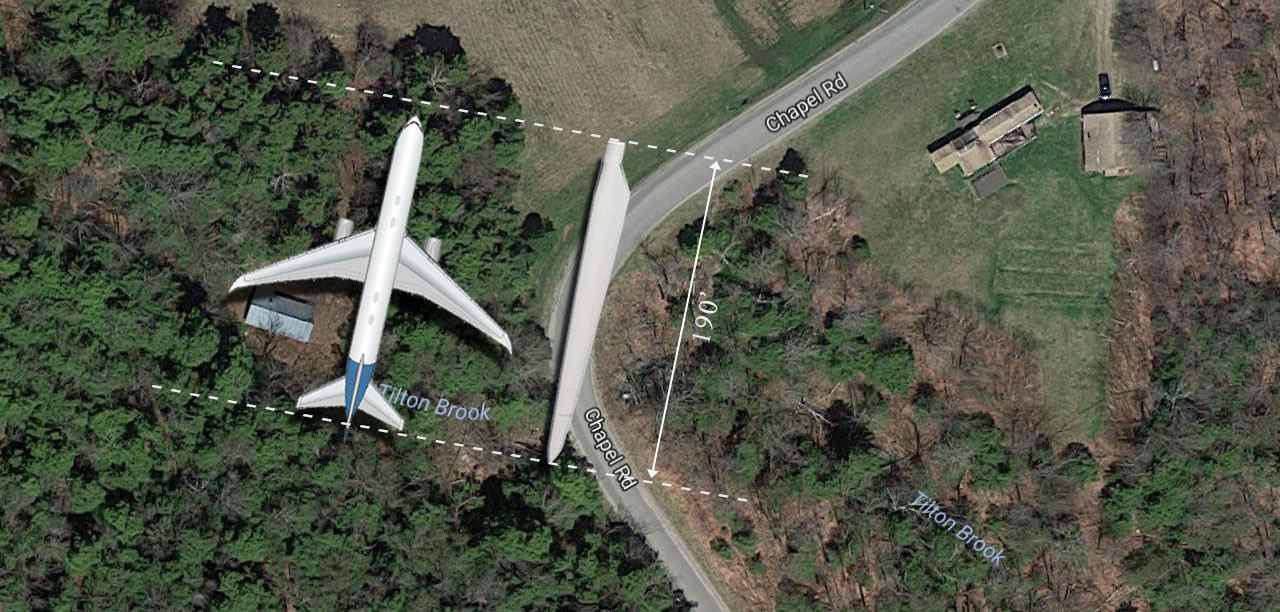
The scale of the project is represented graphically at the Savoy Song website’s page “Blades that slice through a town:”
Savoy’s Wind Bylaw in the News
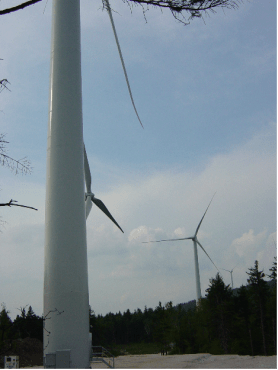
Hoosac turbines at Crum Hill
The Planning Board of the tiny town of Savoy will hold a public hearing on August 24, 2017 at 6:00 pm at the Fire Station. Minuteman Wind, the project developer, says taller turbines are needed to generate the desired output, according to the Berkshire Eagle.
Larry Parnass reported the comments of John Tynan, chairman of the Select Board (“Hearing postponed on Savoy wind power bylaw change“):
The requested change is driven in part by the fact that turbine blades used for the lower height project are no longer available, Tynan said.
“That causes a problem with them reaching the capacity they wanted,” he said of the company’s intended electricity output. “A little bit higher is quite a lot of energy produced.”
The “Commercial Wind Energy Facilities” bylaw currently calls for a maximum height of 425 feet to and a ground clearance of 100 feet. The hearing will consider raising the height to 455 feet and lowering the clearance to 70 feet. The date of the town meeting when Savoy’s voters will be called upon to amend the zoning bylaws has not been announced. The amendment requires a two-thirds majority to pass.
The Board of Selectmen’s meeting on Tuesday, August 22, will also discuss the payment in lieu of taxes (PILOT), which the town authorized them to negotiate at a June 30, 2017 special town meeting. Parnass reported of that meeting:
Though the issue had once drawn over 200 residents to meetings, the recent town meeting was sparsely attended. The article giving the Select Board authority to handle the tax matter passed 13-5, according to Town Clerk Brenda Smith.
The article, “Long-debated $31M Savoy wind power project revived,” reports
Deane-Mayer [of Palmer Capital–a new investor in the project] said that with greater use of natural gas to produce electricity, energy prices have come down. She declined to say whether the $220,000 figure was still a reasonable estimate [for a PILOT for Savoy].
“We’re looking for stable income through the period of the permit,” Tynan said of the tax agreement. “With renewable energy this is your best avenue to get something more favorable to the town.”
A PILOT agreement, as it’s known, can also benefit a developer by lowering initial payments, which would normally be high before depreciation reduces the value of the investment.
JD Allen also reported on the $31 million project for WAMC’s Midday Magazine (“Wind Turbine Project In Savoy Starts Up, Again,” 7/11/17) that, “Some residents have expressed concerns about how the turbines could impact their health.”
Project Location

Turbine location identified by Minuteman Wind
Equation Reveals Falmouth’s Error
Take a Google Earth snapshot. Use its tools to indicate distance. Chart that against industry turbine ratings. Voilà! Anyone can figure out that most of the wind turbines in Falmouth are too close to homes.
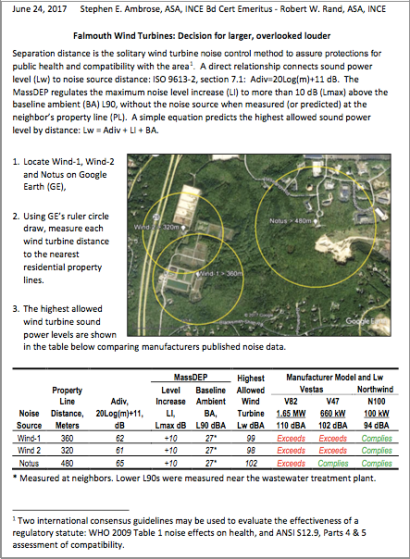
In this first infographic, acousticians Stephen Ambrose and Robert Rand demonstrate the distance of homes from turbines. They reveal that anyone could have anticipated the noise would be too great at nearby property lines by using standard industry data.
The larger the turbine, the greater the sound power levels and therefore the greater the distance needed to reduce noise to the maximum MassDEP allows.
If the size of Wind-1 had been kept to the level of the Northwind (Woods Hole Research Center, 100 kW), its noise footprint would not be disturbing neighbors.
The second fact sheet assesses whether the standard developed by the Cape Cod Commission would protect residents near a turbine.
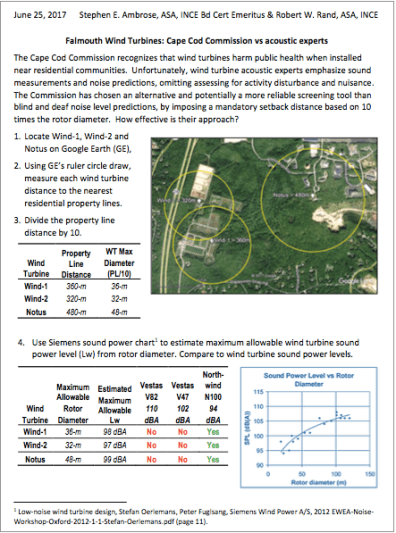
If distance provides the only protection from wind turbine noise, is a 10-rotor diameter setback enough to prevent residents from being disturbed when they garden in their yards, or when they try to sleep?
The graph at right offers an industry analysis showing that larger diameter rotors produce greater sound power levels (higher dBAs).
Again, a small turbine like the Northwind meets the CCC distance standard for reducing noise level. The larger turbines do not.
Net Neutrality Action Day July 12, 2017
Many of the videos supplied by Wind Wise Massachusetts are housed on the Vimeo website. Here is a plea from Vimeo to keep an open Internet. If the Federal Communications Commission rules reduce access, sites like ours may get less traffic as readers are frustrated in loading documents, images, and links to content like videos and news websites

Why we need net neutrality from Vimeo Staff on Vimeo.
Falmouth Selectmen Bow to Court Ruling

Hoosac Wind ribbon-cutting December 2012. Photo credit: Virginia Irvine
Louise Grabowski, President of Wind Wise~Massachusetts, noted the import of the June 20, 2017 ruling from Barnstable Superior Court:
“We are confident the Superior Court’s ruling that these massive wind turbines ‘constitute a substantial and unreasonable interference’ with the lives of those living near them will discourage other towns from erecting these industrial machines too close to people.”
According to Cape Cod Times reporter Adam Lucente, the Board of Selectmen chose not to appeal the decision because it would further divide the town (“Falmouth won’t appeal order to shut down wind turbines,” 7/10/17). Falmouth has already spent hundreds of thousands of dollars in legal costs and has lost revenue from court-ordered shutdowns. Residents had filed many suits, one of which resulted in the turbine operating on a reduced schedule. In this recent decision, the judge ruled against the town’s appeal of a “nuisance” ruling by the Falmouth Zoning Board of Appeals.
Wind Wise has been following the efforts of residents in communities across Massachusetts, where wind power plants have been sited. Grabowski said,
“The Board of Selectman’s decision not to appeal the court’s ruling is a decisive and hard won victory for those in Falmouth who have suffered for years from the harmful health impact of the wind turbines too close to their homes.
Shutdown Ordered for Both Falmouth Town-owned Turbines
Barnstable Superior Court Judge Cornelius Moriarty issued the order to shut down Falmouth’s Wind 1 and Wind 2 on June 20, 2017. The judge denied the appeal brought by Falmouth selectmen against the Zoning Board of Appeals. The ZBA had found the turbines to be a “nuisance.”
Cape Cod Times reporter Ethan Genter wrote (in “Falmouth ordered to shut down turbines“):

Barry Funfar flanked by turbines (see the Boston Globe profile from 2014)
Moriarty’s decision was welcomed by Barry Funfar, who lives next to one of the turbines and has sunk more than $100,000 into fighting their operation.
“We’ve been waiting for this decision for six months,” Funfar said.
“Wind neighbors” have brought nine suits against the town-owned turbines. Due to a judge’s order in one of these, Wind 1 was already out of operation and Wind 2 was operating on a reduced schedule limited to 12 hours. This has given the people impacted by the turbine a chance to sleep at night–something not available to the people of Kingston, Fairhaven, Bourne, Plymouth and areas near the Hoosac project in the Berkshires.
Infrasound & Low Frequency Noise Heard in Boston

L-R Barry Funfar, Neil Andersen, Louise Barteau. Photo credits Louise Grabowski
Eight activists from Wind Wise told the Joint Committee on Environment, Natural Resources and Agriculture why House Bills 464 and 2133 matter to families who live near industrial wind plants. The June 6, 2017 hearing was chaired by Senator Anne Gobi.
The Department of Environmental Protection is mandated to protect the public from noise pollution. These bills would add “infrasound,” “low frequency noise,” and “aerodynamic amplitude modulation” to the types of emissions regulated by MADEP.
Sen. Anne Gobi (center) chaired the hearing
Barry Funfar and Neil Andersen, both from Falmouth, and Louise Barteau from Fairhaven reported their first-hand experience with ILFN.
Watch a video of Dale LaBonte’s comments on the problem with infrasound.
Dr. Wayne Klug of Lanesboro wrote to urge the committee to report out both bills favorably because they are “needed to protect the health and safety of Massachusetts residents.”
The attractive and comforting image of majestic wind turbines turning gracefully against the sky, generating clean, limitless energy—seemingly all benefit and no cost—begins to tarnish as we hear about particulars that neither wind developers nor government agencies have so far cared to discuss.
Of special relevance to the current bills, we hear about the turbines’ high-frequency noise—and its inaudible low-frequency counterpart, called “infrasound”—that creates headaches, vertigo, and elevated blood pressures among humans living within 1.5 miles on level, and 2 miles or more on mountainous, terrain.
Currently, the Massachusetts DEP does not regulate these unique noise characteristics, even though ample evidence suggests that neighbors are being sickened by turbine noise. Current noise assessment procedures require the quantification only of acoustical phenomena that are audible to human hearing (in dBAs).
H. 464 addresses this oversight by making clear that the DEP’s power to regulate noise extends to low frequency noise, infrasound, and aerodynamic amplitude modulation. Similarly, H. 2133 will require that these terms – “low frequency noise”, “infrasound”, and “aerodynamic amplitude modulation” – be included in the definition of noise pollution regulated by the DEP. Adding these three terms will provide the basis for regulating them – as proposed in H. 464.
Wind Wise ~ Massachusetts has additional information on ILFN (infrasound and low frequency noise), vibroacoustic disease, and research studies which confirm the impacts people experience from the inaudible emissions industrial wind turbines generate.
 From his “BE QUIET” license plate to his email signature statement, “Neighbors are far better acoustic analyzers for determining the quality of their life versus any acoustic instrument left unattended by an expert,” Stephen Ambrose has been a champion. His quest has been to safeguard the health and well-being of the public from unwanted noise. As an acoustician, he has addressed noise threats–from manufacturing plants to commercial turbines. His expertise led the MassDEP to invite him to serve on the WNTAG panel.
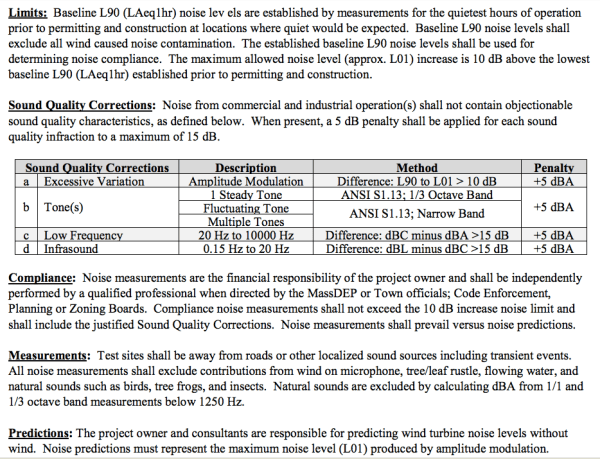
The recommendation (below) has specifications to deal with limiting noise, but its implementation mandates even more accountability:
-
Noise measurements are the financial responsibility of the project owner and shall be independently performed by a qualified professional
-
Noise measurement shall prevail versus noise predictions.
Commenters to DEP–Citizen Input Excluded

This 2014 mapping of turbine complaints shows some of the 850 lodged to date. Blue circles show where DEP measured exceedances.
In Louise Barteau’s comments to the MassDEP, she finds the WNTAG process deeply flawed and incapable of protecting the public from the noise pollution generated by wind turbines like the ones in Fairhaven.
I remain deeply troubled by this lengthy and expensive WNTAG process that refused to include in any meaningful way the voices of Fairhaven citizens who are forced to live near Fairhaven Wind’s Industrial Wind Turbines. This follows a pattern by the MA DEP, the developers, and town officials to exclude these citizens from meaningful participation in decisions that significantly impacted their health and their quality of living.
She questions the purpose of all the study if the DEP refuses to enforce the existing noise regulations for “’multiple measured exceedances’”
The WNTAG process has been an egregious and dangerous example of the bias of the state government when it chose to favor the wind industry over the lives of individual citizens of the state of Massachusetts–many whose health has been sacrificed, whose properties have been taken without compensation, and whose faith in their government has been destroyed.

 Wind Wise ~ Massachusetts