Shelburne Speaker Series concludes but WWR continues
 Michael McCann on real estate values and Robert Rand on acoustics this Saturday, March 3, 2012, in Memorial Hall in Shelburne Falls, MA at 7:00 pm.
Industrial wind turbines have real and adverse impacts. Declines in property values spell reduced income for communities. Noise impacts drive neighboring residents away. Learn how these factors affect places where turbines have been sited.
The program is free and open to the public.
The next episode of Wind Wise Radio (WWR) is Sunday Night 7-8pm Eastern Time and will feature “National Wind Watch’s Eric Rosenbloom and David Roberson on WWR.”
Wind Wise Radio is honored to be joined by the president and vice-president of National Wind Watch , Eric Rosenbloom and David Roberson, for aconversation about their experiences at the center of the struggle against Industrial Wind in the U.S.
Since 2005, National Wind Watch (NWW) has been a indispensable resource providing a central clearinghouse for information and assistance to individuals and local groups seeking the facts about industrial wind power.
Listen to past shows at Wind Wise Radio — last week’s edition featured An Alternative Vision for Vermont.
More Turbine Projects Rejected
One turbine project after another is folding under the pressure of local opposition and economic realities. View a chart of “dead turbines.”
 On March 31, 2012 Nantucket joined the ranks of communities to reject a wind turbine project when the town meeting voted 62% to 38% against the turbine. Jason Graziadei was reporting on the meeting for the Inquirer and Mirror. In an earlier article he reported, “FinCom recommends against turbine.” Residents heeded their recommendation and rejected the Madaket Wind Turbine Warrant Article.
The Lenox Board of Selectmen voted 4-0 on “On Leap Year Day” to abandon the two-turbine project proposed for the drinking water watershed, according to Preserve Lenox Mountain.
The high school in Plymouth will be LEED rated–it will just have solar panels instead of a monster wind turbine, according to Rich Harbert’s report in Wicked Local Plymouth. Superintendent Gary Maestas said that “the new school will open in the fall with a gold rating, instead, and will still be one of the most environmentally progressive structures in the state or country.”
Dennis will not see a turbine built at the Aquaculture Research Corporation (ARC), according to Cynthia McCormick, reporting in Cape Cod Online. The major regional shellfish hatchery dropped its suit against the Old King’s Highway Historic District Committee. Dennis resident Rosemarie Austin appealed the positive ruling of the local historic district committee, prompting the regional committee to overturn the ruling. Austin is President of Save Our Beaches, and had objected to the town of Dennis supporting ARC’s side in the court case. “‘Wind turbines shouldn’t be put in neighborhoods,’ Austin said… ‘Industrial turbines should go in industrial areas.'”
Earlier reductions in the industrial wind turbine proposal roster include Quincy (Moon Island), Bournedale, Northborough, and Swampscott. Read more…
No Science and No Conscience–message at DEP/DPH hearing
The verdict of the crowd of over 50 people in Lee on Tuesday night, February 28, 2012, was that the DEP/DPH panel did sloppy work in the service of big wind. And Commissioner Kimmell seemed, for the first time, inclined to disavow the panel’s findings. “This is not the DEP’s report. We’re taking recommendations.”
Thirty-two people from Lee, Lenox, Florida, Sheffield, West Stockbridge, Plainfield, Shelburne Falls, Buckland, Ashfield, Savoy, Hawley, Charlement, Brimfield, Falmouth, Bedford, and other communities testified to the need for a legitimate public health study.
Only a handful of people spoke in support of the study’s findings.
A scientist from the Cape she said she’d brought signs to characterize the study’s results not as “junk science” but as “no science” and “no conscience.”
Alicia McDevitt, Assistant Commissioner for the DEP, gave the summary of the panel’s work and said the DEP plans to have the recordings of the sessions available on their website.
Listen to Lucas Willard’s coverage on WAMC and read Preserve Lenox Mountain’s “Last Night’s DEP/DPH Smackdown” and Amanda Korman’s Berkshire Eagle article, quoting Lee resident Deidre Consolati, “‘I think it’s time we stopped putting human beings at risk for technology.'”
DEP/DPH “Expert” Panel-Last Hearing is in Western MA on 2/28/12
Join Wind Wise ~ Massachusetts in Lee on Tuesday Februrary 28. Expose the junk science in the MassDEP’s Wind Science Panel Report. The public hearing runs from 5-8 pm at the Lee Middle and High School Auditorium at 300 Greylock Street.
The panel discounted or ignored research that suggested health impacts. But the lack of evidence that turbines are safe led them to the refrain “more studies needed.”
Windwise ~ Massachusetts has called for an immediate epidemiological study on the effects of living near wind turbines, charging that the DEP and DPH have failed the people of Massachusetts with the inadequate study that they released in January.
For more information, see the 1/17/12 Press Release–Windwise ~ Massachusetts calls for immediate epidemiological study on health effects of wind turbines and the post Study Findings Whitewash Health Impacts.
This is the final hearing. Snow date is February 29 at the same place and time. The comment period continues to March 19, 2012.
Help stop reauthorization of the Production Tax Credit for wind energy. It is costly and does not encourage production or create jobs. (Click the “more” link to see details).
Extension of the PTC has been proposed through an amendment of the transportation bill.
Please call Senators Kerry and Brown on Monday or Tuesday, Feb. 27 & 28, 2012.
Senator Scott Brown, Springfield Office: (413) 788-2693; Boston Office:(617) 565-3170
Senator John Kerry, Springfield Federal Building: (413) 785-4610; Boston Office:Kerry (617) 565-8519
Current information on the Transportation bill: Senator Bennett’s Amendment # 1709 to the transportation bill that would extend the PTC has been filed, and negotiations are still on-going to determine which amendments are considered. As of now (Sunday), the chance of the PTC amendment coming up for a vote is 50-50. That can change as the week moves forward, and we should all be concerned that the amendment will come up for a vote. Monday and Tuesday are key days this week.
The best thing we can do is get all the people in our reach to call the Senators and urge them to oppose any extension of the wind PTC AND oppose Bennett Amendment # 1709 to the transportation bill.
We can also call Majority Leader Reid and urge opposition. Read more…
Charlestown turbine starts up in October, shuts down in January
 Could problems plague Fairhaven, which is preparing to erect two turbines of the same type of as this one in Charlestown? It has sunk 2 inches since it began operation in October. In his Boston Herald article, John Zaremba describes the project to shore up the 364-foot, 231-ton turbine at the DeLauri Sewer Pump Station:
Massachusetts Water Resources Authority honchos and engineers met yesterday to figure out a fix for the $4.7 million wind turbine, which started turning in October, only to power down last month when crews discovered it had settled about 2 inches, agency officials said. Possible causes, they said, include soil conditions and vibrations from a sudden shutdown triggered by high winds.
People in Fairhaven already have numerous objections to the turbines planned there–too close to residences, schools, and a recreation area with a bike path. Now they wonder if the two 1.5 MW Sinovel turbines will be offline as much as they are on, given the same developers, contractors and engineers as the project in Charlestown.
Reporters for the renewable energy publication Recharge said in November that the Charlestown project puts Sinovel on the map, but FairAction Fairhaven notes that Sinovel is being charged with intellectual property theft in relation to the 1.5 MW turbine technology.
But not to worry, the financing is all there. Recharge reported that the the Fairhaven developers are receiving “$1.3m in federally subsidised financing, in addition to federal tax credits.”
Read more about why Charlestown needed a Chinese-made turbine…
Lament for Vinalhaven echos wind woes in MA
Alan Farago’s account of living with 3 turbines in Vinalhaven, ME is captured in Big Wind’s Inconvenient Truth from the political newsletter, Counterpunch.
Neighbors can be woken in the middle of the night with an unidentifiable pounding; it is either in one’s head or chest or the walls of one’s house. From aural flickering to a constant disturbance: either way; having to spend significant time, energy and money to prove the point compounds the despair.
Fargo not only captures the experience from Maine, but also the message from Falmouth. The effects exist but are hard to describe and methods to capture the soundscape are only now being developed.
Think of the sounds from a wind turbine as of a thunderstorm. The noise metric, called the dbA scale, captures the peal of thunderbolts. It fails to capture the low rumble of the storm; the vibration and hum of the turbines. Most wind noise controversies are framed around the dbA level because that is how the industry established the metric for sound in the 1990’s.
Farago says it is too late to complain in Maine. The cards are all stacked against IWT noise victims. In Massachusetts, the stack of cards is a little less secure. The comment period to demand a real health study is ongoing until March 19, 2012, with a final hearing of the DEP/DPH on February 28 in Lee.
Madaket turbine would bring property value decline to Nantucket
Property values will decrease states a report by expert appraiser Michael McCann of McCann Appraisal LLC. According to the report, “… [the] degree of probable impact is far in excess of any economic benefit anticipated by the Town of Nantucket to be derived from the sale of electricity from the Madaket landfill turbine.”
The total loss of homeowner equity is predicted to be in the range of $135 to $270 million.
Common Sense Nantucket announced the release of the independent report.
McCann is the next featured speaker in the Shelburne Industrial Wind Information Series on Saturday, March 3, 2012 at 7:00 pm.
Industrial Wind Turbines do not belong in residential neighborhoods
Our legislators “get” it. Senate President Therese Murray comments to the Plymouth Zoning Board of Appeals, “It is my strong belief that industrial size wind turbines do not belong in residential neighborhoods.” She goes on to say, “we must ensure that municipalities can move forward with turbine projects WHILE PRESERVING THE HEALTH AND WELL-BEING OF RESIDENTS” (emphasis added).
Media gets the picture
From Brewster to the Berkshires, medical doctors, public health defenders, experts in numerous fields, and ordinary citizens spoke up in Boston to object to using findings of the DEP/DPH “health” study to set public policy on industrial wind turbines. The hearing on February 14 was one of three, with the next in Bourne on February 16th.
Kyle Cheney, reporter for the Massachusetts State House News Service was picked up in the Boston Herald on Tuesday
Wind turbine critics question panel’s report on health impacts
Massachusetts residents insistent that the drone, flicker and vibration of land-based wind turbines can shatter the health of nearby communities invoked Tuesday the onset of the United States’ HIV/AIDS epidemic to reject a recent report debunking their claims.
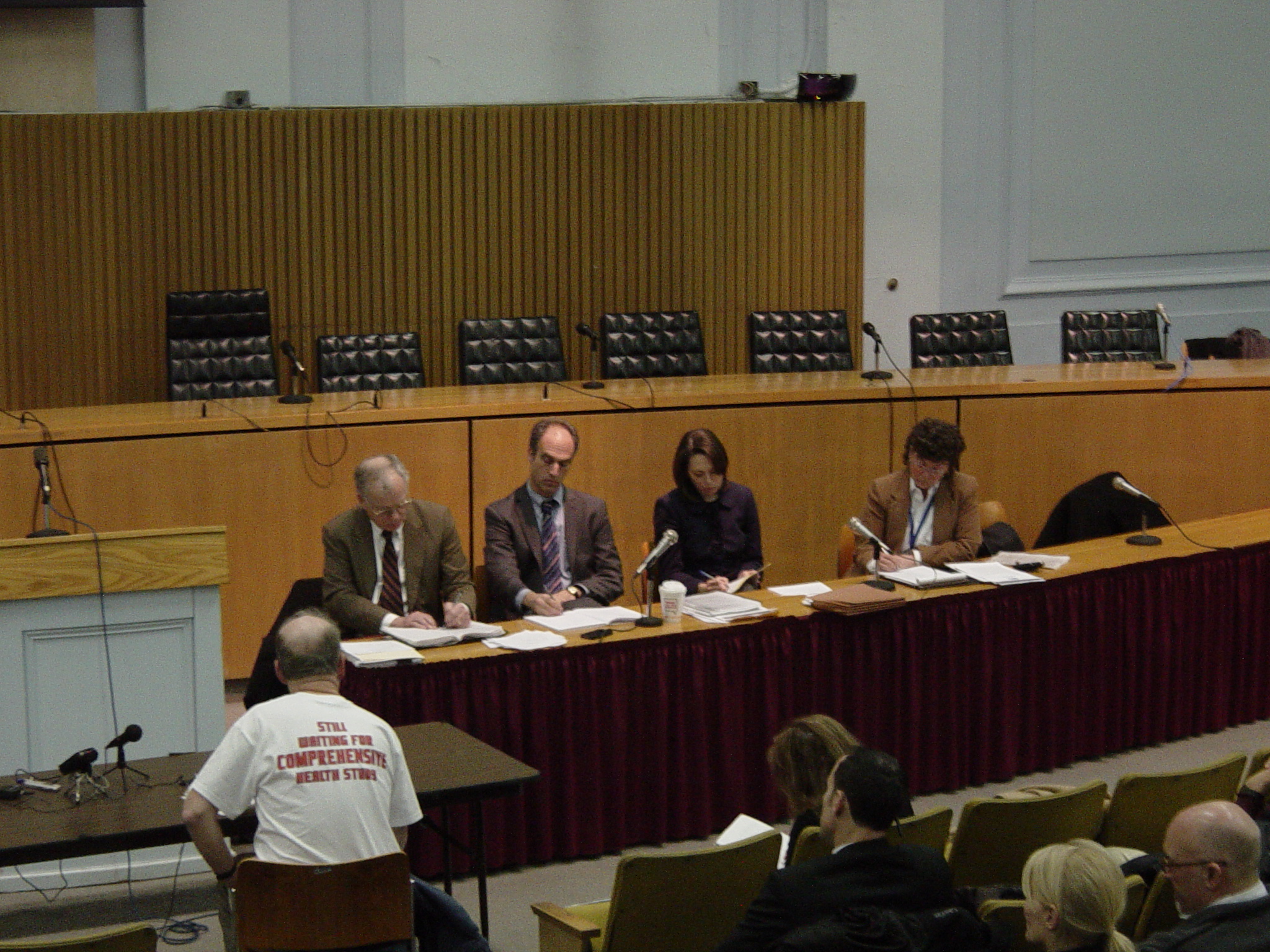
Falmouth resident Malcolm Donald addresses state officials. His T-shirt reads, “still waiting for comprehensive health study.”
R-L Suzanne Congdon, MassDPH; Alicia McDevitt, MassDEP; Ken Kimmell, DEP Commissioner
Bob Salsberg, reporting for the Associated Press was picked up by the Boston Globe. Mass. wind turbine health study debated at hearing
Neil Anderson says the headaches, dizziness and palpitations began shortly after Wind One, a 400-foot high wind turbine, began operating about a quarter mile from his Falmouth home. So did sleep disruptions, ringing in his ears and elevated blood pressure.
In contrast to claims of wind developers that opponents are holding up transition to renewable energy, Ben Luce’s recent presentation in Shelburne demonstrated that 30 Massachusetts ridge lines would be sacrificed to develop the 1 gigawatt estimated capacity of wind resources–acres of trees removed, water supplies disrupted, and habitat lost all for the sake of the equivalent of one conventional power plant.
The WWLP Channel 22 coverage by Christine Lee Wind farm opponents reject study; Say DEP study ignores evidence has produced a robust conversation in the comments.
A. R. Michka says of pro-wind people who think “’Harnessing wind energy resources will allow us to actually shut down coal plants….'”
Not so fast. The latest ISO New England Regional System Plan predicts that New England’s existing coal plants will be replaced with natural gas generators. The wind for coal exchange exists mostly in the minds of those promoting wind energy to New England. It’s a great pitch, and a lot of people fall for it, but it’s patently false. Coal is a base load generation fuel. Wind has no appreciable capacity to contribute to base load generation.

 Wind Wise ~ Massachusetts