Wind Wise Radio–Whitley County, IN & Lowell Mountain, VT
 The Indiana group, Whitley County Concerned Citizens, celebrates their victory on September 15th. In establishing a half-mile setback for industrial wind turbines, “Whitley County is now wind farm free.” WWR will interview Joan Null and Tony Fleming about their fight to protect communities in Indiana. The program airs live at 7:00 pm EDT on August 19, 2012 and repeats any time on the web at Wind Wise Radio.
WWR will also be speaking with some of the heroic Lowell Six who were convicted of trespassing on the disputed land at Green Mountain Power’s Lowell Vermont wind disaster.
 Here they are standing outside the courtroom with their lawyer prior to the start of the trial. They are, left to right, Ryan Gillard, attorney Kristina Michelsen, Robert Holland, Suzanna Jones, David Rodgers, Eric Wallace-Senft, and Anne Morse.
Dawn Devlin Calls in on the Diane Rehm Show
The usually well-prepared Diane Rehm let the AWEA get out its self-serving view of wind power while caller Dawn Devlin presented the “ground-truth” during the August 16, 2012 radio program on NPR. The topic was “The Politics and Potential of Wind Power.”
The clip is here:  . Contact Diane Rehm at Contact Us | The Diane Rehm Show from WAMU and NPR.
Noise Testing–Do it Right
The residents of Kingston and Fairhaven who have complained about noise have some reason to expect testing to vindicate their experience. According to Alicia McDevitt, who just left the MassDEP to become head of the MassCEC, if there are a lot of complaints, the noise source usually exceeds the 10 dB(A) limit (comments at the Wind Working Group presentation on July 18, 2012).
However, in a post comment by Chris Kapsambelis, he warns that residents
need to take note of the fact that the MassCEC Acoustic Study Methodology for Wind Turbine Projects does not use the absolute maximum metric Lmax to determine compliance. It continues to use the L90 metric which was used by the developer in Falmouth to initially declare Wind-1 in compliance. Since then the MassDEP has rejected this approach in favor of the Lmax metric which was used to find Wind-1 out of compliance at night.
The MassDEP instructions for taking field “background” readings is “Take an instantaneous reading every 10 seconds until you have 100 readings. The 10th lowest reading is the ‘background’ level” (i.e. the “L90” level, the level which is exceeded 90% of the time.” (MassDEP Guidance, 2003, p. 12).
In Acoustics and Wind Turbine Noise Chris explains the issues involved in noise testing as well as the consistent track record of the DEP–using the maximum volume of noise from wind turbines for compliance testing protocols.
“Don’t Rush to Embrace Unproven Wind Energy”
 Marie Stamos’s piece in the Patriot Ledger (8/11/2012 points) out the incorrect assumptions people make about laws like the energy bill that passed in the final days of the formal session in July. When it comes to renewables, people think wind turbines and photovoltaics. They ignore efficiency and large scale hydro–which aren’t included in Massachusetts’ green portfolio standard. They think the 64,000 “green” jobs are in new technologies, when in fact they are “antique dealers, resale shops” as well as “bus drivers, … bike repair shop clerks, floor sweepers in solar industries, waste management positions” and even “gas stations that pump gas into hybrid cars.” Her bottom line? Expect more expensive electricity from long-term contracts for wind and solar, but watch out for wind energy. “There are too many unknowns regarding the health, safety, economics of Industrial Wind Turbine technology for it to be pushed along at this time.”
Noise – Scituate Complaints; Kingston Tests
Life under the Scituate turbine is not all rosy according to Boston Globe reporter Jessica Bartlett’s piece Winds of discontent in Scituate.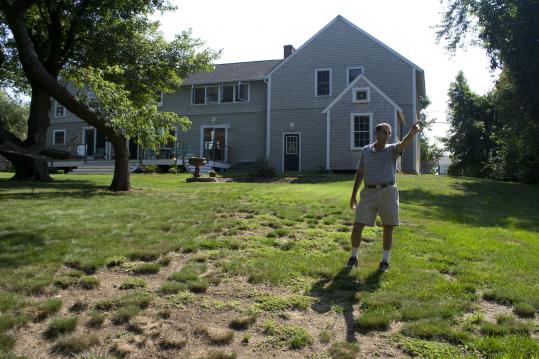
Nancy Melvin, 300 feet from the turbine, said she and her husband did not oppose the construction, ” but now, ‘he’s kept up at least two nights a week, or woken up and can’t get back to sleep.'” David Dardi (right), living over half a mile away is upset “by the whooshing noise that he says creeps into his bedroom two or three nights a week and wakes him up. Now he wants the town to take down the turbine.”
Linda Alvarez, who lives on Collier Road, said she has talked to 10 of her neighbors who hear the turbine at night, and all of them are upset about it.
“They don’t call it a windmill — it’s a turbine,’’ she said. “It’s not just a whoosh, whoosh; it’s a jet engine.”
While people living under and less than a mile from the turbine suffer sleep disruption, town officials trot out the misleading list of benefits–the “turbine is taking the equivalent of 600 cars off the road, saving 330,000 gallons of oil, and eliminating 6.5 million pounds of carbon dioxide per year”–none of these claims is relevant to wind turbines.
Scituate’s is a $6 million turbine operated by Solaya Energy LLC on town-leased land. The town receives $200,000 in energy credits because of the wind power plant.
Kingston’s four turbines have also garnered complaints, so the Department of Environmental Protection, charged with regulating noise, is deputizing the Clean Energy Center to test for noise there. But the CEC is the quasi-public agency that sites turbines, so residents question the reliability of their testing.
Christine Legere reported for the Boston Globe‘s Metro South section, State to measure noise near Kingston’s wind turbine:
“This sound study is being done in response to real, legitimate complaints from residents about existing turbines,” said Country Club Way resident Tim Dwyer, a member of Kingston Wind Aware, a citizens group lobbying to shut down the local turbines until a new permit review process is conducted. “I’m surprised that the entity chosen to make the sound assessment is an agency created to promote clean energy like wind turbines.”
The article points out that the CEC will probably be hiring a consultant to do the noise testing.
Last month, the town’s Board of Health asked state environmental officials to study noise levels.
The four machines in Kingston, which stand more than 400 feet tall, have been the source of numerous complaints from abutters, who say the whirring blades are causing health issues ranging from ringing ears and chronic headaches to vertigo and sleep disturbance.
Sunday 7/30/12 at 7:00 pm WWR discusses corporations which support wind energy as a part of their business plan with Miriam Raftery. She is an award-winning environmental journalist.

Jimmy Salamone from Fairfield, NY has been living with turbines that have been found out of compliance with noise regulations.
Iberdrola sent him a white noise machine and has installed special Noise Reducing Software on the turbines to mitigate the problem. Jimmy will be joining us later in the program to talk about the situation.
Show us the science says Lenox Selectman
Lenox Selectman Channing Gibson served on the town’s Wind Energy Research Panel, composed of 3 proponents and 3 skeptics. In his letter to the editor published in the Berkshire Eagle on 7/29/12, he challenges the governor to do what the panel did. They engaged in a cost/benefit analysis and used “a fact-based investigation of the positive and negative impacts — to the town’s economy, its environment and its citizens’ health — of siting wind turbines on Lenox Mountain for the purpose of generating electrical power for the town.”
It is not enough for the governor or anyone else to say that on-shore wind-generated power needs to be in the energy mix; they must prove it. The proponents of wind, especially the governor, must prove, definitively, to the citizens of Massachusetts that the enormous, taxpayer-supported subsidies our state offers to wind-power developers make economic sense and are worth the vast impacts to the ecology and scenic value of our ridgelines. Show us the numbers. They must prove, definitively, that there are siting standards that will protect human health. They need to prove, definitively, that the governor’s plan will reduce global warming, pollution and the destructive extraction of fossil fuels. Show us the science.
The town ultimately decided to adopt solar technology to meet town electricity needs. Clarence Fanto’s article in the Berkshire Eagle (Wind energy panel recommends against Lenox Mountain turbine) on February 17, 2012 reported
After four months of study, the majority of the Wind Energy Research Panel is recommending the proposal be scuttled because it won’t be a financial benefit to Lenox, but would raise health concerns and yield a negative environmental impact. The panel was assigned by the Select Board to evaluate a single or double municipal wind-turbine installation atop Lenox Mountain.
The report is available on the town’s website.
Testing…Testing…
MassDEP noise regulations (310 CMR 7.10) prohibit noise that is 10 dB(A) above ambient. This is measured by the difference between the lowest L90 reading with the noise source turned off to the absolute maximum reading with the noise source turned on. (View an interactive tutorial on noise levels.)
DEP Acoustician and Deputy Southeast Regional DEP Director Laurel Carlson has said that she will be using the same protocol as she used in Falmouth, which did compare the lowest L90 reading with the noise source off, to the maximum reading with the noise source turned on, when she tests turbine noise in Fairhaven. Alicia McDevitt, who just left the MassDEP to become head of the MassCEC, has also said “that the DEP measures the absolute maximum noise to compare to the ambient.” She went on to say at the Wind Working Group presentation on July 18, 2012 that if there are a lot of complaints, the noise source usually exceeds the 10 dB(A) limit.
Peggy Aulisio of South Coast Today reported on the Fairhaven Board of Health meeting of 7/23/12.
Ms. Carlson, who tested the wind turbines in Falmouth, said she will focus on four to five residences.
The homes are all owned by people who have submitted complaints about the turbines to the town’s Board of Health. They are located on Teal Circle, Mill Road, Little Bay Road and Shawmut Street.
Another location, Peirce Point, is also likely to be tested, Ms. Carlson said.
Carlson’s appearance was also reported by Ariel Wittenberg in the 7/24/12 South Coast Today article “DEP turbine noise test will begin as soon as weather allows.” Fairhaven’s Board of Health has received numerous complaints. Residents at the meeting expressed concern about infrasound, but Carlson said it is not regulated in Massachusetts.
According to iBerkshires reporter John Durkan, the gathering held at Mass. College of Liberal Arts in North Adams on July 26, 2012 was a chance to bring together proponents and dissenters for a discussion of wind energy attitudes for Franklin and Berkshire Counties (“Symposium Surveys Local Attitudes On Wind Power”).
Despite the volume of concerns, when polled, a total of 26 percent of the group polled said they would support a wind turbine in their town, while 41 percent were opposed and 33 percent answered neither.
The forum was conducted by Assoc. Professor Roopali Phadke from Macalester College (St. Paul, MN) under a grant funded by the NSF to research the visual impacts of wind power.
 Lucas Willard, reported on WAMC radio that the 24 residents invited to participate ranged in age from 19 to 78.
Some positive impacts expressed were increased tax revenue for a community, reduction of dependence on fossil fuels and reduction in air pollution. Cons identified were worries about health impacts, effects on the Berkshire tourism economy, cost, decrease in property values, environmental concerns, and loss of land control.
Cosponsoring the event was the Berkshire Regional Planning Commission, which hopes to use symposium data in its work as a technical advisor for potential wind projects.
The Concensus Building Institute also liked the mix of participants, according to the article in the North Adams Transcript by Phil Demers. CBI’s Stacy Smith worked on the NSF grant; she was brought in to Falmouth by the MassCEC to act as mediator.
The Franklin Regional Council of Governments was another cosponsor reported Diane Broncaccio in the Greenfield Recorder (“WHY THE RESISTANCE TO WIND? Study seeks insight into area attitudes Northeast states have fewer facilities, more anti-wind groups”).
Several (participants) said they have already lived “off the grid.” When asked to name an advantage of wind power, participants listed turbines as a chance to break away from fossil-fuel dependence, to help farmers increase productivity, to increase income and to provide “smallscale self-sufficiency. Others said they thought the economic benefits would all go to the developers, while the public would pay for the infrastructure. Health issues were a big concern for some, while others said the issue “will take us away from pursuing good energy policy” that should include using energy more wisely and improving energy efficiency.
| Results of the day’s poll: Do you support industrial wind turbines in Franklin and Berkshire Counties? Yes 14.71% (5 votes) No 82.35% (28 votes) Other 2.94% (1 votes) Total Votes: 34 |
WWR will interview Carmen Krogh and Barbara Ashbee about this open comment period for the planned study to “explore the relationship between wind turbine noise and health effects reported by, and objectively measured in, people living near wind power developments.” This is a joint effort of Health Canada and Statistics Canada.

Carmen Krogh is a retired pharmacist with more than 40 years of experience in health. She has held senior executive positions at a major teaching hospital, aprofessional association and Health Canada. She was a former Director of Publications and Editor-in-chief of the Compendium of Pharmaceutical and Specialties (CPS), the book used in Canada by physicians, nurses and other health professions for prescribing information on medication. Carmen has written and spoken extensively about the social and health impacts of industrial scale wind turbines. Carmen serves on the Board of Directors of The Society for Wind Vigilance.
Barbara Ashbee and her family were forced to abandon their home when their health suffered after huge turbines were sited too close. Barbara has been advocating for wind turbine victims for years.
———
In Michigan,WWR will speak to Josh Van Camp to find out more about a wind association’s (Great Lakes Renewable Energy Association) advise to government employees to delete emails related to a potential recommendation to lower Michigan’s noise level limit for wind turbines
In New Jersey, WWR will speak to Bill Heller about the injunction issued Wednesday to halt construction of the Bayshore Regional Sewerage Authority’s wind turbine.
in Vermont, WWR will speak to Luke Snelling (executive director of Energize Vermont) about the discrepancies between Governor Shumlin’s assessment and the facts on the ground at Lowell Mountain, protesters attempted to block the delivery of turbine parts.

 Wind Wise ~ Massachusetts