State Moves to Accelerate Wind Turbine Siting
Residents of communities where wind turbines are being considered may be tempted to sell and move as quickly as possible given the experience of people living near existing turbines.
Today’s ominous press release from the Massachusetts Secretary of Energy and Environmental Affairs announced “an inter-agency initiative… to provide support and guidance to municipalities, developers and stakeholders for land-based wind projects.”
But those same residents may want to stand their ground, knowing that “The Patrick Administration’s community wind energy initiative is just another attempt by the governor to force the development of hundreds of land-based wind turbines in Massachusetts, despite strong local opposition,” according to Eleanor Tillinghast. She points out:
“The legislature has refused for five years now to go along with [Governor Patrick’s] plan to strip communities of the right to control the location and operation of wind turbines, so now he’s doing an end run by directing his handpicked agencies to come up with a new strategy.”
Tillinghast is on the executive board of Wind Wise ~ Massachusetts, which is concerned that parts of the initiative are aimed at reducing not just local control, but also state noise guidelines. She stated, “This is just another underhanded power grab by the governor who persists in playing politics with the health and well-being of families who live near the wind turbines in order to promote his goal of building additional turbines.”
Kimmell Coy on Noise Testing
One official’s claim of compliance is another resident’s sense of violation as turbine noise testing lags. The Globe South on Sunday June 16, 2013 quoted Commissioner Ken Kimmell defending Department of Environmental Protection policy (Wind advocates say critics’ assertions are exaggerated by Robert Knox). According to Kimmell, most turbines are in compliance most of the time. But this belies the very few tests that have been run (“staffing limitations” were cited by DEP spokesman Ed Coletta), and the flawed methodology in use:
“It’s consistent with the methods used to deal with a variety of projects, such as sand and gravel and asphalt batching plants, for years,” Kimmell said. “We have people on the staff trained to recognize wind gusts and discount them.”
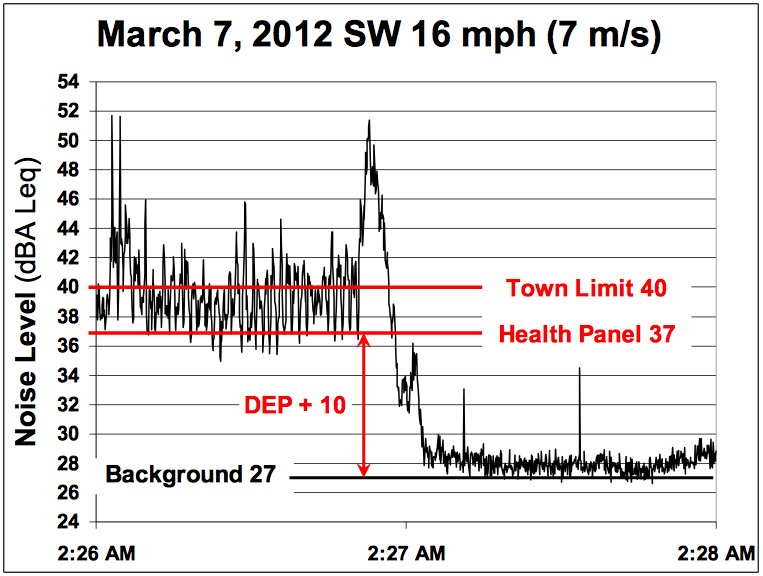
in May residents of Clarksburg, Fairhaven, Florida, Kingston, Monroe, and Scituate sent a letter to the Mass. DEP. These communities, impacted by five different wind turbine projects, asserted that DEP used outmoded standards for testing wind turbines. The letter also noted that developers have special access during testing, while community input is limited. The raw data is not shared, so it is not open to independent verification. The letter called for:
- Use of a fast meter (8 data points per second) setting during sound sampling. The present use of the slow setting (1 data point per second) fails to accurately capture the highs and lows of turbine sound.
- Allow independent monitors during data gathering sessions.
- Include the experiences of affected neighbors during testing, as in the recent study by multiple INCE Board Certified Acousticians at the Shirley Wind project in Wisconsin.
- Prohibit the turbine operators’ paid employees or subcontractors from joining the data gathering team, in order to prevent the potential for manipulation of the turbines during testing.
- Determine the actual production status of the turbine(s) during testing. Some of the testing should be performed unannounced to the turbine operators.
- Make the raw data publicly accessible in a spreadsheet or other digital format.
- Accept comments from independent INCE Board Certified acousticians before finalizing findings.
Mass High Tech Notes Recent Research Findings
In her  blog post, Patricia Resende, Managing Editor of MHT and Boston Business Journal, acknowledges new research findings that “Wind energy may be harmful to your health” (6/13/2013).
According to a recent report, industrial wind turbines can be harmful to people’s health. Well, at least for those who live near the turbines. The report says that neighbors of the wind turbines are at risk of a number of health ailments including stress and sleep disorders.
But, that’s not the case, according to Wind Wise Spokesperson Lilli-Ann Green. “These two papers are adding to the increasing number of peer reviewed medical studies that make it quite clear that the wind turbines are seriously affecting the health of individuals and families,” she said.
Farboud, Amir, R. Crunkhorn, A. Trinidade. “‘Wind turbine syndrome’: fact or fiction?” The Journal of Laryngology & Otology, Mar 2013. 127.3:222-6. doi:10.1017/S0022215112002964
This review article evaluates previous studies of low frequency noise and infrasound published in the last 10 years. The authors find “There is evidence that infrasound has a physiological effect on the ear.” and “There is some evidence of symptoms in patients exposed to wind turbine noise. The effects of infrasound require further investigation.”
Fairhaven’s Turbines Ordered Off at Night
Starting tonight the town’s two turbines–found out of compliance in MASSDEP noise tests–will be shut down from 7 p.m. to 7 a.m., according to Ariel Wittenberg reporting on the joint meeting of the Board of Health and the Board of Selectmen held at noon today (“Fairhaven halts overnight use of turbines” SouthCoastToday 6/10/13).
The shut down vote of the Fairhaven Board of Health was unanimous, and
the board of selectmen also voted to put the turbines’ developers on 30 days notice because state testing of the turbines revealed that the turbines not only violated state noise regulation but also violated the contract between developers and the Board of Selectmen. Under that contract, noise from the turbines cannot exceed 60 decibels at the nearest property. Testing on Mill Road in August revealed the turbine noise did exceed that number.
Louise Barteau said, “’Honestly, I’m really proud of our boards today,’” according to the SCT online piece. Louise will have more to say on the Phil Paleologos radio show on WBSM (wbsm.com) at 5:00 pm.
Ray Hartman Debunks DEP Panel in RI Testimony
Submitting a thorough critique of the 2012 MassDEP “expert panel” report, Ray Hartman demonstrates the fallacy of using those findings to justify wind turbine siting. In his statement to the ZBA for Whalerock Wind Turbine hearing in Charlestown, RI, Harman details the report’s inadequacies:
MAJOR FLAWS OF THE HEALTH IMPACT STUDY
- The Panel who authored the Study was not independent.
- The Panel who authored the Study is no more expert than the many scientists whose research the Panel peremptorily dismissed.
- The research design of the Panel is fatally flawed.
- The Panel failed to implement the appropriate statistical methods to test for the occurrence of IWT-induced adverse health effects.
- The Panel failed to use readily available and most relevant data for experimental sites in New England.
- The Panel cherry picked 5 research studies and ignored countless others.
- The Panel failed to fully report the findings of the limited number of articles upon which it did rely. A more complete reading of these articles reveals scientific findings of adverse health effects.
Raymond Hartman is Director and President of Greylock McKinnon Associates (GMA), a consulting and litigation support firm located in Cambridge, Massachusetts. He is a mathematical economist specializing in microeconomics, econometric and statistical modeling and the study of industrial organization.
 The preliminary report on noise testing of Fairhaven’s two wind turbines, unveiled by Mass. DEP’s Deputy Commissioner Martin Suuberg at the Board of Health meeting on May 21, 2013, continues to invoke strong language.
“Tuesday night’s board meeting erupted in angry shouts” according to ABC6 news political reporter Mark Curtis (“Fairhaven Wind Turbine Dispute Gets Louder” 5/22/2013). He later spoke with resident Louise Barteau, who attended the meeting.
LB: I think the people of Fairhaven have suffered long enough and I think they deserve better.
MC: And you want these shut down now?
LB: I want these turbines shut down now. They are too loud and too close, to too many people.
Curtis noted that the noise issue doesn’t apply just to Fairhaven.
In “Fairhaven eyes partial turbine shutdowns” (South Coast Today 5/22/2013), Ariel Wittenberg quoted Selectman Chairman Charlie Murphy,
“Before people didn’t believe the turbines were that loud at night, but now the study shows it,” he said.
On Wednesday, he said the study’s findings have only strengthened his resolve to “give our residents a good night’s sleep.”
The Board of Health agreed to the Selectmen’s request for a joint meeting. In his terse letter setting the 3-week delay and the awkward mid-day meeting, Chairman Peter DeTerra wrote “Per your request, the Board of Health will meet with the Board of Selectmen on Monday, June 10, 2013 at Noon at the Town Hall. This is the earliest date possible for the Board.”
In Kingston this week another report was issued. Noise Control Engineering (NCE), an independent acoustical firm, evaluated the O’Donnell turbines. The authors found that their data indicates “the O’Donnell Wind Turbines are generating noise that is in excess of the MADEP broadband noise regulation.” The report states:
Of the four neighborhood locations, two were found to be in excess of this regulation with increases over the reference/background noise level of 12 and 16 decibels…. The turbine induced noise is significantly above the MADEP regulation that only permits up to a 10 decibel increase.
This comes as no surprise to residents who suffer the sleep deprivation of noisy nights. “Residents are being forced to abandon their homes during periods of high wind speeds. Others, with no alternative, simply hunker down and try to survive day-to-day with a debilitating lack of sleep,” according to the letter Tim Dwyer dispatched to Selectmen. He is requesting a meeting on June 4, 2013 to discuss the NCE findings. The letter is reported in the Wicked Local Kingston article by Kathryn Gallerani, “Kingston resident claims independent testing of O’Donnell turbines proves non-compliance” (5/25/2013).
“The evidence that the O’Donnell turbines are operating outside the boundaries of the DEP noise regulation is incontrovertible, and the effects are devastating,” he writes.
Dwyer said being out of compliance would put O’Donnell in default of the town’s zoning bylaws and in violation of Wind Power Purchase Agreement she signed with the town.
Late the previous week Kingston learned Kially Ruiz, operator of the Independence turbine, will not cooperate with DEP-contracted testing of all four turbines in the town (“UPDATE: Independence turbine owners refusing to cooperate with sound study” by Kathryn Gallerani, Wicked Local Kingston 5/21/2103).
Following the Money
Confirmation that wind turbines in Fairhaven and Kingston violate DEP noise guidelines surfaced this week. Resident complaints have already resulted in lawsuits–or soon will. Noting the expense of litigation, Laura Griffin’s Guest Editorial in the Milton Times, (“Time for Debate on Wind Turbine” 5/23/2013) says
“…lawsuits about health and noise are dogging turbine projects across the state. Falmouth even considered dismantling its turbine.
Litigation costs more than wind power earns, so the lost time and the litigation may have worked in [Milton’s] favor. What’s needed is a public discussion and that’s never been the case with the wind turbine.”
The Milton turbine is currently on hold since a binding arbitration order was issued, ruling that the turbine cannot be run during hours when golfers are present at the Quarry Hills Golf Course on the Quincy/Milton line.
Griffin spells out the costs to date: “As of May 15, the town had spent more than $1 million on the wind turbine project and a quarter of that or $246,000 has been for legal fees.”
Costs for turbine curtailment and litigation are only two pieces of the economic puzzle. A third element is lost value in people’s property.
In the wake of Falmouth’s defeat of Question 2 on how to finance dismantling the town-owned turbines, Neil Andersen challenged the town to “‘Deal with us [abutters]. If you’re going to buy my house, do it. Let me put an end to this hell.'” According to Brent Runyon, reporting for The Enterprise (“Neighbors React to Town’s Vote to Not Dismantle Wind Turbines” 5/24/2013), Andersen’s home is assessed at $525,400.
Good luck getting that kind of money any time soon.
Ariel Wittenberg, interviewing homeowners and realtors for the South Coast Today (“Turbines complicate sales of abutting homes” 5/25/2013), got an earful on the turbine effects on property values.
After a few months of “watching buyers come by, look at the turbines and drive away,” [Fairhaven turbine neighbor Justin] Downey took it off the market and said he is now hoping to find someone to rent it.
Realtor Susan Whitehead said she has been trying to sell a property on Weeden Road for two years. That property was put on the market for reasons unrelated to the turbines, but Whitehead said buyers ask about the machines, which are visible across Little Bay, “100 percent of the time.”
“They ask about the noise, they ask about the flicker, and then they don’t put in an offer,” she said.
Because of this, the asking price of the home has dropped from $389,000 to $244,900, Whitehead said.
Trying to sell a home near wind turbines is something Falmouth real estate agent Margaret Gifford said is not easy. There, residents have been battling to shut the turbines off for the past two years, and Gifford said agents swap stories of houses languishing on the market for years at a time, being passed around from broker to broker.
In the run-up to the Falmouth election, Laura M. Reckford had explored issues with the real estate market there in her Cape Cod Wave piece “Falmouth Real Estate — ‘The Turbine Effect’” 5/15/2013.
Outrage in Fairhaven; Dismay in Falmouth
When the DEP’s Deputy Commissioner Martin Suuberg reported at the Board of Health presentation on May 21, 2013, he said testing measured 5 instances where turbines were out of compliance at 3 locations. The best he could offer the disturbed audience was a promise to work with developers. According to Louise Barteau:
The citizens of Fairhaven are outraged that there were five instances where the turbines were found out of compliance, and the state DEP and the town Board of Health are not taking any action. Why is there no action to stop the turbines?
Barteau said the findings identified noise readings that exceeded the DEP’s guideline of 10 dB(A) above ambient on November 9, 2012 at 12 Little Bay Road (10.7), on March 20, 2013 at Pierces Point (11.4), on April 2, 2013 at Little Bay Road (12.9) and on April 12, 2013 at Little Bay Road (11) and Teal Circle (11.5).
——-
The lop-sided vote on Question 2 in Falmouth on May 21st was sobering. Scott Giordano Tweeted for the Bulletin: “election results: 6,001 NO votes & 2,940 YES votes on removing the turbines.” In spite of the concern expressed in recent weeks by many townspeople over the divisions created by the turbines, the sheer cost may have been the deciding factor.
I will abide with the result of Question 2. But I must, at the same time, continue the work necessary to preserve acceptable health and living conditions for all residents of Falmouth.
Falmouth Votes on Turbine Question Tuesday
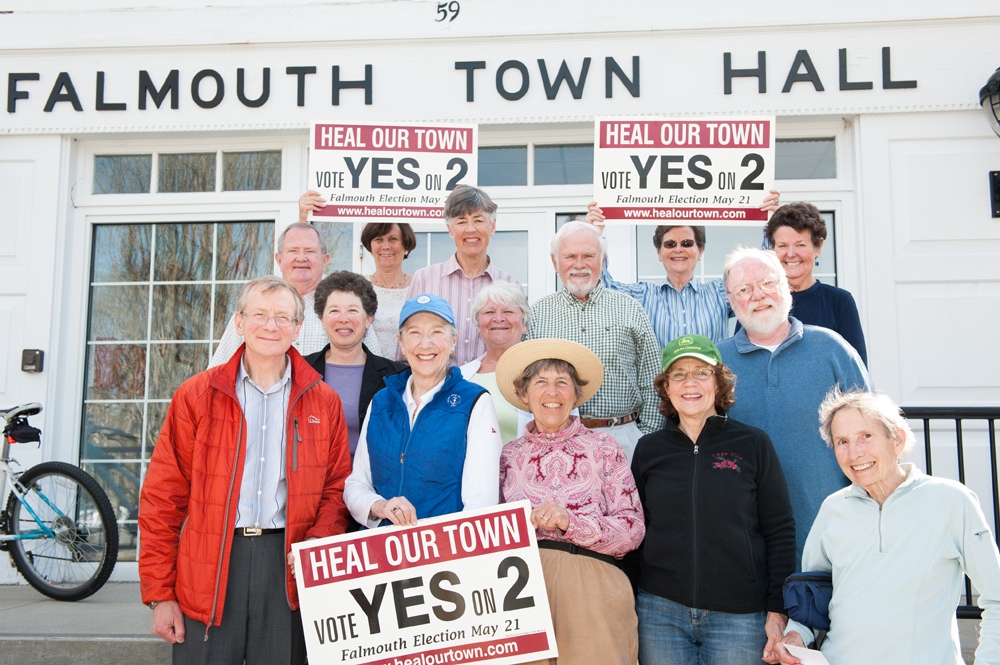 Interest in the outcome of Falmouth’s vote on May 21, 2013 continues with reports on National Public Radio, in the Cape Cod Times, the Falmouth Enterprise, and in the online magazine, Cape Cod Wave.
Sean Corcoran’s piece, Cape Cod Community To Vote On Status Of Wind Turbines for WCAI–a National Public Radio affiliate–sets the scene:
Falmouth was among the first towns in Massachusetts to install large turbines so close to homes. When people complained, the town tried curtailing their operation when it got real windy. Then they shut them off at night. They even considered buying out the homeowners.
But now Board of Selectman chairman Kevin Murphy says the turbines simply need to come down.
In “Falmouth turbine removal up for vote” in the Cape Cod Times of 5/19/13, Sean Teehan captures one of the views frequently expressed: townspeople were for wind energy until they saw the effect the giant turbines had on residents.
Linda Davis supported building and paying for two town-owned wind turbines when the project came before voters at town meetings between 2007 and 2009.
But as the complaints from neighbors living near the turbines grew since the first one started spinning in 2010, Davis had second thoughts and began poring over her notes and reviewing videos of those meetings.
“Clearly, very few people asked questions, and everyone was on board,” Davis said. “It became clear this year to me and to other people who were sort of on the sidelines watching “» we really had a problem here, and it was tearing our community apart.”
Laura M. Reckford’s article in the Cape Cod Wave, (“Falmouth Real Estate — ‘The Turbine Effect’” 5/15/13), explores the uncertainty the real estate market is feeling as properties stay on the market longer and are sold a reduced prices.
Realtor Nadine Krasnow of Falmouth Fine Properties said she has no doubt that the turbines have affected property values in the West Falmouth neighborhood with views of the 400-foot high towers.
“In my opinion, it’s had a noticeably chilling affect and it has definitely become more difficult to sell houses there; and the reason is, if people have other choices, which they do, why are they going to buy in a place where value has gone down and it’s unclear what will happen in the future?”
Krasnow said that slow home sales in the neighborhoods near the turbines seem to be an exception from the rest of town, which has rebounded well from the recession in recent months.
When Brian Tarcy interviewed three former selectmen (Cape Cod Wave: Three Former Selectmen Offer Prespectives on Turbines 5/15/13), Eric Turkington (also former State Representative) observed:
“As more and more people testified that they had experienced health problems, others heard their voices and went up to investigate, and it became clear that this was not a bunch of hypochondriacs. Defenders of the wind industry say the connection between the turbines and the health problems haven’t been proven in scientific studies. Well, it will be.”
More information on the costs and issues can be found at the Heal our Town website. For a chronology of Falmouth’s town-owned turbines, Mark Cool’s Firetower Wind blog offers editorials from an impacted wind neighbor. The recent events are highlighted in “A warning to communities…” (3/20/2013). The earlier sequence is detailed at Falmouth’s Energy Debacle Timeline | Firetower Wind.
Falmouth Enterprise: “Vote Yes on 2”
The Falmouth Enterprise editorial of May 7, 2013 endorses Question 2. Here are excerpts:
It is unfortunate that what began as such a noble cause has unfolded as a monumental error. Falmouth was among the leaders of communities with vision when it took advantage of state and federal incentives to buy and erect turbines in West Falmouth.
But as we all know, that noble endeavor has had a terrible side effect; it has rendered life almost unbearable-outright unbearable-for many of those who live nearby. In two weeks, voters will have the opportunity to follow the selectmen’s lead and put the town on a path to setting things right. We hope voters will approve Question Two by a large margin.
At stake here is Falmouth’s self-image as a community that cares. This is no small thing. Falmouth has long been a community of neighbor helping neighbor.
There will be a price tag to removing the turbines. But when has Falmouth ever said “no” to bringing relief to fellow residents?
There will be some who decry the expense as another bungled municipal project. They will be wrong. Installing turbines was right but the site was wrong and no one knew that at the time.
There will be many who believe that taking down the turbines will be a step backward in the effort to develop clean energy and lower our carbon footprint.
We don’t think so. As long as the turbines stand, they will hold captive the attention of policy makers and sap the will of the community to move forward with other renewable energy and energy conservation projects. The turbines need to come down so Falmouth can move forward.
What is not arguable is that the lives of some number of people living around the turbines have been made miserable. It’s time to move deliberately forward and bring them relief.

 Wind Wise ~ Massachusetts