Peru Rejects Turbine Noise at Special Town Meeting
Lucas Willard’s WAMC Radio news report captures the issues facing tiny Peru MA in “Voters In Berkshire Town Defeat Amendments To Wind Turbine Bylaw.” Monday’s special town meeting defeat of the proposed bylaws was significant. “‘If we had voted in favor of the proposal it would have opened up the entire town for development,’ said (John) DiTammaso.” Click here to listen.
John DiTamasso, a concerned town resident who engaged in grassroots organizing to encourage citizens to attend the meeting, said he is concerned over ill-health effects caused by wind turbines including headaches and sleep disruption,and said the changes would have taken power away from citizens in a town that many residents find is unsuitable for wind development.
The Berkshire Eagle also covered the meeting, reporting Peru voters reject plan to lower level of noise allowed by wind turbines:
The special town meeting was delayed 30 minutes to account for an overflow crowd at the Town Hall. The more than 250 people in attendance — 42 percent of the town’s registered voters — had to be shuffled to the more spacious new fire station.
Two of the opinions captured by staff reporter Dick Lindsay were:
“The bylaw should only allow turbines in commercially zoned areas,” said Candice Cahalan.
Kevin Cahill, who is concerned a greater setback is needed from homes, wants to revisit the bylaw allowing for up to a 660-foot turbine 990 feet from the nearest house.
He said no matter how many turbines are erected, “some people are going to suffer seriously with their health.”
WAMC’s Willard included a clip from an interview with Steve Ryeck of Heath, who noted “‘When we did the research it became fairly clear that there were a lot of issues around health and noise.'” Willard also included Eleanor Tillinghast’s view:
“I think what we’re seeing throughout the region, throughout the state, and actually throughout New England is that people are looking at the experiences of other people who live near wind turbines and are saying ‘we don’t want that in our community’,” said Tillinghast.
Eleanor is a board member of Wind Wise ~ Massachusetts who lives in the Berkshires. For more on the bylaw language, see Peru’s Voters Weigh Noise Control.
Strong Testimony Supports Independent Commission
From around the state, over 25 wind “neighbors” and their supporters gathered in Boston for the bills to create an independent commission to study health effects from wind turbines. Most testified before the Joint Committee on Public Health. Sean Driscoll captured the message effectively in his report for the Cape Cod Times (“Falmouth residents testify on health effects of wind turbines“):
BOSTON – Three years after the first wind turbine went up at Falmouth’s wastewater treatment facility, town residents had a message Tuesday for state legislators: A thorough, scientific study of how the devices affect the human body is long overdue.
Describing herself as a “wind refugee,” Sue Hobart led off the series of emotional personal accounts. She was forced to abandon her home, she said, because of the grave health effects she experienced from the Notus turbine at Webb Research. The 7 people from Falmouth were joined by 9 others–from Kingston, Fairhaven, Scituate, and Florida, Mass. Dan Alvez from Kingston said that although he voted for the town to become a “Green Community,” the recent study of “flicker” confirmed his experience with the strobing light thrown by the Independence turbine–it affects his home 141 days of the year.
Even the pro-wind Sierra Club supports the independent commission, according to the State House News Service report published on Boston.com (“Cape Cod lawmaker pushes for study of turbine health effects“):
Roxanne Zak, energy committee chair of the Sierra Club, said a study would provide information about the proper amount of distance between wind turbines and residents to prevent health effects on residents. Zak said it is critical for the public to acknowledge “wind turbine syndrome” is real, and that sound and pressure differences can create health problems for some people.
“We can’t dismiss the evidence that people are having problems,” she said.
Sullivan is CWOI on Wind
Secretary Richard K. Sullivan told Patrick Cassidy of the Cape Cod Times (“Taking sting out of wind turbine siting” 6/28/13) that the new initiative announced last week would look at successful wind energy projects. The definition of “successful” is left unstated.
Being coy about wind projects is part of the game for this administration. In this case, the “coyness” is CWOI–short for Community Wind Outreach Initiative:
The effort announced by Sullivan — dubbed the Community Wind Outreach Initiative — will include representatives from his office, the Department of Energy Resources, the Massachusetts Clean Energy Center, the state Department of Environmental Protection and the state Energy Facilities Siting Board.
The question is, how will the administration promote safe siting? That requires finding locations where turbines will produce no noise impacts and no strobing hazards. To date, the most recent studies that establish distances at which effects are felt are Nissenbaum’s (et. al.) studies in Maine, The Shirley WI research, and Shepherd’s study in New Zealand. International groups call for a minimum distance of a mile and a quarter (2 km). With the safety of these distances in doubt, it is wise that Secretary Sullivan does not rule out a more robust and scientific study than the selective literature review sponsored by Mass DEP and MDPH in 2011-2012.
“Again, we’re not sitting here saying we have all the right answers,” he said. “We want to get this right.”
Sullivan said he is open to the possibility of a more comprehensive state or federally supported study of the health effects of wind turbines.
Malcolm Donald, in a Cape Cod Times Opinion piece “Turbine neighbors unmoved by new wind outreach plan,” elaborated:
This should offer a smile to the Falmouth Board of Health, whose request to the state Department of Public Health to conduct such a study a year ago was rejected because it didn’t have the funds. (Oh, but Sullivan is not the DPH commissioner. He only controls the vast pools of Massachusetts Clean Energy Center money collected from every electricity ratepayer in the commonwealth each month.)
As a caller to WCAI’s On Point with Mindy Todd, Donald noted that the promise Governor Patrick made–not to leave Falmouth “holding the bag”–seems in doubt. Malcolm said, “Falmouth is still holding the bag. Either the turbines must go or the neighbors must go.” The program “What’s the Future for Land based Wind Turbines in Massachusetts?” was broadcast on June 27, 2013.
Four bills filed on behalf of Wind Wise ~ Massachusetts will be among those addressed at a state house hearing on Tuesday July 9, 2013. People from many communities around the state–both with and without wind turbines–will present testimony. The hearing begins at 9:30 am according to the office of John F. Keenan, the Senate co-chair of the Joint Committee on Public Health.
The bills were filed by senators and representatives across the state, from Sarah Peake on Cape Cod to Michael Knapik in Western Mass. and including Todd Smola and George Peterson in Central Mass. The bill numbers are:
- S.1041 An Act to Protect the Health of Citizens of the Commonwealth filed by Senator Knapik. This legislation establishes a commission to study the health impacts of wind turbines and to recommend administrative and legislative changes to mitigate or eliminate any adverse health effects from wind turbines.
- H.2048 Resolve to Establish a Commission to Study the Health Impacts from Wind Turbines filed by Representative Peake. This legislation has a more specific mandate to investigate and study the incidence and impacts in the Commonwealth of adverse health effects from wind turbines.
- H.2049 An Act to Protect the Health of Citizens of the Commonwealth filed by Representative Peterson.
- H.2089 An Act to Protect the Health of Citizens of the Commonwealth filed by Representative Smola.
Co-sponsors of the bills are similarly bi-partisan and even more varied geographically.
Fairhaven Town Counsel Ignores Privacy Promise
South Coast Today reported on July 4, 2013 that a questionnaire emailed to town residents had several startling elements. Peggy Aulisio’s article “Questionnaire on wind turbines raises concerns” revealed that a message sent to about 60 households which had submitted health complaints about the two wind turbines violated the confidentiality statement on the form itself.* The email header listed the addresses of all the individuals to whom the questionnaire was sent.
Another cause for concern, according Louise Barteau, is the appearance that the survey was intended to identify residents who had been opposed to the turbines all along.
Ms. Barteau said the questionnaire sounds like something the developer, Fairhaven Wind LLC, would have written. She said it raises red flags because it is mostly concerned with whether residents were opposed to the wind turbines before they went up and had health problems previously. She said the survey doesn’t seem to be interested in the sleep deprivation or health problems residents are experiencing.
Peter DeTerra, Board of Health Chairman, identified Town Counsel Thomas Crotty as the sender of the e-mail. DeTerra told SCT that Crotty wanted to bring more “neutral” voices to the July 15th hearing requested by the turbine developer. The questionnaire is signed by Board of Health Agent Pat Fowle, who declined to comment to SCT Editor Aulisio. The article also reported that Board of Health member Barbara Acksen, and Selectman Chair Charles Murphy, both were unaware of the email message.
*Privacy: The Board of Health will maintain these records. All personal information will remain confidential. The owner of the wind turbines will be contacted about the nature of the complaints. This information is confidential and will not be shared unless express permission is granted by the complainant.
The questions included in the email are provided below.
Peru’s Voters Weigh Noise Control
 Peru MA voters have an opportunity to reject a change to their bylaws. The existing bylaw could be stronger, but the proposed new language will make them weaker. It is important that the town is working to protect residents from wind turbine noise, the kind that has prompted hundreds of complaints in communities across the state, including: Hancock, Florida, Clarksburg, Monroe, Scituate, Kingston, Fairhaven, and Falmouth.
The bylaw proposals headed for town meeting on July 8, 2013 would allow wind turbine noise above 40 decibels at 1000 feet. Peruvians can protect themselves by just saying “No” at town meeting on Monday at 7:00 pm at the Peru Community Center.

Noise complaints are a reliable predictor of decibel level, as illustrated by acoustic experts Stephen Ambrose and Rob Rand. They have gathered a series of studies that show how.
The Mass DEP, which responds to noise pollution, has a current state guideline limiting allowable noise to 10 decibels above the ambient. Ambient sound is the background level when turbines are not operating.The DEP has found turbines in Falmouth and Fairhaven to emit noise above that level and those communities have ordered the turbines to be shut down at night.
A proposed new zoning bylaw also waives peoples’ right to quiet at their properties. No one should have to live with unreasonable noise.
Proposed:–new section 10.4 (d)
The Peru Zoning Board of Appeals shall waive the requirements in Section 10.5(a) herein when the owner of any Inhabited Structure so grants his or her permission. Said permission shall be in writing and recorded in the Berkshire Middle District Registry of Deeds.

The Peru wind project known as “Garnet Wind” is a commercial project of Boreal Renewables based in Arlington MA and juwi, an international renewable energy company whose world headquarters is in Wörrstadt, Germany and its U.S. headquarters is in Boulder, Colorado.
With more than 70 residents in attendance–some pro-wind-development and others concerned about resident safety–Fairhaven’s Selectmen heard the proposed mitigation plan. Ariel Wittenberg, reporting for South Coast Today, said developer Sumul Shah believes that turning off one turbine will do the trick:
Three members of Fairhaven Wind LLC met with selectmen Monday night to submit a “mitigation plan” and explain what developer Sumul Shah described as the “extreme step” of shutting off one turbine per evening.
Tests conducted by Fairhaven LLC and the Massachusetts Department of Environmental Protection last week confirmed that shutting down one turbine overnight would ensure the turbines do not exceed state noise regulations, Shah said.
Shah’s presentation to selectmen was required because the board put the developer on 30-day notice for violating the lease by violating state noise regulations. The overnight shutdown of both turbines was mandated by the Board of Health, which will have to review any mitigation plans before they are put in place. The health board will meet with Fairhaven Wind at a July 15 meeting.
While Shah’s presentation had the sound of compromise, it again pits economic interests against residents’ health. Wittenberg did not gather any comments from wind neighbors who were in attendance.
Selectman Charlie Murphy said he is interested in whether the developer’s plan would be “a way we will not have an economic impact on the Town of Fairhaven and still allow people to have a good night’s sleep.”
Falmouth Considers Multiple Options
In his Wicked Local Falmouth account of the open Falmouth Selectmen’s discussion of options for addressing wind turbine issues, reporter Scott Giordano expanded on his live tweets during the meeting (“POLL: Turbine discussion divides Falmouth selectmen” 7/1/13).
Selectmen Chairman Brent Putnam said while the July 1 meeting is a “preliminary discussion” with no input from the public, he believes public comment will be allowed at future meetings.
Giordano published a roundup of the meeting highlights which included:
· The majority of selectmen seemed to think the option of removing the turbines is now off the table, based on the May 21 election results. But Putnam said that would depend on whether the state would help fund removal of the turbines.
· Selectman Kevin Murphy noted that turbine neighbors still can attempt to remove the turbines through legal challenges.
· Putnam said if the town looks at eminent domain as option, they would need to come up with a figure to buy and re-sell homes and go back to Town Meeting for a vote.
· Murphy suggested selectmen wait to hold a public hearing until selectmen formulate a plan/option on how they wish to proceed.
· Selectmen agreed to delay any further public discussions on the wind turbines until August, while they gather more information.
————————-
Live-tweeting from the Falmouth meeting on Monday July 1, 2013, Scott Giordano captured the “what-to-do” angst. These items paraphrase a few of his tweets:
- Flynn: selectmen must develop an operating plan; voters said we don’t want to pay to take down the turbines.
- Murphy: lawsuits continue as an option for residents seeking removal
- Putnam: Is taking down turbines entirely off the table or is relocation possible; consultant Tony Rogers estimates 20-40 houses could be sources of litigation; engaging in “mass eminent domain” requires a cost estimate; people are able to sleep now (under night time curtailment)
- Jones: “We’ve had all the meetings and heard all the experts. We may just have to make a decision.”
But no decision was forthcoming this night. Falmouth will consider turbines again next month.
Scott A. Giordano is @ScottGBulletin and reports for The Bulletin and Wicked Local Cape Cod.
One Down in Scituate
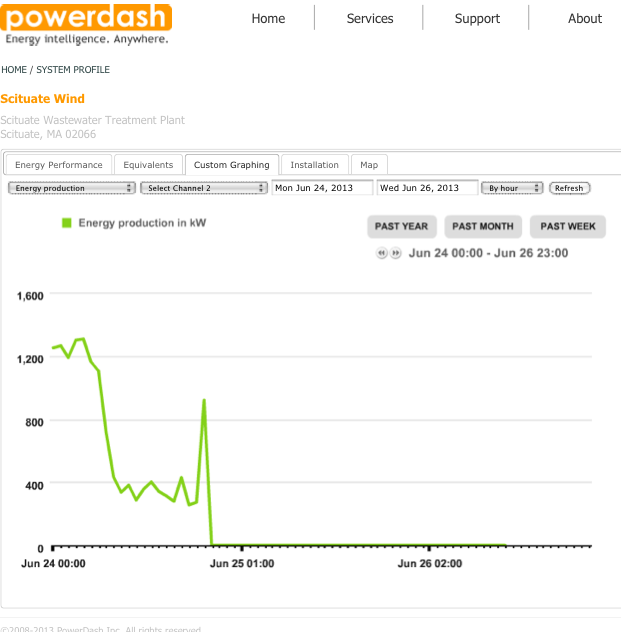 Scituate Wind neighbors who monitor the online power dashboard noted some strange readings followed by a dip in output after a thunderstorm Monday night. Despite several days of tweets and posts, it took reporters a while to track down the details of the Scituate wind turbine outage.
According to Nancy White’s reporting in Wicked Local Scituate “Scituate wind turbine may have been hit by lightning” (6/27/13):
Sometime during the storm – between 8 and 9 p.m. – the turbine had a number of errors within its electronic systems, (Sumul) Shah said. The turbine has not been running since that time. “It’s a slow and tedious process,” Shah said of going through the turbine’s many electronic systems and errors. “We have to look at everything, soup to nuts.”
Some residents noted what appeared to be a blackened area on one blade, but according to White, Shah did not confirm any charring and said the blade has a system to protect it from lightning.
Scituate’s DPW director Albert Bangert also told White that the turbine may have been hit by lightning, but the only damage was a blown fuse.
Senate President Therese Murray has sponsored a bill to provide state aid to Falmouth to decommission the wind turbines, according to the Wicked Local/Falmouth Bulletin report of Scott Giordano on June 27, 2013 (“Murray sponsors bill to fund removal of Falmouth’s wind turbines“). Co-sponsors of Senate Bill 1802 include state representatives David Vieira, R-East Falmouth, and Timothy Madden, D-Nantucket.
The Falmouth Selectmen will meet on July 1 in a working session to consider options following the defeat of a Prop 2 1/2 override–one of the possible ways to fund the costs associated with dismantling the two town-owned turbines.
A hearing on the bill has not yet been scheduled by the Committee on Municipalities and Regional Government.

 Wind Wise ~ Massachusetts