MassDEP Considers New Noise Regs
The MassDEP’s Wind and Noise Technical Advisory group met on 3/7/14 to review the committee’s work. Laurel Carlson, DEP Deputy Regional Director, presented her discussion document overview.
Presentation by Laurel Carlson, MassDEP, on possible changes to the MassDEP approved methods of noise testing.
Compliance Testing–DEP favors retaining 10 dBA. “Slow is out, fast (meter) is in.” Attended data collection is still in; have not settled on “when” or “where” of testing.
Alternatives that have been raised; pre-construction permitting & additional recommendations are reviewed
Laurel Carlson continues with additional recommendations, noting attended sampling is logistically challenged. Comments by Stephen Ambrose, Todd Drummey (about Falmouth), and Michael Bahtiarian. DEP’s Martin Suuberg responds.
Issues with Pre-construction background noise levels
Carlson and Suuberg both repeated the DEP’s interest in getting comments on the findings to date and especially on the unresolved concerns.
According to Stacie Smith of the Consensus Building Institute (CBI), the public can send comments through the end of March 2014 to WNTAG via jherlihy@cbuilding.org. CBI will compile and post the comments all on the WNTAG website, and notify the group that they are there.
Stephen Ambrose Presents: Wind Turbine Harm
 In his slide show revisiting the Bruce McPherson (memorial) study, acoustician Stephen Ambrose demonstrated the shell game used to hide the impacts of wind turbines felt by nearby residents. Rob Rand collaborated on producing this quick, accessible series of images depicting where the harm lurks. Both Rand and Ambrose experienced adverse health effects while studying the Webb turbine from the home of Sue and Ed Hobart in Falmouth.
 Ambrose, who is INCE Board Certified, prepared “Wind Turbine Harm” as testimony for the Falmouth Zoning Board of Appeals hearing on March 6, 2014. His presentation was not projected, but was distributed at the hearing–in support of the claim brought by the Hobarts that the Webb Research (Notus) Turbine is a nuisance. The hearing was continued to May 1, 2014.
This “Bruce McPherson Study Epilogue” has also been submitted to the MassDEP Wind Turbine and Noise Technical Advisory Group (WNTAG), of which Stephen Ambrose is a member. The last meeting was held on March 7, 2014 and materials have not yet been posted on the WNTAG web site. Unfortunately, “neither infrasound nor low frequency is being addressed by WNTAG,” according to the minutes of the initial meeting held in July 2013.
The original study funded by Bruce McPherson was subsequently published in 2012 as “Wind turbine acoustic investigation: infrasound and low frequency noise – A case study,” a peer-reviewed article in the Bulletin of Science, Technology & Society.
Mapping Fairhaven Noise Complaints
 Noise complaints about the wind turbines in Fairhaven continue to come in. Turbine locations are indicated with yellow pins–at the center of the image. This map is based on complaints from a year ago and indicates locations with one or more complaints (red circles). The locations where DEP testing occurred are shown with yellow circles, and the places where exceedances occurred are indicated with blue circles. Additional complaints were lodged at locations outside the range of this map.
The new middle school, built since the turbines began operation, is the large rectangular structure in the lower left corner of the image. This is one of eight schools around the commonwealth located in close proximity to a turbine.
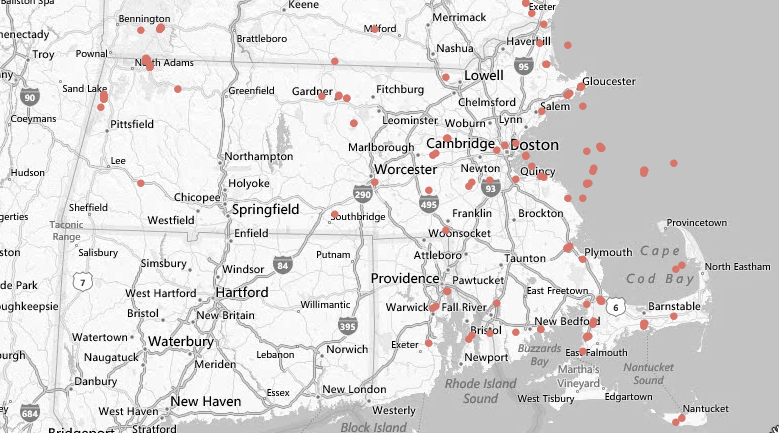
Turbines in this and other communities can be found in a new interactive GIS map developed by the United States Geological Survey (USGS).
Home Values Not Responsive to Statistical Analysis

The Boston Globe Magazine listing (2/9/14) of a Kingston home for $899,000 in the Country Club Way neighborhood reads like an ordinary upscale purchase until the last sentence: ” Cons A wind turbine is visible at street’s end.”
The 400+ foot turbine not only looms over the property, but would also be audible to the residents. In fact, all five turbines in Kingston are not very distant from the property location (approximately where the yellow pin appears in the middle of this map–which can be found on page 11 in the report “O’Donnell Wind Turbines Noise Analysis, Kingston, MA” by Allan Beaudry and Michael Bahtiarian).
This could be why the home, which originally listed for $949,900 in June 2013, has been on the market for 224 days and is now offered at a price reduction.
That a disclaimer is needed in a property listing contradicts the findings of the recent report commissioned by the MassCEC and performed by UConn and Lawrence Berkeley Lab (California) statisticians. The report had been prominent on the Kingston town website until residents complained that it was another misleading, pro-wind document similar to others the town had posted. Kathryn Gallerani reported on the concern in The Enterprise (Brockton), “Residents question decision to post turbine study on town website:”
KINGSTON – A study commissioned by the Massachusetts Clean Energy Center indicates that despite claims to the contrary it cannot be demonstrated statistically that wind turbines affect nearby home prices.
Critics say the findings of this new study are misleading. Some residents are angry that the study has been posted to the town’s website.
The misleading aspects of the study have to do with the methodology, which lumps together many years of property sale data and homes at various distances from turbine locations. Michael McCann, an appraiser who has been consulted as an expert in many wind turbine siting proposals, has said
The CEC/Hoen study is far from transparent. Not a single property sale is identified, and this of course makes it impossible to independently verify any of the facts or relevance of the data relied on by the author. Further, using 122,000 “sales” in an effort to claim the study is reliable is misleading. Only a minuscule number of those transactions are likely to have been affected by neighboring turbines, so the actual impacts get lost in the rounding of statistical analysis.
“Gale of Opinion” Unleashed in DPU Hearing
Andersen said he hoped state officials would visit the homes of people living near wind turbines but, because he didn’t expect that to happen, he had brought a speaker to replicate the “infrasound” from the turbines near his home in Falmouth.
Andersen said the inaudible sound would likely cause people in the auditorium to become sick, but that he would like to let it run during the remainder of the hearing.
“One thing I can guarantee you is that nobody is going to fall asleep,” he said.
After a quick consultation DPU hearing officer Robert Shea said he was worried about the liability of making people sick if what Andersen said was true.
“I’m not by any means minimizing the complaint you report here,” he said. Watch the video.
“Thank you,” Andersen said. “I don’t have any recording.”
The fact that the mere threat of experiencing the same symptoms as turbine neighbors worried Shea and the other state officials in attendance was enough, he said. Watch another clip.
 The WXTK-95 newsradio program hosted by Ed Lambert discussed the hearing. Listen to the 10-minute clip. Lambert believes
The “regulators” at the DPU have already come up with the guidelines. All this is eye-wash, in my opinion, because they’ve already come up with the guidelines. They’re just doing this to make people feel good, and “oh yes, we’re listening to you: the pros and the cons.”
Gloucester Hearing on DPU Initiative
A small attendance at the Gloucester hearing on January 29, 2014 did not diminish the strength of testimony presented by eight individuals. In his testimony, acoustician Stephen Ambrose described his first-hand experience with turbines in homes of affected neighbors. He also brought his more than 35 years of professional experience to the issue:
I have visited Fairhaven, Kingston and Scituate and other wind turbine sites. Neighbors living near these facilities are being harmed, yet they are being ignored by those entrusted with the responsibility for protecting public health. Why is this? Why is Massachusetts only funding studies to disprove and invalidate neighbors’ complaints? This is WRONG! The State must acknowledge neighbors’ hardships and provide comfort and assurance that this will be remedied. An expression of sympathy is the right first step. Instead, the State continues to voice disdain and contempt for neighbors’ complaints. This must STOP!
Read more of his testimony.
Compelling Testimony at Pittsfield Mass.DPU Hearing
Reporting for the Berkshire Eagle, Dick Lindsay described the crowd attending the Mass. DPU hearing in Pittsfield on January 27, 2014 (“Berkshire residents air concerns over commercial wind farms“).
Opponents to commercial wind energy facilities during the well over three-hour public hearing cited how the state and wind farm developers have ignored the environmental, economic and health impact of wind turbines. The most compelling testimony came from several people who live near the Hoosac Wind project in the town of Florida. The 19 turbines went on line in December 2012, and a month later town residents Nancy Shea and her husband Tim Danyliw moved out of their home.
Shea says they could no longer handle the noise and ill feeling, living 2,200 feet away from the closest turbine.
“It felt like the room was spinning,” she said. “It sounds like a jet engine over the house that doesn’t go away.”
Another neighbor to Hoosac Wind, Michael Fairneny, also feels the project has robbed his quality of life in the rural community.
“My happiness was taken away from my own home,” he said. “It’s like living next to an airport an [the planes] never land.”
See Larry Lorusso’s testimony at Hoosac Wind Watch.
Nearly 100 people attended and 30 who spoke frankly told the DPU panel that Western Mass. does not want more wind turbines or more state involvement in turbine siting.
Wind power just isn’t worth the hassle, according to Ellen Landauer of nearby Charlemont in Franklin County.
“Decommission all the wind turbines in the state, take them down and ban them forever,” she said.
Eleanor Tillinghast, representing environmental organization Green Berkshires, chastised the Patrick administration for its unrelenting pressure to site wind turbines.
We’re here today because the Department of Public Utilities, at the direction of the Patrick Administration, has opened an investigation into guidance for best practices for siting wind turbines onshore.
Why should the residents of Massachusetts believe the outcome will be either best practices or guidance.
For the past five years, the Patrick Administration has used one tactic after another to push wind turbines into our communities.
Hearings Continue This Week
 The Patrick administration effort to site wind turbines continues this week with the Mass. Department of Public Utilities hearings in Pittsfield on Monday evening (1/27/14 at 5:00 at Berkshire Community College) and in Gloucester on Wednesday evening (1/29/14 at 7:00 at the Gloucester High School auditorium).
This investigation into so-called “best practices,” which is really another effort to by-pass the legislature’s authority, is in a hearing and comment period. The final hearing date is February 6th, with a 4:00 pm meeting in Hyannis. The comment period has been extended to February 20th.
Read Chris Kapsambelis’s submission. Among his other points–most related to noise–is this recommendation:
The present practice that relies on sound studies as the basis for compliance with 310 CMR 7.10 needs to be abandoned in favor of easily calculated separation distances that guarantee compliance throughout the year under all possible wind shear conditions.
Globe Profile Reveals Life Disrupted by Falmouth Turbines

In her Boston Globe profile (“A Falmouth veteran battles wind turbines — and health woes” 1/24/14), Bella English shows Barry Funfar to be like many retirees. He enjoyed his garden–which also helped him cope with PTSD.
In Falmouth, where the Funfars have lived since 1979, gardening became a big part of his life, and his doctors encouraged it as a healthy outlet for his PTSD….
You might call it an obsession. His lot, not quite an acre, has 128 varieties of clematis plants, 500 rhododendrons and azaleas, eight varieties of magnolias, and this year, he put in 10 Japanese maples. That doesn’t include myriad other plants; Funfar reckons he’s got “thousands of them out there.” He has given away hundreds.
Then the wind turbines invaded his home and backyard refuge, disrupting his recovery from PTSD and worsening his medical conditions. On December 5, 2013, the Falmouth Zoning Board of Appeals agreed with his complaint that the turbines are a “nuisance,” (but Falmouth is again suing its ZBA over this finding).
In letters included in the Funfars’ complaint, his treatment team at the VA hospital supported his claim. Psychologist Christy Capone reported that Funfar had been making great progress with his PTSD symptoms until the installation of the turbines. “His symptoms have worsened significantly. . . . His backyard, previously his ‘sanctuary’ where he spent many peaceful hours gardening, is now a place of stress and conflict,” she wrote.
Funfar joined the Marine Corps in 1965, according to English, and “flew 127 combat missions as a door gunner on Huey helicopters and was awarded seven Air Medals for meritorious service.”
Falmouth Weighs in on Wind Siting
In his impassioned statement to the DPU’s panel at the hearing on January 9, Dave Moriarty said,
I just want to tell you what’s going on in Falmouth, okay? My town is suing itself. Is that ridiculous? That’s ridiculous! And who’s paying for it? The ratepayers and the taxpayers of Falmouth.
They’re paying for the bullets they’re being shot with.
Watch the video clip.
In other testimony, Mark Cool’s 22-page submission carefully documents best practices that were NOT observed in the siting of Falmouth’s wind turbines. His response to question 8: “What… provisions should the guidance include to address postconstruction monitoring and compliance measures?” is a succint, “First, do no harm.”
Read his blog post at Firetower Wind.

 Wind Wise ~ Massachusetts