Comments Spill Over to Greenfield from Hoosac Ribbon-cutting
Ray S. Hartman’s op ed, the “Inconvenient truth on wind” in the December 14,2012 Greenfield Recorder, reviews the failings of wind technology
… in inland New England, IWTs will not reduce our carbon footprint. They will not contribute in any way toward limiting global warming. They will however significantly increase the cost of every person’s and business’s electricity, precisely at a time when we cannot afford it. The reason is that the subsidies paid to keep this economically unsustainable technology operating will be spread over everyone’s monthly electric bill, in addition to the cost of the normal fossil-fuel-based capacity required to back-up those IWTs.
Hartman exclaims:
Wake up, Massachusetts. The Patrick administration is telling the Big Lie to promote a pipe dream energy technology (Big Wind) that will be revealed as the Big Boondoggle a decade from now. I wish Big Wind were the answer; it would be such a wonderful way to power our region. The inconvenient truth is that it fails upon almost all criteria.
An earlier letter (12/11/2012) “Losing on wind” from Lloyd Crawford anticipates some of Hartman’s points and concludes
Disturbingly, demand for new electricity is growing faster than in-state wind/solar generating capacity. So, contrary to what the governor said to the media [at the Hoosac ribbon-cutting], we are actually losing ground.
These facts eclipse all other facets of the debate about wind power in that they challenge the very core of widely held assumptions about what we can really accomplish with wind energy. When so little is gained, why is it worth the massive public subsidies, impact on neighbors, wildlife, etc?
Preserving Scotland’s Vistas Goal of Wind Wise Radio Petition

A price worth paying? The Braes O’Doune windfarm towers over Stirling Castle
From sublime to scandalous–the industrialization of the Scottish landscape is unthinkable, but also well underway.
Sign this petition to join the many people who want to experience the Scotland of history and legend and not a blighted wind turbine zone. (Over 1000 as of 12/17/12).
The Petition is addressed to First Minister Alex Salmond, head of the Scottish Government; Minister for Energy, Enterprise and Tourism Fergus Ewing; Member of the Scottish Parliament Murdo Fraser; and the Scottish People.
The petition invokes the legacy of John Muir and declares:
The current policies of the Scottish Government are promoting the reckless development of industrial wind throughout the beautiful landscapes of Scotland.
Each of the signers of this petition would like you to know:
We are not coming to Scotland to see your wind power plants.
We are not going to spend our hard-earned money to visit a land blighted by excessive wind turbine development.
Wind Wise Radio host Harley Keisch became involved with this quest when he suggested a letter-writing campaign to listeners during the program of November 25, 2012. The show featured a live discussion with Inverness Councillor Jim Crawford who is reviving the Countryside Party to oppose industrial wind development in Scotland. Also aired was a pre-recorded interview with David Gibson. He described the Protecting our Mountains manifesto of the Mountaineering Council of Scotland (MCofS).
For more on the top photo, see the Daily Mail article by Rebecca Camber and David Derbyshire: “The shocking picture that shows how a wind farm has disfigured one of Britain’s loveliest landscapes.”
Murdo Fraser has spoken out against the rampant onshore development of industrial wind projects.
Eagle Editorial Provokes Well-informed Response
In “Negatives of wind turbines ignored,” Stockbridge resident Terry Flynn takes issue with “The force of wind, ” an editorial in the Berkshire Eagle of December 5, 2012. His point is that turbine construction itself is not a green enterprise. The editorial, Flynn says,
fails to describe the extensive blasting often needed to create the massive pads for the turbines, the largest of which are as tall as 50-story buildings, and the extensive blasting also needed to prepare a deep base for roads as wide, in parts, as Route 7 — roads which traverse steep slopes, destroy hundreds of acres of forest, disrupt hiking trails and drainage routes, and destroy wildlife habitats.
The editorial seems to be written by someone who has not had experience with turbines. Or if the writer has, she/he apparently has never been worried by a turbine gear oil leak (50 gallons in one turbine in Princeton), never experienced hours a day of strobing flicker (3 hours a day in Scituate), never worried about their own–or their children’s–inability to sleep and therefore to think clearly, concentrate, study, or work (Falmouth), or never had to lament the destruction of a scenic wildlife corridor (Florida and Monroe).
More Truth-telling Around Hoosac Wind
Letters to the Editor and a Diane Broncaccio piece continue the media attention to the Hoosac ribbon-cutting protest. The North Adams Transcript published two letters from residents who did their homework when the Shelburne wind project was proposed.
Ray Hartman from Shelburne Falls writes in “Gov. Patrick’s embrace of wind power is ill-advised,”
What the science and the more extensive experience of other countries have demonstrated is the following: Industrial wind turbines (IWTs) make no engineering or economic sense in inland New England.
Based upon available prevailing winds, as estimated by the U.S. Department of Energy, IWTs will produce little sustainable energy. Moreover, the energy they produce will be intermittent and available when the grid does not need it.
From Hawley, Lloyd Crawford’s analysis in his letter, “Putting the Hoosac Wind Project in perspective,” points out how little the project contributes to electricity demand (as well as how much it fails to reduce greenhouse gas emissions).
In truth, residential electricity only accounts for about a third of total electricity consumption. Massachusetts has 2.5 million households. To put this in perspective, this largest wind farm in Massachusetts will produce, on an annual basis, only enough power for one out of every 250 households in the state … or one 750th of electrical power consumed in Massachusetts.
Monday’s protest at the ribbon-cutting continues to resonate in regional media. Diane Broncaccio, reporting in The Daily Hampshire Gazette (“Neighbors of Hoosac wind project raise noise concerns“) described the meeting the governor had with Florida resident Mike Fairneny and Falmouth resident Malcolm Donald.
“I never anticipated that,” said Farineny, who lives about a half-mile from the wind turbines on Crum Hill. His greatest concern is about the potential sound impact once the turbines are turned on. He said he asked the governor for an independent sound-study of the ambient noise, which would set a baseline for the limits of allowable noise once the turbines are turned on, at month’s end. Farineny said he has been asking his selectmen for that also, but they have said no.
“I feel like my whole world is going to turn to crap,” said Farineny, who has lived in his home for 28 years.“We were told we would never even see these things, and now I’m afraid we’re going to hear them.”
Wind Noise Characteristics Unique, Lack Regulation
| Update: Ambrose letter compliments journalistic integrity Letter: Turbine reporting sets high standard December 23, 2012 12:00 AM I want to congratulate Ariel Wittenberg for her well-written article about the Dec. 6 Institute of Electrical and Electronic Engineers dinner meeting in Westport (“Turbine noise regulations debated,” Dec. 7). I was there as a guest. The article was a concise, accurate and unbiased account of events. SouthCoastToday.com has a very good reporter who maintains a neutral position for the paper. Stephen Ambrose, Windham, Maine |
Wind turbine noise is not like other sounds and is not specifically regulated, according to the presentation of Michael Bahtiarian, vice president of Billericia-based Noise Control Engineering, to an audience of 30. The December 6th program was hosted by the the Institute of Electrical and Electronic Engineers.
Reporter Ariel Wittenberg, writing in South Coast Today, described Bahtiarian’s remarks in Turbine regulations debated at engineer conference.
There are no federal or state regulations relating to wind turbine noise, Bahtiarian said. In Massachusetts, any noise source is considered in violation of noise regulations if it is more than 10 decibels louder than ambient noise, but Bahtiarian said these regulations do not take into account the complex nature of turbine noise.
“Wind turbine sound is what we call aerodynamic amplitude modulation, which means there is a fluctuation of sound that changes as the blades pass through the air,” Bahtiarian said, describing the technical term for what some people call the “wooshing” nature of turbine sound.
Wind turbine noise expert Steve Ambrose interacted with the presenter. In the audience were people from Windwise Falmouth and Fairhaven.
Bahtiarian also brought up an alternative set of sound regulations put together by some Massachusetts electrical engineers that would regulate infrasound, broadband (or typical audible sound) and aerodynamic amplitude modulation. That regulation would put a sound source in violation if it creates either broadband or infrasound more than 6 decibels above ambient sound. Bahtiarian said the alternate regulations have been proposed both to the Falmouth Board of Health and the Cape Cod Commission.
No more Mc Mansions, No more Wind Projects
by Lloyd Crawford
The only way we are going to save the Berkshires is by stemming rampant consumption.

Gov. Patrick’s 7500 sq.foot, 9 bathroom, vacation home in Richmond
Facts about Iberdrola’s Hoosac Wind Project:
* It will generate 1/10th of 1 percent of the electricity consumed in this state (1) (2)
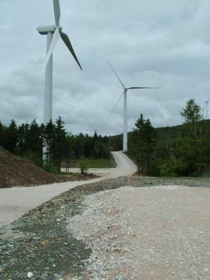
Hoosac Wind project, Florida/Monroe
* Electricity demand in Massachusetts is expected to grow 1 percent per year for the next decade. (1)
* That means we would need to bring a project like this on line once every 5 weeks for the next 10 years just to keep up with demand growth…without ever addressing our current problems. And…that’s just for electricity which is only 30% of our carbon emissions problem! (3)
(1) ISO NE 2012 Regional System Plan
(2) Projected annual output of this project 28.5MW x 8760 hrs/yr x 25% capacity factor = 62,415 MWh, 2012 est. total consumption of electricity in MA -63,730,000 MWh
(3) U.S. Energy Administration Agency Data
Hoosac Ribbon Cutting Opportunity for Truth Telling

(Gillian Jones/North Adams Transcript)
People impacted by wind turbines in Falmouth lent support for Hoosac Wind Project neighbors in Florida at the ceremony on December 3, 2012.
The North Adams Transcript report by Edward Damon, “Residents protest wind turbines as Gov. Patrick, officials celebrate Hoosac Wind Project,” caught the usual scenario of officials patting themselves on the back for climate action while area residents are left to deal with their changed local environment.
Among them was town resident Michael Fairneny, who has lived with his wife on Moores Road for 29 years. Fairneny is concerned about how the turbines have changed his life, and whether he will have more to worry about once they begin to spin.
He claimed he was never given notice he’d be able to see a turbine from his property. Now, he can see three from inside his home and seven from his property.
And the turbine-infested vista is the least of his worries.
“I’m worried about my health, and my family’s health,” he said.
Fairneny points to recent studies that suggest living near wind turbines can cause negative health effects such as headaches, heart palpitations and sleep disturbances.
“We’re concerned because there’s not enough information to really know how bad living near turbines can be,” he said.
Additional coverage:
 WAMC radio in Albany–“Massachusetts Gov. Sees Opening of Berkshire Wind Farm” by Lucas Willard.
Listen to the December 3, 2012 broadcast.

WWLP channel 22 Springfield “Wind farm project to power 10,000 homes” by Laura Hutchinson
Video clips with the story are splices of raw footage.
 iBerkshires reporter Andy McKeever provides a strong photo gallery in the local news article “Gov. Patrick Celebrates Completion Of Hoosac Wind Project.”
 From Williamstown for Your News Now, Madeleine Rivera includes comments from protesters in her report “Governor Patrick celebrates largest wind farm in Massachusetts.”
Windwise Fairhaven Hosts Open House
 While people enjoy downtown holiday shopping in Fairhaven on Saturday, December 8th, Windwise will be sharing health information at the Northeast Maritime Institute at 32 Washington Street. The Open House runs from 10:00 am to 1:00 pm.
Resources by and for health professionals will be available, along with data on property value decline and other impacts on communities.
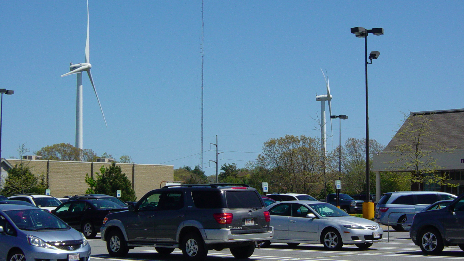
Fairhaven’s turbines loom behind the parking lot for Stop & Shop (on right)
The drop-in hours give townsfolk a convenient opportunity to pick up information sheets, share experiences, and exchange details about health and economic impacts of Fairhaven’s twin turbines.
Canadian researcher Carmen Krogh calls wind-afflicted residents the “new experts” because they are the ones who know what havoc wind turbines wreak on households and communities.
Listen to a preview of Saturday’s event on Phil Paleologos’s show on Tuesday, December 4, from 5:10 to 6:00 pm, when “More than Just Talk” highlights the information exchange on WBSM radio 1420 AM. The show is an opportunity for questions and comments from turbine neighbors who may want to know more about possible adverse health impacts. Call in 508-996-0500.
Fairhaven’s Issues Aired on WBSM Radio
For the second time this month, WBSM radio’s Phil Paleologos has invited Fairhaven residents to describe their experience with industrial wind turbines. The town shutting out discussion is the issue on this November 28, 2012 show. Ken Pottel and Peter Goben explain.
Ariel Wittenberg’s piece “Espindola questions Fairhaven board’s exclusion of Windwise from agendas” is mentioned in the broadcast.
The “More than Just Talk” radio show of November 14, 2012 allowed Fairhaven residents Louise Barteau and Karen Isherwood to describe the impacts of wind turbine noise on Fairhaven residents. WBSM 1420 AM serves the New Bedford and Fall River areas.
PTC Dramatics of Governors Ignore Economic Realities
Wind Action’s Editorial, Governors Demand Wind PTC to Cover State Costs, brings home the wasteful realities of Federal incentives to the wind industry in the form of the Wind Production Tax Credit:
The production tax credit, which turns twenty years old this year, serves little purpose today other than to line the pockets of project owners and tax-advantaged investors and artificially mask the true price of wind power.
If the PTC were to expire, Renewable Energy Credit prices in states with Renewable Portfolio Standard policies would likely go up for a while until the industry can implement necessary cost-cutting measures. States will respond by reexamining ways to rein-in RPS-related energy costs. We will also likely see the industry shift their business plans away from those based on tax avoidance to plans based on energy production – as they should be. American taxpayers and ratepayers would be best served by letting the PTC expire.
The Governors’ self-serving pleas aside, there is no justification for wind projects eligible under any State RPS programs to receive the benefit of BOTH the State policies and the PTC wealth transfer from taxpayers. Congress has a responsibility to say NO.
The better answer is let the PTC expire. To weigh in on this, take the Wall Street Journal POLL: What should happen with U.S. government subsidies of renewable energy development? that accompanies the pro/con positions in the piece Do We Need Subsidies for Solar and Wind Power?

 Wind Wise ~ Massachusetts
