Scituate Folks Can’t Sleep while Fairhaven Residents Can’t Meet
 In his reporting on wind turbine impacts, reporter Dan Hausle (Sleepless in Scituate: Turbines keep many awake) recounts the issues town residents are bringing to the Board of Health.
They say since it started spinning last march, they can’t sleep and are dealing with other health problems.
The video on turbine flicker, the strobing light that the McKeever family of four lives with, is edited from a Youtube clip into the WHDH 7 NBC report.
At a town health board meeting, residents who live near the turbine complain the flicker and noise is costing them sleep the stress, affecting their work and their children’s school.
“It sounds like you’re sleeping next to LaGuardia…you don’t buy a house in Scituate to have the LaGuardia-like experience,” said Tom Thompson.
Meanwhile on the same night the Scituate Board of Health heard these complaints, the Fairhaven Board of Health meeting encountered intense pressure to take up the questions raised by Selectman Bob Espindola (who was not present because the select board was meeting at the same time). The questions relate to a wind turbine bylaw draft proceeding through the town boards.
According to South Coast Today‘s Ariel Wittenberg, the Fire Chief shuts down overcrowded Health Board meeting when 35 residents arrived for the scheduled meeting–held in a room that seats 12.
Refusals made by two Board of Health members to address the agenda item
angered members of Windwise, who accused the board of being “numb” to residents’ health concerns about the turbines.
“There is a health crisis in this town you are ignoring,” Dawn Devlin said.
John Methia agreed, saying “You’ve got a room full of people with headaches and sleep deprivation and frayed nerves that you’re ignoring.”
Health Issues Haunt Existing Turbines as New Projects Progress
Emily Sweeney’s Boston Globe Local section piece captured many of the concerns that haunt, even terrorize, wind turbine neighbors. “The Roar Over Wind Turbines” captures the furious and sometimes despairing quality that enters homes after turbines appear in town. From strobing light to inability to concentrate to migraines and sleep disruption, complaints are being lodged in five towns South of Boston.
In a video posted with the piece, Doreen Reilly’s camera (although tilted 90 degrees off vertical) captures both the disorienting strobing and what her family does to cope with the invasive effect–absent themselves.
My family is not here just because it’s not enjoyable to be here–as you can imagine. So, would you want to sit and have dinner right about now?
Reporter Sweeney notes that while understanding of health effects is in its infancy, new studies are coming out. In the meantime,
Tim Dwyer, who lives on Country Club Way in Kingston, insists he’s not making up his symptoms. Dwyer said he and his wife have been awakened by a “constant and rhythmic grinding noise” that they could hear even with their windows shut, their air conditioning running, and a white-noise machine on. He also said he experienced a feeling of increased pressure in his ears.
While the questions rise and town boards are sued by impacted residents, new development in Gloucester also received coverage in the Sunday Globe. In “Gloucester sets sail with new use of wind” Steven Rosenberg describes the commercially-owned turbines going online there.
Kirk and other city officials believe that locating the turbines in an industrial park – away from neighborhoods, and near Route 128, helped negate any opposition. And, to date, there’s been no opposition to the turbines. Paul McGeary, the city councilor who represents the neighborhood nearest to the turbines, says it’s because they stand about 1,000 feet away from the nearest homes.
“What really helped us was location, location, location. It’s properly sited,” said McGeary, who helped organize public meetings about the turbines in the neighborhood over the last year.
But what happens in one town after another is that people support industrial scale wind in theory. Once the vibrations, noise, and flicker are experienced, harmful effects are noticed. Turbines set 1,000 feet from homes are probably not far enough away to avoid health impacts.
Louise Barteau’s Op Ed is a call for townspeople in Fairhaven to protect themselves (Your View 1/4/13: Wind energy bylaw demands greater scrutiny). The harm they should avoid is from wind turbine audible and inaudible noise–which recently received scientific scrutiny in the Shirley WI Wind Farm study. Barteau finds inaction of town boards, and inadequate testing for noise. Her recommendation is that residents arm themselves with factual information and use the wind bylaws discussion as the opportunity to speak out.
If you are like me, and want better protections from your town government, a good start would be to attend the Monday, Jan. 7, Fairhaven Board of Health Meeting at the Fairhaven Town Hall at 6:30 p.m., where they will discuss the new draft of the wind energy bylaws. Oh — and read the reports by Cooper and the Wisconsin Four first. These reports are based on actual data, not the hypothetical models espoused by the developers and their employees. I am a great believer in fact-based science and independent investigation — aren’t you?
Wisconsin Study Finds Wind Turbine Noise at Sub-audible Levels
Infrasound and low frequency noise (ILFN) were studied in a cooperative arrangement by firms who have worked for wind development companies and for wind turbine opponents. The study, released in late December, found that ILFN is a serious concern and that there are inadequate standards for measuring emissions at lower frequencies.
The study (“A Cooperative Measurement Survey and Analysis of Low Frequency and Infrasound at the Shirley Wind Farm in Brown County, Wisconsin”) was initiated by Clean Wisconsin with partial funding by the Wisconsin Public Service Commission.
The four investigating firms are of the opinion that enough evidence and hypotheses have been given herein to classify LFN and infrasound as a serious issue, possibly affecting the future of the industry. It should be addressed beyond the present practice of showing that wind turbine levels are magnitudes below the threshold of hearing at low frequencies.
| The four firms: | ranged in experience from working entirely for wind developers to working exclusively for wind opponents |
| Channel Islands Acoustics, Camarillo, CA |
“derived modest income” from wind developers |
| Hessler Associates, Inc., Haymarket, VA |
“derived significant income from wind turbine development projects” |
| Rand Acoustics, Brunswick, ME |
“almost exclusively retained by opponents of wind projects” |
| Schomer and Associates, Inc., Champaign, IL |
“have worked about equally for both proponents and opponents of wind turbine projects” |
The report has four appendices – one written by each acoustical firm.
One technical finding pointed to the inadequacies of using only sound waves measured by A-weighting.
Currently the wind turbine industry presents only A‐weighted octave band data down to 31 Hz. They have stated that the wind turbines do not produce low frequency sound energies. The measurements at Shirley have clearly shown that low frequency infrasound is clearly present and relevant.
…Thus, the International Electro‐technical Commission (IEC) standard needs to include both infrasonic measurements and a standard for the instrument by which they are measured.
Measurements were collected from three unoccupied homes (abandoned) in the Shirley Wind Park, a complex of eight Nordex100 (2.5 MW) wind turbines.
Duke Energy runs the wind park and refused to cooperate with the researchers’ needs for turbines to be turned ON and OFF. The study would have been more definitive in establishing impacts if the wind turbine data were collected under nearly identical wind and power conditions.
Devlin Warns Bylaw Change Inadequate
The limits and loopholes of a proposed town bylaw prompted Curt Devlin’s letter “Your View: Proposed turbine law remains far too little,” published in South Coast Today(12/26/12):
Far from offering residents any real protection, this latest proposal will have the likely outcome of inviting smaller turbines, in larger numbers, that can still be legally sited in very close proximity to residents. Current zoning bylaws in Fairhaven permit siting turbines in every type of zone as a so-called municipal project. There is currently no legal restriction that would prevent private property owners from siting an industrial wind turbine in the midst of any neighborhood in town. Nothing in the new proposal will change this cozy little arrangement appreciably.
What is at stake for Fairhaven–and any other community considering siting bylaws–is the impact to families and ultimately to the community:
One of the existing 400-foot turbines is just 1,600 feet from one family home. That’s four times the height — exactly what [planners] are proposing. At that distance, one member of the family was so badly affected that he moved out to escape the torment. The turbines are literally tearing this family apart. Add another turbine refugee to the list.
“Wind power needs baseload plants”
The letter published in the Worcester Telegram & Gazette on 12/25/12 adds more facts to the Gardner NCCI turbine scenario:
In Shaun Sutner’s well-researched article (“A host of problems,” Telegram & Gazette, Dec. 16) about the cost and delays on the North Central Correctional Institution wind turbines in Gardner, there is a comment by Tom Pirro, who says, according to the articile, that he “does not object to wind power because any harm is more than offset by lessening dependence on polluting power sources, such as fossil fuels.”
It is a myth that intermittent wind power alone can create electricity without baseload power plants. National Grid’s standard mix of electricity this fall included 36 percent natural gas, 29 percent nuclear, 9 percent coal and 7 percent oil. When the wind does not blow, ISO New England must ensure that the electricity stays on, and thus the dependence on baseload natural gas and nuclear power is a must in Massachusetts.
Mr. Pirro apparently was not thinking of harm to humans from industrial wind turbines like those in Templeton and Falmouth, where residents have experienced harm to their health through sleep deprivation. In Falmouth, the state found a violation of the Massachusetts noise pollution regulations, and the turbines cannot be run at night.
On-shore wind turbines in Massachusetts make no sense economically, do not lessen effects of climate change, and are causing harm to people’s health.
VIRGINIA IRVINE
Brimfield
http://www.telegram.com/apps/pbcs.dll/article?AID=/20121225/LETTERS/112259955/1055/letters
Christmas Anything but Merry for Wind Neighbors

Courtesy of Windtoons.com
Wind I in Falmouth has been turned off since Thanksgiving due to an electrical problem. Wind II will be off for Christmas Day, in part because Vestas operational software has malfunctioned and led to a manual shutdown. Exasperated neighbor of a turbine, Barry Funfar, writes in a Christmas Eve letter:
In April 2013 it will be three long tiring years that this excruciating upset of our lives has persisted. We abutters have learned over time that the effects of the turbine’s emissions has resulted in both psychological and physical detriments to our health and well-being. We have learned that one does not acclimate to the turbine effects, symptoms become increasingly severe with length of exposure. By now we worry that some of our maladies may be irreversible. We sadly have learned that our town and state officials place finances above the health of their constituents.
For the whole message, read on… Read more…
Gardner Correctional Center Turbines Unmoving
An aerial photo shows the two wind turbines towering over the North Central Correctional Institution in Gardner. (T&G Staff/Rick Cinclair)
The North Central Correctional Center (medium security prison) in Gardner holds a captive audience of around 1,000 prisoners who will be guinea pigs for the state’s blind rush into industrial wind development, if the turbines ever start rotating. Shaun Sutner, reporting for the Worcester Telegram and Gazette, finds “Turbine project at prison stands still” (12/12/16). In his well-researched article, Sutner identifies numerous complications that have kept the turbines, built in 2010, from going online. Problems include needed infrastructure upgrades to connect with the grid and to hook up to the prison electrical system.
All told, taxpayers have shelled out about $427,000 for the wind power so far, yet not one watt of electricity has been generated.
Worker rescued in Hanover Turbine Fall
 WHDH-7 NBC TV News reported on 12/14/12 that 30 or more rescue personnel contributed to the extraction of a fallen worker from a wind turbine tower in Hanover, MA. The accident is described in this report by Victoria Block, “Worker falls in wind turbine in Hanover.”
The rescue operation was very technical and dangerous. It involved men from the regional rescue team that was trained to conduct a rescue inside a wind turbine.
“He was inside the tower. He fell about 40 feet. Halfway down the tower there was a platform. He was caught on the platform. That’s why there were so many complications because it’s a narrow space that they had to do to get him out,” said Donald White.
It took about an hour and a half to stabilize the worker and to haul heavy lines and gear up inside the space.
In the Patriot Ledger, “Worker in good condition after fall from Hanover wind turbine” 12/14/12, Lane Lambert reported:
The 53-year-old man, who Hanover Fire Chief Jeffrey Blanchard identified as Ernest Ray, of Harwich, was taken to South Shore Hospital with non-life-threatening injuries. Blanchard said Ray was “conscious and stable” when rescue crews arrived on the scene around 9:20 a.m. Friday.
The turbine, 210 feet, is a 225 kw Lumus project at the wastewater treatment plant. CEO Sumul Shah is also involved with the projects in Fairhaven, Dartmouth, Scituate, Princeton, Charlestown, Deer Island, and Newburyport. The Hanover project was funded in part by a grant of $230,500 from the Renewable Energy Trust of the Mass Clean Energy Center (whose funds come from ratepayer surcharges).
The Hanover turbine has been in the news in recent weeks, with concerns about being able to get replacement parts from the manufacturer in India (Hanover wind turbine will take a little longer by Mark Burridge in Wicked Local Hanover).
In an October article “Hanover wind turbine nearly ready to go,” Burridge noted the delays in commissioning the turbine:
Construction was set to begin in the fall of 2010. However, after a series of delays, the project was built earlier this year.
“The turbine was manufactured in India last fall. Language barriers, differences between U.S. and international electrical regulations as well as shipping delays are what have caused most of the delays on this project,” [Hanover DPW Director Victor] Diniak explained.
Falmouth’s Status as a Cautionary Tale Continues
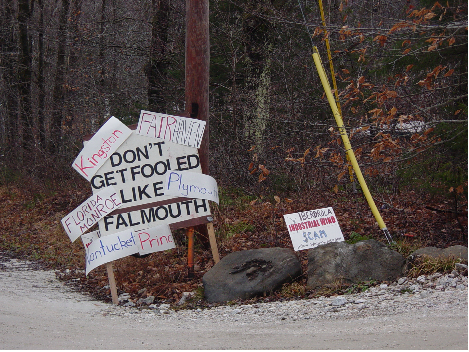 The turbine options group has run its course and doesn’t find any good solutions, according to the Falmouth Enterprise. Brent Runyon reported on 12/14/12 that the 21 meetings over 7 months are about to conclude with a product that is a compromise at best (Town work of turbine options group nears the end). “I think everybody had hoped to come up with a whiz-bang solution that would make everybody happy,” town assessor David A. Bailey, is quoted as saying.
“In the end, I think whatever is decided is going to be some sort of compromise.” But that compromise is not viewed in the same way by all sides, he said. “I think one of the problems is that there are a group of affected people who feel that a compromise is sort of akin to somebody being punched in the head once every five minutes, and the compromise is to be punched in the head every 10 minutes,” he said.

 Wind Wise ~ Massachusetts