Rogers Letter Resets “Moral Compass” in Falmouth
“When moral wisdom is lost” proclaims the headline of Ron Zweig’s latest “My View” (Dec. 11). Moral wisdom has been lost all right, but not by Judge Muse in his intelligent and balanced decision on the operation of Falmouth’s wind turbines.
Rather, it is Zweig and other Falmouth residents who have lost their moral compass, willing to sacrifice the well-being and health of their neighbors for the proverbial “thirty pieces of silver.” Zweig does not even have the decency to acknowledge the physical harm, documented by medical records, done to his fellow townspeople. Instead, he continually refers to “alleged” health effects, betraying his own alleged sense of morality.
In addition to being a resident of Woods Hole, it should be noted that Zweig owns his own wind turbine, a source of annoyance to some of his neighbors; and is a member of the board of Cape Light Compact, which through its subsidiary Cape and Vineyard Electric Cooperative, was as recently as two years ago eager to bring many more wind turbines — “more Falmouths” to Cape Cod.
Mitigation Plan for Fairhaven Emerges from Behind Closed Doors
An editorial in South Coast Today shows the difficulty residents and wind neighbors face in Fairhaven (“Our View: Open the door on wind talks,” 12/13/13). The secret talks between the town and the developer have had only one ray of illumination. The Standard-Times (publisher of SCT) used a request for public records to pry the proposed noise mitigation plan loose from the Board of Health.
Delicate as this commercial relationship between the town and the operator may be, the lesson should have been learned months ago that transparency and communication will serve all parties best.
It shouldn’t be like pulling hens’ teeth in these most important matters of public interest: the neighbors who claim to be affected by the turbines’ operation; the taxpayers whose pocketbooks are affected by the number of megawatts produced; and the relationship between the public and town leaders left raw.
And oh, what a plan it is: some turbine neighbors will get 4 hours of sleep on some nights between mid-November and mid-April once the settings have been programmed into the turbine controls:
From the period of November 15 to April 15, Fairhaven Wind will curtail the operation of one wind turbine between the hours of midnight and 4 am during the following Conditions (collectively, the “Mitigation Conditions”):
(a) Wind is, or is projected to be, generally from the Northwest, Northeast or South-Southwest;
(b) Wind is, or is projected to be, below 7 meters/second; and
(C) No precipitation is projected during the time period.
Falmouth ZBA Again Finds Turbines are Nuisances

“GENE M. MARCHAND/Falmouth ENTERPRISE – Two of Falmouth’s wind turbines, one at the Falmouth Wastewater Treatment Facility (left) and the other at the Falmouth Technology Park, as viewed from the Chapoquoit Beach parking lot.”
Will the town sue its ZBA again about the wind turbines playing havoc with the health of nearby residents? That is the question now that a unanimous decision on 12/5/13 agreed with Barry and Diane Funfar’s appeal of a Building Commissioner ruling. According to the Cape Cod Times, Eladio Gore determined the turbines were not a nuisance, following a complaint filed in April.
In Sean Driscoll’s reporting “Another win for turbine abutters” (12/7/13),
Wind turbine opponents scored another victory this week when the Zoning Board of Appeals agreed once again that Falmouth’s municipal turbines are a nuisance to nearby residents.
The ruling means the town is ordered to take whatever steps are necessary to remove the nuisance caused by the turbines, which are located at the town wastewater treatment plant on Blacksmith Shop Road. Thursday’s meeting was a continuation of Funfar’s hearing, which initially began in September, said Zoning Administrator Sari Budrow.
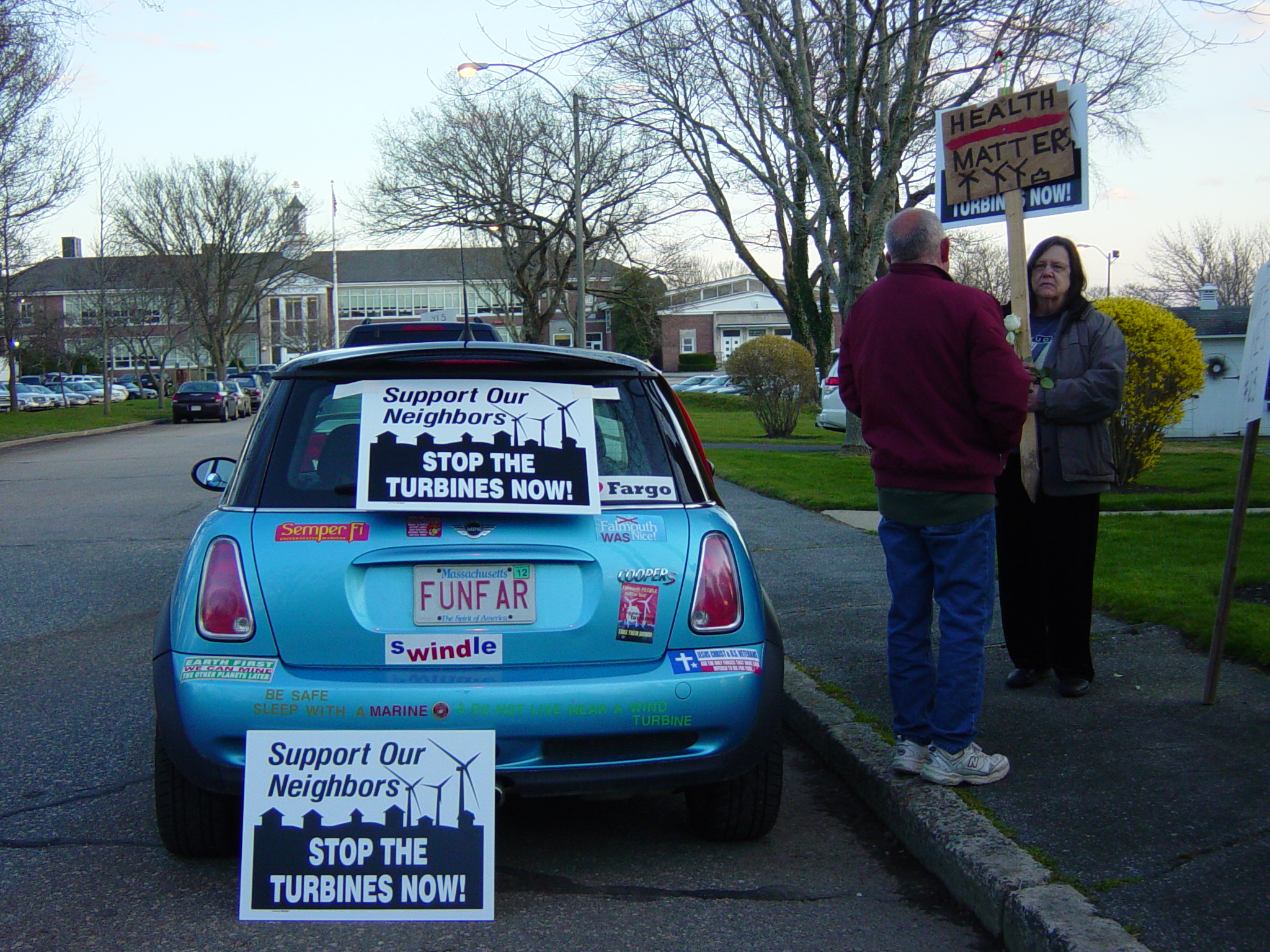
Photo by Virginia Irvine
The Funfars are West Falmouth residents whose issues range from loss of enjoyment of their property to exacerbation of Barry Funfar’s Vietnam War-related PTSD, to devaluation of their property. The reduced valuation seemed to be a deciding factor, according to Sam Houghton’s report in the Falmouth Enterprise (“Falmouth ZBA Rules Wind Turbines Are Nuisance at Ridgeview Avenue Home” 12/6/13).
“Just the history of the assessed value that I see here convinces me that there is a real impact on Mr. Funfar’s property because of the proximity to the turbines,” said board member Kenneth H. Foreman. The appraisal also stated that all sales within a half a mile of either Wind 1 or Wind 2 are affected in the same negative way.
While some of the discussion revolved around Town Counsel Duffy’s advice to discount symptoms that could relate to pre-existing conditions:
Town counsel Frank K. Duffy Jr. did not doubt that Mr. Funfar suffered, but he urged the board to vote in compliance with Massachusetts state law, which discussed pre-existing conditions. “It is too difficult to separate the symptoms caused by the pre-existing condition and the symptoms caused by the noise complaint.” A nuisance, he said, must be a nuisance under all circumstances.
Chairman of the board, Matthew J. McNamara, did not agree with Mr. Duffy. “I want to remind the board that one of the purposes of the bylaw is to protect the welfare, health and safety of all town residents.” We should be more inclusive than exclusive, he said. Those with pre-existing conditions should not be excluded when making appeals to the town about nuisances, he added.
In his press release about the hearing (“ZBA Again Decides Falmouth Wind Turbines a Nuisance”), Malcolm Donald reported that health effects were also considered.
Submitted as testimony were four letters from of Veterans Administration doctors addressing Mr. Funfar’s health degradation since the Falmouth Turbines became operational since March of 2010.
Bills Heard Before Joint TUE Committee
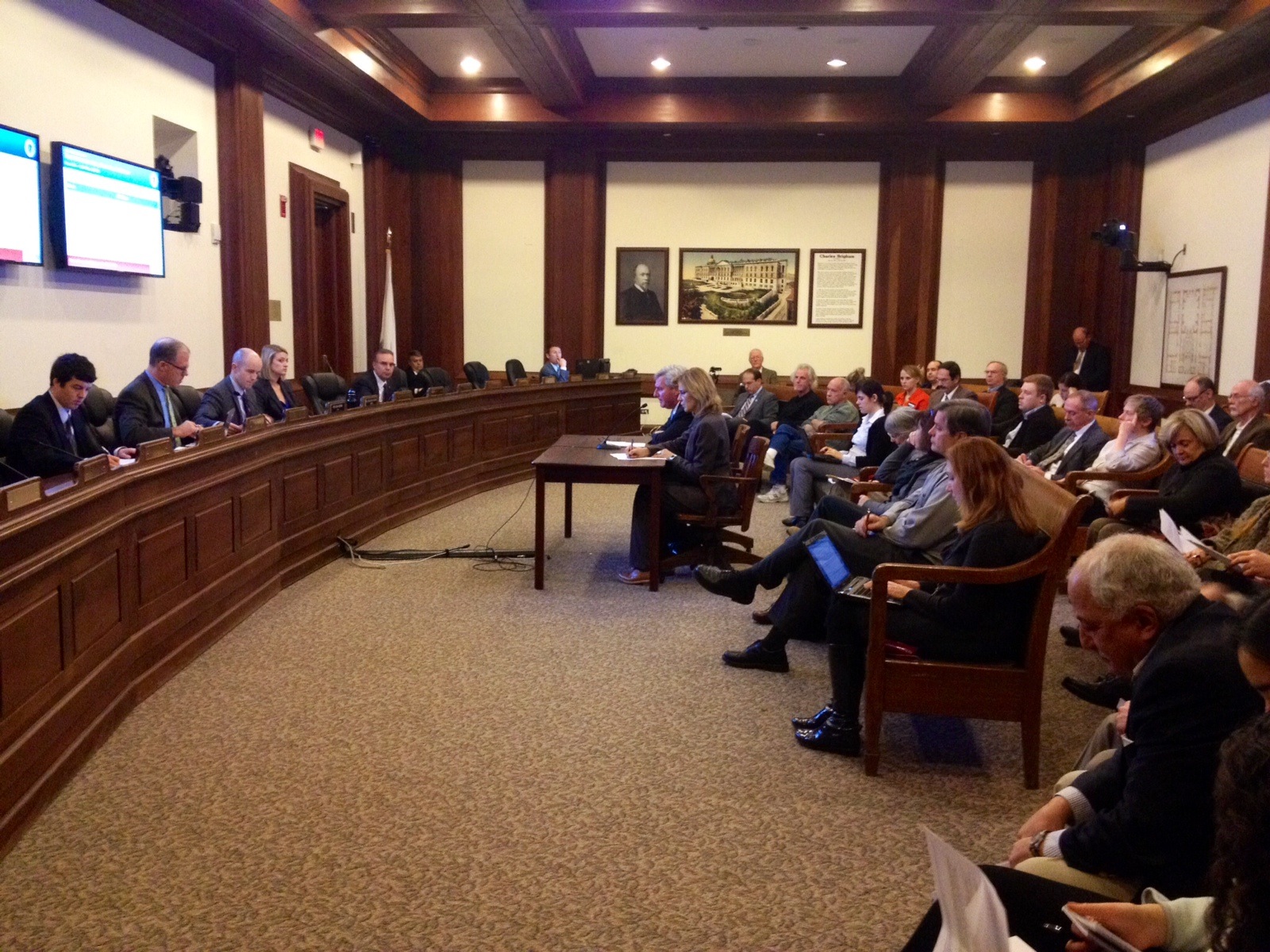
Louise Grabowski and Rep. Bruce Ayers at table, center
The hearing room before the Joint Committee on Telecommunications, Utilities and Energy was filled with opponents of a comprehensive siting proposal for onshore wind plants on December 3, 2013 in Boston. From Peru to Wellfleet, residents expressed their concerns about wind development and supported a fund to compensate for wind turbines’ adverse impacts. (Read more about the bills Wind Wise supports and opposes).
The Boston Globe posted “Wind energy bill returns to Beacon Hill” (12/3/13). According to reporter Colleen Quinn from the State House News Service,
Rep. Timothy Madden, a Democrat from Nantucket, opposed the [siting] bill, saying it takes away a “great deal” of local control.
“My opposition on this bill has not changed over the last several years,” Madden said.
Madden filed a bill (H 2957) that would allow coastal communities to create exclusion zones for wind turbine development.
Comments by siting bill sponsor Rep. Frank Smizik, that agriculture was one area that would benefit from expedited rules, were challenged by Michael Parry of Shelburne.
Michael Parry, a sheep farmer who owns 220 acres in Shelburne, said he would never put a wind facility on his property after researching the effects of turbines.
“I would never subject our neighbors to that. I wouldn’t subject my family to that, and I wouldn’t subject my livestock to that,” he said.
Parry mentioned a wind facility located near a dairy farm in Glenmore, Wisconsin where the farmer reported reduced milk production from his cows after the turbines went up. Parry said he favors renewable energy, but feels environmentalists are pushing projects before the impacts are understood.
Reporting for GateHouse News Service, Frankie Barbato’s piece ran in Acton’s The Beacon and appeared in the Wicked Local “Wind turbines proposition faces resistance” (12/3/13).
“This bill is disgraceful,” Neil Andersen, a Falmouth resident who lives near a wind turbine told a Joint Committee on Telecommunications, Utilities and Energy hearing… “There are other ways to obtain energy efficiency, and it’s not this way.”
Andersen began to choke up when he said he suffers from headaches and ear pressure on a daily basis. He said the wind turbine by his house has “turned his life upside down.”
Andersen offered his porch for lawmakers to see and hear for themselves, and both Senate Co-chair Ben Downing and House Co-chair John D. Keenan seemed interested, according to one person present.
Both news reports noted that few siting bill supporters were present and no one from the Patrick administration testified.
Fairhaven’s Base Slumps
 Mark Curtis, reporting for ABC6 News in Providence, got the story in Fairhaven, where a one-fifth of an inch subsidence is causing concern (“More problems at Fairhaven wind turbines; Builder promises fix” 12/2/13).
Some believe the turbines were built on unstable wetlands. and will always be on unsafe ground.
Louise Barteau, a Fairhaven wind turbine opponent said, “If the foundation is not properly secured, I’ve always had a concern that these are so close to the bike path and I worry about public safety.”
So does the town:
“I spoke to the developer and they say this is under warranty right now, and they are making sure the turbine is shut down. Everything is safe. They’ve guaranteed me of the safety,” said Fairhaven Board of Selectmen Chairman, Charles Murphy, Jr.
Firetower Wind Predicts Deja-Vu on WESRA
In his post on the wind siting bill (“WESRA: Recycling Bad Legislation” 11/29/13), Mark Cool of Falmouth anticipates that “December 3rd will likely be deja-vu day on Beacon Hill when state lawmakers hear testimony regarding the Wind Energy Siting Reform Act (WESRA). “ He reminds us of what citizens have said before about wind siting:
It was just over 2 years ago (Oct 20, 2011) when 8 hours of testimony on the same bill proposals (by the same two) was entertained by the same committee at the Barnstable High School. During the daylong hearing, committee members, joined by almost every member of the Cape delegation, heard from nearly one hundred speakers who either praised the bills for a clean energy future or the horrors of living near large wind turbines.Neil Andersen of Falmouth told of his experiences [watch the YouTube clip]. (Then and current) committee co-chairman Sen. Benjamin Downing, (D-Pittsfield), said the committee would ask the state Department of Environmental Protection and the state Department of Public Health to meet with Falmouth residents as part of a review of health impacts from the operation of wind turbines. Did that happen? NO.DEP spokesman Edmund Coletta said to the committee back then, “We have just learned of this request today, and we are looking forward to discussing this idea with the committee.” When in reality, the DEP had been notified of the Falmouth wind turbine problem as early as March 2011. The Falmouth Board of Health had dispatched a letter to the DEP requesting urgent guidance regarding the existence of a potential wind turbine nuisance condition. A side-stepping mischaracterization of the actual truth perhaps?
Hearing Approaches, DPU Comment Period Extended
The latest version of the wind siting bill will be heard before the legislature’s Joint Committee on Telecommunications, Utilities and Energy on December 3, 2013. Dubbed “WESRA” for its earliest manifestation as the Wind Energy Siting Reform Act, versions of WESRA have been sidelined in two past legislative sessions.
- Siting Reform Act (WESRA) — H.2980 (Rep. Smizik) & S.1591 (Sen. Finegold)
Bills to help communities pay to dismantle wind turbines and to study health impacts from turbine operations are also on the agenda for Tuesday afternoon in Boston. To read about the bills and Wind Wise’s positions on them, consult the legislation page.
- Wind Energy Relief Act — H.2987 (Rep. Vieira) & S.1604 (Sen. Knapik)
- Health Impacts from Wind Turbines Act — H.2970 (Rep. Peterson)
February 26, 2014 is the extended deadline for responses to the Mass. DPU’s siting initiative. This is the governor’s effort to bypass the legislature in promoting the development of wind projects.
Barnstable Court Decision Recognizes Harm to Residents
In the ruling (FalmouthvFalmouthZBApreliminaryinjunctiondecisionandorder) issued November 21, 2013, Judge Christopher J. Muse ruled that the Falmouth turbines must shut down for 12 hours each night. According to the press release from Wind Wise Massachusetts,
“This is believed to be the first time that a Court in the U.S. has ruled that there is sufficient evidence that wind turbines near residential areas are a health hazard to families living nearby,” said Virginia Irvine, president of Wind Wise Massachusetts.
Judge Muse described the role the court has to balance harm. He found that the nuisance claim the Andersens brought to the Zoning Board of Appeals, which the ZBA affirmed, was likely to succeed and as a result, granted the injunctive relief of requiring the turbines to be off for 12 hours at night and on the holidays of Thanksgiving, Christmas, and New Year’s.
The court finds the Andersens’ claims that they did not experience such symptoms prior to the construction and operation of the turbines, and that each day of operation produces further injury, to be credible.
Thus, the court must consider further injunctive relief that would have meaningful effect in the immediate future, in the absence of mitigation measures that may ultimately prove successful.
According to Falmouth resident Malcolm Donald, reporting on the hearing continued from 11/7/13 “Superior Court Upset at Falmouth Wind Turbines“,
…a Superior Court Judge told Falmouth Town Counsel, Frank Duffy, that he was very disappointed that the Town of Falmouth hadn’t abided by the November 7th agreement with Neil Andersen to run the wind turbines from 7 AM to 7 PM. Judge Muse made it clear that when an agreement between parties is presented to him that he expects it to be enforced. “Agreements stand as ordered” said the judge.
State Wants Wind to Sail Ahead as DPU Solicits “Best Practices”
Cape Cod Times reporter Patrick Cassidy brought to light the public comment period which ends December 6, 2013 (Wind-siting proposal slipping by unnoticed, 11/15/13). Until now, there has been no media attention to the solicitation for “Best Practices” in siting wind turbines. Although Department of Public Utilities spokesperson Mary-Leah Assad emailed Cassidy that the DPU order was advertised in Boston newspapers, he notes “there has been little indication that the general public is aware of the opportunity to comment.”
The guidelines for best practices that are expected from the DPU process are not regulations but would be offered to towns to use in existing reviews of wind-energy projects, DPU spokeswoman Mary-Leah Assad wrote in an email.
The guidelines also may be used by state permitting agencies or for programs that “involve grants, technical assistance, community engagement and other such activities,” Assad wrote.
What Assad does not say is that the Energy Facilities Siting Board under the DPU is set up to smooth the way for siting energy production plants including “wind energy facilities.”
“I believe it’s a way to circumnavigate the law frankly,” said Lilli-Ann Green, a Wellfleet resident and board member on Windwise-Massachusetts and Windwise- Cape Cod, groups that have vociferously opposed wind energy development. “They’re asking for comments almost immediately on a topic that’s very broad and very deep.”
For more on the topic, see DPU Comment Period: So Many Critera, So Little Time. The Cape Cod Times was the only news outlet to report on the Community Wind Outreach Initiative–the state government’s end run around the legislature, which has resisted bypassing local control of wind turbine siting decisions.
DPU Comment Period: So Many Critera, So Little Time
December 6, 2013 is the deadline to tell the Mass. Department of Public Utilities your thoughts about their wind siting initiative. In this latest incarnation of streamlined siting regulations for wind turbines, the Energy Facilities Siting Board (EFSB) takes control. This board currently sites coal and natural gas plants.
In its “motion into Best Practices” for siting land-based “Wind Energy Facilities” (WEFs), the DPU is asking for comments in 10 areas: Design, Environmental and Human Health, Safety, Construction Impacts, Socio-Economic Impacts, Decommissioning, and Review Process. Each area includes multiple subareas, with the Environmental and Human Health category listing “noise” as the first of its 10 items.
The public can weigh in on height maximums, setbacks, construction impacts, effects on wildlife, strobing, and the euphemism “use of mechanisms that may provide added flexibility, such as voluntary agreements between developers and impacted residents” AKA gag clauses. The DPU has structured its request for comments with 12 questions.
The bad news is that the December 6, 2013 deadline gives wind skeptics a mere 5 weeks to respond to the “investigation” on the Motion into Best Practices. The DPU plans to issue a draft “wind siting guidance proposal” in spring 2014. The good news is that the DPU claims it will hold hearings, beginning in January. (The “interested” parties attending the pro-wind Working Group presentation on October 30th received a week’s advance notice over the public announcement of the comment period).
The Docket number is D.P.U. 13-165. For more details, read on…

 Wind Wise ~ Massachusetts